
Tag Archives: acupuncture business insurance

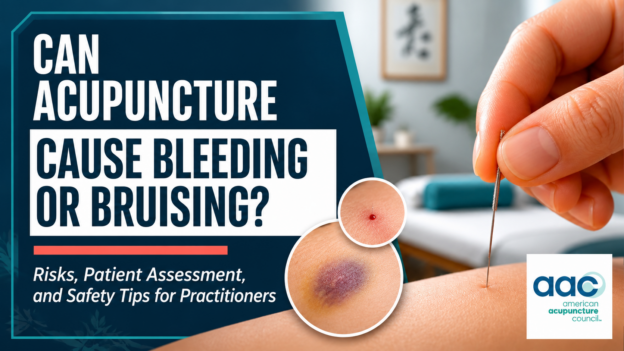
Acupuncture needle inserted into skin with visual examples of minor bleeding and bruising.

Can Acupuncture Cause Bleeding or Bruising? What Practitioners Should Know

Can Acupuncture Cause Bleeding or Bruising?

Yes. Acupuncture can cause a small amount of bleeding or localized bruising when a needle is inserted or withdrawn. These reactions are recognized in clinical safety research and are usually minor. They are not, however, automatically harmless in every patient: medication use, a bleeding or coagulation disorder, relevant medical conditions, the anatomical site, and the needling technique all influence risk.

For acupuncturists, the practical question is not simply whether a spot of blood is normal. It is whether the patient has been appropriately assessed, the needling approach is suitable, bleeding is controlled, and any unexpected event is documented and managed.

Why can acupuncture cause bleeding or bruising?

Acupuncture needles pass through the skin and may encounter small superficial blood vessels. A small amount of blood at the insertion or withdrawal site can therefore occur. Blood that escapes into nearby tissue may produce a localized bruise or, less commonly, a more noticeable hematoma.

The likelihood of a visible reaction can vary with the location and vascularity of the area, individual tissue characteristics, needle selection, insertion depth and angle, and the degree of manipulation. A small spot of blood does not by itself establish that a treatment was performed improperly. Conversely, persistent bleeding, an expanding hematoma, unusual pain, or symptoms suggesting a deeper injury should not be dismissed as an ordinary treatment response.

How common are bleeding and other acupuncture adverse events?

A 2021 systematic review and meta-analysis of prospective clinical studies found that bleeding was among the more frequently reported minor adverse events. Its pooled estimate was approximately 4.92% of treatments, with a very wide confidence interval (1.18%–11.01%) and substantial between-study heterogeneity. The authors emphasized that studies used differing definitions and methods for recording adverse events; some recorded minor bleeding or local pain that may be considered an expected needling reaction.

The same review estimated serious adverse events at approximately 7.98 per one million treatments. These figures provide context, not a guarantee of safety for an individual patient or a prediction for a particular practice. Different patient populations, practitioner settings, reporting methods, and definitions affect the estimates.

Who may have a higher risk of bleeding or bruising?

Patients taking anticoagulant medication

Anticoagulants reduce blood clotting and can increase the likelihood or duration of bleeding. Examples include warfarin, heparin, and direct oral anticoagulants such as apixaban and rivaroxaban. Medication history should include the drug, dose when known, indication, relevant monitoring information when applicable, and any history of unusual bleeding or bruising.

A large Taiwanese database case-control study published in 2023 examined 13,447,563 acupuncture sessions among 821,946 people. Anticoagulant use was associated with a higher risk of minor bleeding. The study did not find a statistically significant increase in major bleeding for anticoagulant use overall, although certain anticoagulant subgroups had higher observed risks. The findings support careful assessment; they do not establish that acupuncture is universally safe or universally contraindicated for everyone taking these medicines.

Do not advise a patient to stop or change a prescribed anticoagulant or antiplatelet medication to facilitate acupuncture. Any medication decision belongs with the prescribing clinician. When risk is unclear, coordinate with the patient’s medical team and consider whether treatment should be deferred or modified.

Patients with coagulation disorders or relevant medical conditions

Known bleeding disorders, thrombocytopenia, liver disease, a history of unexplained or prolonged bleeding, and other conditions affecting hemostasis warrant additional assessment. The World Health Organization’s 2020 Benchmarks for the Practice of Acupuncture identifies a disturbance of blood coagulation as a contraindication in its benchmark guidance. Practitioners should apply this guidance alongside current clinical information, local regulations, scope of practice, and appropriate medical consultation rather than assuming that every medication-related bleeding risk is identical to a diagnosed coagulation disorder.

Other patient and site considerations

Older or medically complex patients may have multiple factors that influence bruising risk. Needling near visible or palpable superficial vessels, or in areas with greater vascularity, calls for careful anatomical assessment. Ask about prescription medicines, over-the-counter products, supplements, prior bruising, and recent changes in health rather than relying on a brief question about “blood thinners.”

How can acupuncturists reduce preventable bleeding?

Risk reduction begins before the first needle is inserted:

  • Take and update a relevant history. Ask about bleeding disorders, liver disease, anticoagulants, antiplatelet agents, supplements, prior complications, and unusual bruising or bleeding.
  • Assess the site anatomically. Identify visible or palpable vessels and structures at risk. Select points, depth, angle, and needle specifications with the patient’s condition and anatomy in mind.
  • Use appropriate technique. Avoid unnecessary force or aggressive manipulation, and adapt treatment to the patient’s response and clinical circumstances.
  • Follow infection-control and needle-handling standards. Use sterile, single-use needles and comply with applicable hygiene and sharps-disposal requirements.
  • Explain material risks and obtain informed consent. Discuss the possibility of minor bleeding or bruising and any patient-specific precautions in understandable language.
  • Observe and reassess. Inspect needled sites when appropriate, particularly when the patient’s history or treatment location raises concern.

WHO guidance recommends attention when withdrawing needles from body regions prone to bleeding and pressing with a clean swab when needed. It also emphasizes appropriate needle depth, technique, informed consent, and complete treatment records.

What should you do if a patient bleeds after acupuncture?

For slight, localized bleeding, withdraw the needle carefully and apply direct pressure with a clean, dry sterile swab until bleeding stops. Do not rub the site. Reassess the area before the patient leaves. If a bruise or hematoma develops, assess its size, progression, pain, and associated symptoms; follow appropriate clinical protocols and seek medical evaluation when warranted.

Persistent bleeding, rapidly expanding swelling, severe or escalating pain, marked weakness or dizziness, or signs of a significant vascular injury require prompt assessment and escalation. Suspected deep injury or systemic symptoms should not be managed as routine superficial spotting. Follow emergency procedures and arrange urgent medical care when indicated.

Document the patient’s relevant history, the site and technique, the event and its timing, observations, actions taken, the patient’s response, advice or referral, and follow-up. Documentation should be factual and completed in accordance with applicable professional and legal requirements.

Is bruising after acupuncture dangerous?

A small, localized bruise that does not enlarge and resolves without other symptoms is generally a minor reaction. A large or expanding hematoma, persistent bleeding, severe pain, numbness, weakness, or symptoms that suggest a deeper injury require further assessment. Patients should be told how to contact the practitioner and what changes warrant medical attention.

Practitioners should avoid promising that bruising will never occur. Clear pre-treatment communication helps patients distinguish an anticipated minor reaction from a symptom that needs follow-up.

What this means for acupuncture practice

Bleeding and bruising are recognized possible effects of acupuncture, but prevention and response depend on sound clinical judgment. A careful medical and medication history, anatomical knowledge, appropriate needling, informed consent, direct pressure when indicated, and accurate documentation are practical foundations of patient safety.

The American Acupuncture Council (AAC) supports acupuncturists through professional liability coverage and risk-management resources. Practitioners can learn more about AAC claims service and risk management and review AAC policy information to understand available coverage and services. Coverage terms vary; consult the applicable policy and insurer for specific questions.

References

  1. World Health Organization. WHO Benchmarks for the Practice of Acupuncture. Geneva: WHO; 2020. ISBN 978-92-4-001688-0. WHO publication.
  2. Acupuncture-related adverse events: systematic review and meta-analyses of prospective clinical studies. BMJ Open. 2021;11:e045961. doi:10.1136/bmjopen-2020-045961.
  3. Hsieh HT, Chou HJ, Wu PY, Lin SK. Bleeding risk after acupuncture in patients taking anticoagulant drugs: A case control study based on real-world data. Complement Ther Med. 2023;74:102951. doi:10.1016/j.ctim.2023.102951. PMID: 37141924.

Educational disclaimer: This article is for educational purposes and is not a substitute for individualized medical advice, diagnosis, treatment, or consultation with a qualified healthcare professional. Acupuncturists should follow applicable laws, professional standards, scope-of-practice requirements, current clinical guidance, and emergency protocols. Patients should not stop or change prescribed medication without guidance from the prescribing clinician.


Acupuncturist reviewing an insurance policy beside acupuncture needles in a treatment clinic

Does Malpractice Insurance Protect Your Entire Acupuncture Practice?

Does Acupuncture Malpractice Insurance Protect Your Entire Practice?

Acupuncture malpractice insurance coverage is essential for protecting your professional practice, but does your policy protect your entire acupuncture business? If you operate a clinic, employ other practitioners, work with independent contractors, or provide services at multiple locations, the answer may be more complicated than you think.

Professional liability insurance protects against certain claims arising from professional services. However, it does not automatically mean that every practitioner, business activity, location, or physical asset associated with your clinic has coverage.

As your acupuncture practice grows, your insurance needs may change. Understanding the difference between individual malpractice protection and broader business insurance can help you identify potential coverage gaps before a claim occurs.

What Does Acupuncture Malpractice Insurance Coverage Include?

Acupuncture malpractice insurance, also known as professional liability insurance, generally addresses allegations of negligence or other covered wrongful acts associated with professional services. These claims may involve treatment decisions, clinical procedures, patient injuries, or other professional activities, depending on the policy.

However, operating an acupuncture clinic involves risks beyond the treatment itself. Patients and visitors may experience accidents on the premises. Employees may have separate professional liability exposures. Business equipment can be damaged or stolen. A landlord or another organization may also request protection under your insurance arrangements.

These exposures do not necessarily fall under the same insurance coverage.

The National Association of Insurance Commissioners explains that medical professional liability insurance addresses covered liability claims and associated defense costs. It also distinguishes claims-made policies from occurrence-based policies, which respond differently depending on when an incident occurs and when a claim is reported.

For an acupuncture practice owner, the important question is not simply whether you have malpractice insurance. It is whether your actual acupuncture malpractice insurance coverage addresses the risks associated with the way your business operates.

Does Your Acupuncture Insurance Cover Employees and Independent Contractors?

One of the most important questions for an acupuncture clinic owner concerns the people working in the practice.

Consider a clinic with several licensed acupuncturists. Each practitioner provides treatments, maintains patient records, and makes independent clinical decisions. If a patient alleges negligence involving one practitioner, the clinic owner may also become involved in the resulting claim.

Do not assume that the owner’s individual malpractice policy automatically covers every practitioner working in the clinic.

Employees and independent contractors may have different insurance arrangements. Their professional liability coverage should be verified individually, and the clinic owner should determine whether the business itself has appropriate protection for its potential liability.

Ask your insurance representative:

  • Are employees covered under the clinic’s professional liability policy?
  • Must each licensed practitioner maintain an individual malpractice policy?
  • Are independent contractors included, or must they obtain their own coverage?
  • Does the policy address claims against the business arising from another practitioner’s professional services?
  • Are there specific requirements for documenting each practitioner’s coverage?

Written confirmation matters. A verbal assurance or a general description of a policy is not a substitute for reviewing its actual terms and endorsements.

How Do Additional Practice Locations Affect Insurance Coverage?

Expanding your acupuncture practice can introduce additional insurance considerations.

You might begin with one treatment room and eventually operate a larger clinic, establish another office, or provide acupuncture services at a wellness center or other facility.

Each location should be evaluated against the policy’s definitions of covered premises, professional services, and insured activities.

Questions to consider include:

  • Does the policy identify or include all locations where you provide treatment?
  • Are temporary or shared treatment facilities addressed?
  • Does coverage extend to services provided away from your primary office?
  • Does a landlord or facility require additional-insured status?
  • Are there special requirements for off-site services or travel?

Do not assume that opening another office automatically updates your insurance. Notify your insurance representative when your practice changes and obtain confirmation of any necessary policy changes.

Does Acupuncture Malpractice Insurance Cover Additional Treatment Modalities?

Acupuncture practices often evolve beyond the services initially offered when the practitioner purchased coverage.

A practitioner may add herbal medicine, cupping, moxibustion, gua sha, facial acupuncture, injection therapy, or other services as professional training and business needs develop.

However, coverage for one professional service does not automatically establish coverage for every additional modality.

Before introducing a new service, review the policy’s covered professional services, exclusions, endorsements, and any underwriting requirements.

The American Acupuncture Council explains that its professional liability program generally addresses services within the practitioner’s state-defined scope of practice, subject to specific policy exclusions. Its FAQ also identifies certain services, including injection therapy, that may require a separate application and underwriting approval.

Three questions deserve particular attention:

  1. Is the service covered under the policy’s definition of professional services?
  2. Is the service permitted within the practitioner’s applicable state scope of practice?
  3. Does the insurer require additional documentation, training verification, or a special endorsement?

Insurance coverage and legal scope of practice are separate issues. Having insurance does not authorize a practitioner to provide services outside the law or professional licensing requirements.

Professional Liability vs. Premises and General Liability Insurance

Another common misunderstanding involves the difference between professional liability insurance and coverage for accidents occurring at the clinic.

Consider two situations.

Situation one: A treatment-related allegation. A patient claims that an acupuncture procedure caused an injury. This type of allegation may fall under professional liability coverage, subject to the policy terms.

Situation two: An accident in the waiting room. A patient slips on a wet floor while entering the clinic. This is generally a premises or general liability exposure rather than an allegation involving professional negligence.

The two situations involve different risks and may require different insurance coverage.

AAC describes premises liability coverage as protection addressing certain injuries or property damage involving invited guests at the clinic. Its general liability information also discusses broader exposures, including common areas, personal injury allegations, and certain property damage risks.

Practice owners should determine which coverage applies to their particular premises and operations instead of assuming malpractice insurance handles every accident.

Does Your Acupuncture Practice Insurance Cover Equipment and Business Property?

Your acupuncture practice depends on physical assets that may represent a substantial investment.

Treatment tables, office furniture, computers, specialized equipment, and other business property can be lost, stolen, or damaged.

Professional liability insurance is not automatically property insurance. A policy designed to address allegations of professional negligence should not be assumed to cover the replacement cost of business equipment.

The American Acupuncture Council describes a Business Personal Property option that can cover qualifying business property, including treatment tables and furniture, subject to the policy’s limits, deductible, and conditions.

When evaluating this protection, ask:

  • Which business assets qualify for coverage?
  • What are the policy limits and deductible?
  • Are computers and specialized treatment equipment included?
  • Does coverage apply at every business location?
  • Are theft, fire, water damage, and other potential losses treated differently?

Make sure the amount of property coverage reflects the value of the assets you actually need to protect.

Additional Insured Coverage: Who Needs It?

Landlords, wellness centers, healthcare facilities, and other organizations sometimes request additional-insured status as part of their contractual arrangements with practitioners.

An additional insured is an entity or person added to an insurance policy through an endorsement. Depending on the policy wording, this arrangement may provide protection for certain claims arising from the named insured’s activities.

AAC explains that its additional-insured option may provide defense and indemnity protection to an eligible additional insured when a claim results from the named insured’s actions or inactions, subject to the applicable policy provisions.

AAC also describes shared-limit and separate-limit options. With shared limits, the named insured and additional insured use the same liability limits. Separate limits provide distinct limits for each, subject to the endorsement.

It is important to understand that additional-insured status does not automatically make the additional insured a covered practitioner for their own independent professional negligence. The actual endorsement determines the extent of protection.

If your landlord or business partner requests additional-insured status, ask the insurance provider to review the contractual requirement and confirm the appropriate endorsement in writing.

When Should You Review Your Acupuncture Malpractice Insurance Coverage?

Your insurance should reflect your current practice, not simply the way your business operated when you first purchased coverage.

Review your arrangements whenever you:

  • Hire an employee or engage an independent contractor.
  • Open another treatment location.
  • Move your existing clinic.
  • Introduce a new treatment modality.
  • Begin providing services at another facility.
  • Change your business ownership or legal structure.
  • Enter a new lease or facility agreement.
  • Purchase expensive equipment or other business property.

Also review your policy at renewal. Pay attention to changes in coverage limits, exclusions, endorsements, premiums, and reporting requirements.

For claims-made policies, understand the retroactive date and any applicable extended reporting period provisions. An occurrence policy generally responds to covered incidents that occur during the policy period, even when the claim is made later. These distinctions can become particularly important when changing insurance providers or retiring.

Acupuncture Insurance Coverage Review Checklist

Use these questions when reviewing your current insurance arrangements:

  • Does my professional liability policy cover all the services I currently provide?
  • Are all licensed practitioners in my clinic appropriately insured?
  • Have I confirmed the insurance arrangements for independent contractors?
  • Does my policy address my current business entity and ownership structure?
  • Are all practice locations properly identified or included?
  • Do I have appropriate premises and general liability protection?
  • Is my business equipment adequately insured?
  • Do landlords or other organizations require additional-insured endorsements?
  • Do I understand my liability limits, exclusions, deductibles, and reporting requirements?
  • Have I discussed recent changes in my practice with my insurance representative?

If you cannot confidently answer these questions, it may be time for a more thorough insurance review.

Protect Your Acupuncture Practice as It Grows

Running an acupuncture practice involves more than providing excellent patient care. It also requires attention to professional responsibilities, business operations, employees, facilities, and financial risks.

Acupuncture malpractice insurance coverage is an important part of that protection, but the right insurance arrangements depend on the complete picture of your practice.

The American Acupuncture Council has developed insurance programs specifically for acupuncture and related healthcare professionals. Its coverage options include professional liability and additional coverage choices that may address certain premises, property, and additional-insured exposures.

Rather than waiting until a claim or unexpected loss exposes a potential gap, take time to review your coverage today.

Not yet an American Acupuncture Council member? Request a quick quote and discuss your practice’s insurance needs with AAC.

Explore AAC Coverage Options | Learn About AAC Malpractice Insurance | Read AAC Frequently Asked Questions

Get a Quick Quote

Insurance coverage is governed by the applicable policy, endorsements, exclusions, conditions, and underwriting requirements. This article provides general educational information and is not legal, insurance, or professional advice. Consult your insurance representative regarding your specific coverage and applicable state requirements.

Acupuncturist explaining occurrence and claims-made malpractice insurance policy structures

The Two Malpractice Policy Structures Every Acupuncturist Needs to Understand

Choosing malpractice insurance is not simply a matter of comparing premiums and coverage limits. Acupuncturists also need to understand how their policy responds when a patient makes a claim—particularly when that claim arrives months or even years after treatment.Two common professional liability insurance structures are occurrence-based and claims-made coverage. Both can protect practitioners against eligible professional liability claims, but they operate differently.Understanding the distinction can help you make more informed decisions when purchasing insurance, changing carriers, expanding your practice, or planning retirement.

Watch: The Two Malpractice Policy Structures Every Acupuncturist Needs to Understand

1. What Is an Occurrence Malpractice Insurance Policy?

An occurrence policy generally provides coverage for eligible incidents that occur during the policy period, regardless of when the claim is subsequently made. The important consideration is the date of the incident, rather than the date the patient files a claim.

Example of occurrence coverage

Suppose an acupuncturist has an occurrence policy from January through December 2026. A patient receives treatment in June 2026. Two years later, in June 2028, the patient alleges that the treatment caused an injury and files a malpractice claim.

If the alleged incident falls within the policy’s coverage and satisfies its other requirements, the 2026 policy may respond even though the policy is no longer active.

This is an important characteristic of occurrence coverage: ending or changing the policy does not ordinarily eliminate coverage for eligible incidents that occurred during its effective period.

Practical consideration: Practitioners generally do not need to purchase separate tail coverage simply because an occurrence policy expires or they change insurers. Other policy conditions, exclusions, limits, and reporting requirements still apply.

2. What Is a Claims-Made Malpractice Insurance Policy?

A claims-made policy generally responds when a claim is first made during the applicable policy period and satisfies the policy’s reporting requirements. The alleged incident must also fall on or after the policy’s retroactive date.

Two important dates therefore matter:

  • When the alleged professional incident occurred.
  • When the claim was first made and reported, as required by the policy.

Example of claims-made coverage

Imagine an acupuncturist has a claims-made policy that begins January 1, 2026, with a retroactive date of January 1, 2026. A patient receives treatment in June 2026 and makes a claim in June 2027.

If the practitioner has maintained eligible continuous coverage and the claim meets the policy’s reporting requirements, the insurer may respond.

Now suppose the practitioner cancels the policy at the end of 2026 and does not arrange appropriate extended reporting coverage or replacement prior-acts coverage. When the patient makes a claim in 2027, the former policy may no longer respond because the claim was made after the applicable reporting period ended.

Practical consideration: Claims-made coverage may have lower initial premiums, depending on the insurance program. Practitioners should understand how premiums may develop over time and what happens when coverage ends.

3. What Is a Retroactive Date?

The retroactive date establishes how far back a claims-made policy can cover eligible professional services or incidents. Generally, an incident occurring before the retroactive date will not qualify for coverage under that claims-made policy, even if the claim is made during the current policy period.

For example:

  • Policy effective date: January 1, 2026.
  • Retroactive date: January 1, 2024.
  • Alleged incident: June 2024.
  • Claim reported: March 2026.

The incident occurred after the retroactive date, and the claim was made during the policy period. Subject to all other policy requirements, coverage may apply. An incident from December 2023, by contrast, occurred before the retroactive date and generally would not qualify.

Important: When renewing or changing carriers, verify that your retroactive date is preserved when appropriate. Do not assume a new policy automatically includes your previous coverage history.

4. What Is Tail Coverage?

Tail coverage, formally known as an extended reporting period (ERP), allows eligible claims arising from incidents during the applicable claims-made coverage period to be reported after the policy terminates.

It can be particularly important when a practitioner retires, changes insurance carriers, closes a clinic, stops practicing, or cannot continue renewing an existing claims-made policy.

Tail coverage generally extends the time available to report eligible claims. It does not ordinarily extend the period during which new professional incidents can occur.

Why tail coverage matters

Suppose you treated a patient in 2025 while maintaining a claims-made policy. You subsequently retire and terminate the policy in 2026. If the patient makes a claim in 2028, the original policy may not respond unless an applicable extended reporting provision or other coverage arrangement is in place.

An ERP may preserve the ability to report eligible claims arising from the earlier covered period. Before terminating a policy, ask whether tail coverage is available, whether it is included in any circumstances, whether it costs extra, whether the extension is limited or unlimited, and what purchase deadlines apply. Never assume an automatic extension or retirement provision exists.

5. What Happens When You Switch Insurance Companies?

Changing insurance carriers deserves particular attention when you have claims-made coverage. The goal is to avoid a gap between the coverage protecting your previous professional services and the policy that will protect you going forward.

Prior-acts coverage (sometimes called nose coverage): A new insurer may agree to cover eligible incidents that occurred before the new policy began, subject to an accepted retroactive date and underwriting conditions.

Tail coverage: Your previous insurer may provide an extended reporting period so you can report eligible claims after the former policy terminates.

These arrangements can help maintain continuity, but they are not interchangeable in every circumstance. Before switching, coordinate the effective dates, retroactive date, reporting obligations, and written confirmation of coverage with both insurers.

6. Which Malpractice Insurance Structure Is Better for Acupuncturists?

There is no universally correct answer. The appropriate policy depends on the practitioner’s circumstances, financial considerations, career stage, and the actual terms of the insurance contract.

Consideration Occurrence Claims-made
Primary coverage trigger Date of covered incident Date claim is made and reported
Retroactive date Generally not applicable Usually applicable
After policy termination Generally continues for covered incidents during the policy period Requires applicable continuation or extended reporting arrangements
Tail coverage Generally unnecessary May be necessary
Initial premium May be higher May be lower
Long-term planning Simpler reporting structure Requires attention to continuity and termination

The table describes general policy characteristics, not a guarantee of coverage under any particular contract.

For new graduates, an initially lower claims-made premium may be attractive. However, it is important to understand future premium development and potential termination costs. Established practitioners should consider their accumulated coverage history and the consequences of changing carriers. Practitioners approaching retirement should evaluate whether their claims-made policy includes retirement provisions or whether purchasing an ERP will be necessary.

7. Questions Every Acupuncturist Should Ask Before Purchasing Coverage

  1. Is the policy occurrence-based or claims-made?
  2. If claims-made, what is the retroactive date?
  3. What reporting deadlines apply when a claim or incident occurs?
  4. Is extended reporting coverage available, and what does it cost?
  5. Can prior-acts coverage be maintained if I change carriers?
  6. Does the policy cover the specific services and modalities I provide?
  7. Are my practice locations and professional entities properly identified?
  8. What are the per-claim and aggregate coverage limits?
  9. What exclusions, deductibles, and other conditions apply?
  10. What happens to my coverage if I retire, close my practice, or stop practicing?

Do not rely exclusively on a sales summary. Request and review the actual policy, endorsements, and applicable coverage documents.

8. Why Malpractice Insurance Should Be Part of Your Risk Management Strategy

Insurance is an important part of responsible practice management, but it does not replace good clinical procedures. Acupuncturists should maintain appropriate patient screening, informed consent, safe needling practices, accurate clinical documentation, infection-control procedures, and appropriate referrals.

When an adverse event or patient complaint occurs, follow the policy’s notification requirements promptly. Preserve relevant records and avoid making statements or taking actions that could compromise the handling of a potential claim.

A well-selected insurance policy and sound clinical risk-management procedures work together to support a more resilient practice.

Conclusion: Understand Your Policy Before You Need It

Occurrence and claims-made malpractice insurance can both provide valuable professional liability protection. Their most important difference is how coverage is triggered and what happens when the policy ends.

Occurrence coverage generally follows the covered incident. Claims-made coverage generally depends on when the claim is made and reported, together with the applicable retroactive date and reporting provisions.

Before purchasing, renewing, switching carriers, or retiring, understand exactly how your policy works.

Explore Malpractice Insurance with the American Acupuncture Council

The American Acupuncture Council provides malpractice insurance resources for acupuncture professionals. Review your options and ask questions about the policy structure, coverage terms, and requirements that apply to your practice.

Protect your practice with informed insurance decisions.

Visit American Acupuncture Council to learn more.

References and Further Reading

Editorial note: Confirm and insert the exact source documents and links reviewed by the editor before publication. Do not treat general educational references as a substitute for the policy contract.


Educational Disclaimer: This article provides general educational information about professional liability insurance. It is not legal advice, insurance advice, or a substitute for reviewing your actual policy. Coverage definitions, exclusions, reporting requirements, retroactive dates, and extended reporting provisions vary by insurer and contract. Consult your insurance representative, qualified insurance professional, or legal counsel regarding your particular circumstances.

Acupuncturist reviewing patient safety and clinical documentation in a professional acupuncture clinic.

Frequently Asked Questions About Acupuncture Malpractice Claims

Acupuncture Malpractice Claims: FAQs for Practitioners

Acupuncture malpractice claims can raise difficult questions about patient safety, clinical judgment, informed consent, documentation, and professional liability insurance. For licensed acupuncturists and practice owners, understanding these issues before a complaint arises can help strengthen clinical processes and support an appropriate response when something goes wrong.

A patient complaint or unexpected adverse event does not automatically establish malpractice. The circumstances, applicable standard of care, causation, resulting harm, and relevant law all matter. The following frequently asked questions explain practical considerations for managing risk while keeping patient welfare at the center of care.

Watch: Frequently Asked Questions About Acupuncture Malpractice Claims

Note: The original presentation is retained for educational context. The discussion below provides updated guidance and clarifies claims that depend on clinical circumstances, insurance policy terms, or state law.

1. What types of acupuncture incidents can lead to malpractice claims?

Potential claims can arise from alleged treatment-related injuries, inadequate patient assessment, failure to obtain informed consent, infection-control problems, delayed referral, or incomplete clinical records. Reported acupuncture complications include bleeding, pain, fainting, infection, nerve injury, and, in rare cases, injury to internal structures.

Pneumothorax, a collection of air in the space around a lung that can cause partial or complete lung collapse, is an important serious complication to recognize. Needling near the thorax and upper back requires appropriate anatomical knowledge, technique, and judgment. Chest pain or shortness of breath during or after treatment warrants urgent medical assessment; suspected pneumothorax should not be dismissed as a routine treatment reaction.

Other incidents may involve burns associated with moxibustion or infection linked to inadequate infection-prevention practices. Appropriate training, patient screening, safe technique, clean needle practices, and timely clinical assessment are essential safeguards.

Research on acupuncture safety provides useful context, but adverse-event studies do not establish the frequency of malpractice lawsuits. An adverse event is not, by itself, proof of negligence. Whether a particular incident creates liability depends on the facts and applicable law.

2. How long does a patient have to file an acupuncture malpractice lawsuit?

There is no single filing deadline that applies to every acupuncture malpractice claim in the United States. Statutes of limitation, statutes of repose where applicable, discovery rules, and other procedural requirements vary by jurisdiction and circumstances.

The relevant deadline may depend on when the alleged injury occurred, when it was discovered or reasonably should have been discovered, the patient’s age, the type of claim, and other legally significant facts. Special rules may apply in certain cases.

Practitioners should not rely on a generalized list of state deadlines or assume that the clock always starts on the treatment date. If a patient threatens litigation, sends a demand, or alleges a serious injury, promptly contact the appropriate claims representative and qualified legal counsel. Do not wait until you believe a lawsuit is imminent to review any reporting obligations under your policy.

3. Does clinical documentation affect the outcome of a malpractice claim?

Accurate, timely clinical documentation can help explain the care provided, the reasoning behind clinical decisions, and the practitioner’s response to changes in the patient’s condition. It cannot guarantee a favorable legal outcome, but incomplete, inconsistent, or inaccurate records can make it more difficult to reconstruct the care and evaluate what happened.

For each visit, document the information appropriate to the patient’s presentation and the services provided, including:

  • Relevant medical history, medications, allergies, and risk factors.
  • Presenting symptoms, examination findings, assessment, and treatment plan.
  • The informed-consent discussion and material risks addressed, when appropriate.
  • Treatment details, including points treated, relevant technique, and the patient’s response.
  • Patient education, aftercare instructions, referrals, follow-up recommendations, and changes in the plan.
  • Any adverse event, assessment, intervention, communication, and subsequent disposition.

Records should accurately reflect what occurred and be completed in accordance with applicable professional, legal, and organizational requirements. Do not backdate entries, delete unfavorable information, or alter an earlier note to make it appear contemporaneous. If a correction or late entry is necessary, use the record system’s appropriate process and identify it transparently.

For additional guidance, review the American Acupuncture Council’s documentation guidance and patient-record and documentation resource.

4. Does a signed informed-consent form protect an acupuncturist from a lawsuit?

A signed form can help document a consent process, but it does not automatically prevent a lawsuit or eliminate liability. Informed consent is a communication process, not simply a signature.

Patients should receive understandable information about the proposed treatment, material risks, expected benefits, and reasonable alternatives when relevant. They should have an opportunity to ask questions and voluntarily decide whether to proceed. The specific legal requirements depend on jurisdiction and circumstances.

Practitioners should document the discussion as appropriate, address patient questions, and revisit consent when the treatment plan changes materially. Consent does not excuse negligent technique, inadequate screening, or a failure to respond appropriately to a complication.

5. What should an acupuncturist do after a patient reports an injury?

Prioritize patient safety. Assess the reported symptoms within your competence and arrange prompt medical evaluation or emergency assistance when indicated. Do not delay referral because the symptoms arose during or after acupuncture treatment.

Document the event objectively, including the patient’s report, relevant observations, actions taken, communications, and referral or follow-up arrangements. Preserve the original clinical record and other relevant materials in accordance with applicable requirements.

Notify your insurer or claims representative promptly when required by the policy or circumstances. Follow instructions about communications, records, and claim handling. Avoid speculation, promises about payment or legal outcomes, and attempts to negotiate or admit legal responsibility without appropriate guidance.

6. What does professional liability insurance cover?

Professional liability insurance may help protect an acupuncturist against covered claims alleging professional negligence, subject to the policy’s definitions, limits, exclusions, conditions, and reporting requirements. The precise response depends on the policy and the facts of the claim.

Before purchasing or renewing coverage, practitioners should understand whether the policy is claims-made or occurrence-based, whether retroactive coverage or an extended reporting period is relevant, and how the policy addresses defense costs, covered services, practice locations, and other insured parties. Do not assume that every allegation, activity, or expense is covered.

Insurance and risk management serve complementary purposes. Appropriate clinical training, patient assessment, informed consent, safe technique, accurate records, and timely referral support patient care. Coverage provides a separate layer of protection for eligible claims under the applicable contract.

Visit the American Acupuncture Council to learn about its professional liability resources and request information about available coverage. Review the actual policy documents and confirm any coverage questions directly with the appropriate representative.

Practical steps to reduce avoidable risk

  • Review patient screening, contraindications, and referral procedures regularly.
  • Maintain appropriate training in anatomy, needling technique, and infection prevention.
  • Make informed consent a meaningful conversation and document it appropriately.
  • Keep accurate, individualized, contemporaneous clinical records.
  • Recognize complications early and seek urgent medical evaluation when indicated.
  • Understand your policy’s coverage, exclusions, and claim-reporting requirements.
  • Consult qualified legal or professional advisers when a matter raises significant concerns.

Conclusion

Acupuncture malpractice claims are best approached through patient-centered clinical care, clear communication, accurate documentation, and a sound understanding of professional responsibilities. Serious complications can occur even though many reported acupuncture adverse events are minor. Neither an adverse event nor an allegation alone determines whether malpractice occurred.

By strengthening safety procedures, documenting care faithfully, responding appropriately to unexpected events, and reviewing professional liability coverage, practitioners can improve their preparedness without treating every patient complaint as proof of wrongdoing.

Learn more from the American Acupuncture Council

Explore AAC’s resources on clinical documentation, accurate patient records, and professional liability coverage FAQs. Review your policy and contact the appropriate representative if you need clarification about your coverage or reporting responsibilities.

References and further reading

  1. World Health Organization. WHO benchmarks for the practice of acupuncture. 2021.
  2. Witt CM, Pach D, Brinkhaus B, et al. Safety of acupuncture: results of a prospective observational study with 229,230 patients and introduction of a medical information and consent form. Forschende Komplementärmedizin. 2009;16(2):91–97. doi:10.1159/000209315.
  3. Huang CC, Kotha P, Tu CH, et al. Acupuncture: A Review of the Safety and Adverse Events and the Strategy of Potential Risk Prevention. American Journal of Chinese Medicine. 2024;52(6):1555–1587. doi:10.1142/S0192415X24500617.
  4. Ochi JW. Pneumothorax After Acupuncture: Medicolegal Consequences and Prevention. Medical Acupuncture. 2023;35(1).
  5. American Acupuncture Council. Does Your Documentation Match Your Services?
  6. American Acupuncture Council. Prevent Claim Denials—Document Acupuncture Properly.

Educational disclaimer: This article is provided for general educational and professional risk-management purposes only. It is not legal advice, medical advice, or a coverage determination. Laws and filing deadlines vary by jurisdiction, and insurance coverage depends on the actual policy terms, conditions, limits, exclusions, and applicable facts. Consult qualified legal, clinical, or insurance professionals for advice specific to your circumstances.

Acupuncturist documenting patient treatment notes on a clinical chart in a treatment room

Documentation and Charting Practices That Protect Acupuncturists

Documentation and Charting Practices That Protect Acupuncturists

Accurate acupuncture documentation and charting are essential parts of responsible clinical practice. A well-maintained patient record helps practitioners track changes in a patient’s condition, explain clinical decisions, communicate with other healthcare professionals, and document the treatment actually provided.

For licensed acupuncturists and practice owners, good records also support professional risk management. They cannot guarantee protection against a complaint or malpractice claim, but incomplete, inaccurate, or poorly maintained documentation can make it harder to demonstrate what happened during an encounter.

The American Acupuncture Council (AAC) emphasizes the importance of detailed patient histories, examination findings, treatment plans, patient education, and encounter-specific notes. The goal is straightforward: maintain records that accurately tell the clinical story while supporting patient safety and continuity of care.

Watch: Documentation and Charting Practices That Protect You

For additional AAC guidance, see Proper Patient Records and The Importance of Patient-Informed Consent.

What Should an Acupuncturist Document in Every Patient Record?

An effective clinical record should allow another qualified professional to understand why the patient sought care, what the practitioner assessed, what treatment was provided, how the patient responded, and what follow-up was recommended.

The exact requirements depend on applicable law, licensing-board rules, professional standards, payer requirements, and the services provided. The following checklist is a practical starting point.

1. Patient history and presenting concerns

Record the patient’s primary complaint, relevant medical history, symptom changes, and other information that informs the treatment plan. Update medications, allergies, and relevant health conditions when appropriate.

Note clinically significant changes since the previous visit. For example, a new medication, recent injury, increased bleeding risk, or change in symptoms may affect the treatment decision.

2. Examination findings and clinical assessment

Document relevant examination findings, including positive and negative findings when clinically meaningful. Explain the assessment or diagnosis within your professional scope and the reasoning behind the proposed treatment plan.

When findings suggest that the patient’s condition requires evaluation beyond your competence, document the referral recommendation and the action taken.

3. Treatment provided and clinical rationale

Describe the treatment actually delivered, rather than relying solely on a prewritten template. Depending on the treatment and applicable requirements, this may include acupuncture points or anatomical regions, relevant needling techniques, other modalities used, and clinically significant details about treatment parameters.

Document material changes from the planned treatment and why they were made. Records should accurately reflect the encounter, not merely demonstrate that a standard workflow was followed.

4. Patient response and follow-up

Record the patient’s response during and after treatment, including clinically significant changes, unexpected symptoms, or adverse events. Document relevant patient education, aftercare instructions, referrals, and recommended follow-up.

These details support continuity of care. They can also help explain how the practitioner responded when the patient’s condition changed.

AAC’s Proper Patient Records resource discusses histories, examinations, treatment plans, patient instructions, record authentication, and the importance of encounter-specific electronic notes.

Informed Consent Must Be More Than a Signed Form

Informed consent is a communication process, not simply a signature on a document. Patients should receive understandable information about the proposed treatment, relevant benefits and material risks, reasonable alternatives when applicable, and an opportunity to ask questions.

The conversation should reflect the individual patient’s circumstances and the treatment being considered. Where relevant, discuss precautions, possible adverse reactions, and circumstances that may warrant additional evaluation or a different approach.

Document the substance of the discussion as appropriate, the patient’s questions or concerns, and the consent decision. A signed form can supplement the clinical record, but it does not replace documentation of a meaningful conversation.

The legal requirements for informed consent vary by jurisdiction. Practitioners should consult the applicable acupuncture licensing authority and qualified legal counsel when clarification is needed.

For additional guidance, read AAC’s The Importance of Patient-Informed Consent.

How to Improve Electronic Health Record Charting

Electronic health records (EHRs) and templates can improve consistency, but they also create risks when information is copied forward without verification.

AAC specifically cautions against identical, “cookie-cutter” records that fail to reflect the patient’s presentation and the treatment received at each visit.

  • Verify imported information. Confirm that carried-forward medications, allergies, histories, and other details remain accurate.
  • Personalize each encounter. Update symptoms, examination findings, assessment, treatment, and patient response.
  • Authenticate the record. Complete required dates, times, signatures, or electronic authentication.
  • Correct errors transparently. Follow the applicable EHR correction process and preserve the original information and an identifiable audit trail when required.
  • Protect confidentiality. Limit access appropriately and follow applicable privacy, security, and record-release requirements.

Documentation should be completed promptly while the encounter remains fresh in the practitioner’s memory. If a late entry or correction is necessary, identify it appropriately and follow the governing rules. Never backdate a note or make an alteration intended to conceal what was originally recorded.

The Centers for Medicare & Medicaid Services (CMS) provides guidance on accurate and timely records in its Documentation Matters Toolkit. Specific CMS billing and documentation rules apply only where relevant; they should not automatically be treated as requirements for every acupuncture practice.

Documenting Unexpected Reactions and Clinical Changes

An unexpected reaction does not automatically establish negligence. Nevertheless, it requires an appropriate clinical response and accurate documentation.

If a patient experiences dizziness, unusual pain, bleeding, or another unexpected reaction, document the relevant observations, the patient’s reported symptoms, the assessment performed, and the actions taken. Record instructions, referrals, escalation of care, and follow-up arrangements when applicable.

If symptoms suggest a potentially serious condition, prioritize appropriate medical evaluation or emergency assistance within the circumstances. Documentation must never delay necessary care.

The World Health Organization’s WHO benchmarks for the practice of acupuncture provide a broader framework for safe acupuncture practice, including treatment procedures and safety considerations.

The record should describe what actually happened and how the practitioner responded. Avoid speculation, retrospective embellishment, or statements that go beyond the facts known at the time.

Record Retention, Confidentiality, and Practice Ownership

Maintaining a complete record includes managing it throughout its required retention period. Acupuncturists should identify the applicable state or territorial rules, privacy obligations, payer requirements, and other relevant requirements for their practice.

Do not assume that one retention period applies nationwide. For example, New Jersey has specific regulations addressing acupuncture treatment records, corrections, and retention. Those provisions should not be generalized to practitioners in other jurisdictions.

Establish written procedures for record access, authorized release, secure storage, backups, corrections, and retention. Plan for record custody and patient access if the practice relocates, closes, or changes ownership, consistent with applicable law.

Practice owners should also ensure that staff understand their responsibilities for confidentiality and that electronic systems support appropriate access controls.

A Practical Acupuncture Charting Checklist

Before closing an encounter, confirm that the record:

  • Documents the presenting concern and relevant history.
  • Includes pertinent examination findings and clinical assessment.
  • Explains the treatment plan and records the treatment actually delivered.
  • Reflects relevant informed-consent discussions.
  • Documents the patient’s response and any significant adverse events.
  • Includes patient education, precautions, referrals, and follow-up instructions when appropriate.
  • Is dated, authenticated, and completed in accordance with applicable requirements.
  • Contains no unverified copy-forward information or undocumented material discrepancies.

Practice owners can periodically review a sample of records to identify recurring gaps, improve templates, and provide staff training. Such reviews should focus on accuracy, completeness, and quality of care rather than simply increasing the amount of text in each note.

Conclusion: Better Documentation Supports Better Practice

Effective acupuncture documentation is a clinical responsibility first and a risk-management tool second. Accurate records help practitioners communicate, monitor progress, explain decisions, and maintain continuity of care.

Consistent charting, meaningful informed consent, transparent corrections, appropriate follow-up, and secure record management form a stronger system than any single form or template. None guarantees a particular legal outcome, but together they support a more reliable record of the care provided.

Work With the American Acupuncture Council

The American Acupuncture Council offers acupuncture-focused professional liability resources and risk-management support. Practitioners can explore AAC Claims Service & Risk Management and review available coverage options to understand how professional liability protection fits into their overall practice-management plan.

References and Further Reading

  1. American Acupuncture Council. Proper Patient Records. Practical guidance on patient histories, examinations, treatment plans, patient education, and electronic records.
  2. American Acupuncture Council. The Importance of Patient-Informed Consent. Discussion of informed consent and acupuncture practice risk management.
  3. World Health Organization. WHO benchmarks for the practice of acupuncture. 2021. Technical guidance on acupuncture practice and safety.
  4. Centers for Medicare & Medicaid Services. Documentation Matters Toolkit. Resources concerning accurate, complete, and timely documentation.
  5. North Carolina Medical Board. Medical Records: Documentation, Electronic Health Records, Access, and Retention. Professional guidance on record content, authentication, access, and retention; jurisdiction-specific.
  6. New Jersey Administrative Code. N.J.A.C. § 13:35-9.16 — Preparation of patient records. State-specific recordkeeping requirements relevant to regulated practitioners, including acupuncturists.

Educational Disclaimer

This article is provided for general educational and professional risk-management purposes only. It is not medical, legal, insurance, billing, or regulatory advice and does not establish a standard of care. Documentation, informed-consent, confidentiality, record-retention, and scope-of-practice requirements vary by jurisdiction and circumstance. Practitioners should consult their applicable licensing authority, qualified legal counsel, and relevant professional or insurance advisers when needed.

Acupuncture Research for Pain Relief

Acupuncture Research for Pain Relief

Can acupuncture really reduce chronic pain without medication?

Acupuncture is one of the most researched natural treatments for pain.

Studies show it can help reduce chronic pain conditions like back pain, neck pain, and osteoarthritis.

By stimulating specific points in the body, acupuncture helps release natural pain-relieving chemicals and improves circulation.

Many patients report less pain, better movement, and improved quality of life.

Large reviews of clinical trials confirm that acupuncture is both safe and effective for managing chronic pain, especially when used as part of a comprehensive care plan.

And remember, the American Acupuncture Council (AAC) offers an unparalleled track record in acupuncture risk management.

There is a reason acupuncturists have trusted AAC with their business for 50 years.

Not an American Acupuncture Council member? Get a Quick Quote and find out how much you will save! Click here!