



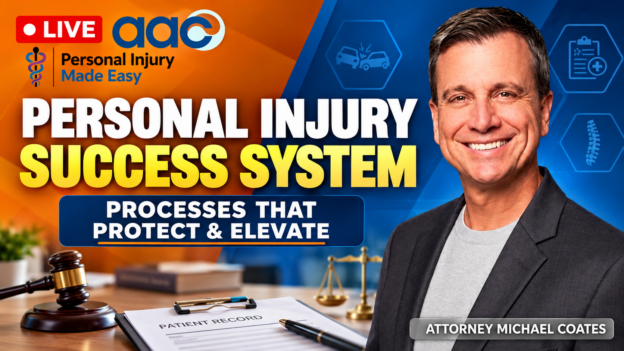
The Personal Injury Success System: Processes That Protect and Elevate Acupuncture Practices
Building a personal injury (PI) practice takes more than clinical expertise. Acupuncturists also need consistent intake procedures, accurate clinical documentation, appropriate referral pathways, and clear financial arrangements. In this American Acupuncture Council (AAC) presentation, Michael Coates of Personal Injury Made Easy discusses processes that can help healthcare providers improve practice organization and communicate a patient’s recovery more clearly.
Watch the Presentation: The Personal Injury Success System
Download the presentation transcript: Read or download the original transcript. The transcript is provided by AAC and may contain transcription errors.
1. Establish a Consistent Personal Injury Intake Workflow
The first visit establishes the clinical baseline and sets expectations for the care relationship. Coates advises practitioners to gather information relevant to the patient’s injuries and the body’s response to the incident without attempting to reconstruct the accident or determine legal fault.
For an acupuncture practice, a structured intake process should capture the patient’s account of the presenting symptoms, relevant health history, medications, prior injuries, functional limitations, and clinically relevant circumstances of the incident. Record the patient’s statements accurately and distinguish reported information from examination findings and clinical interpretation.
Photographs of vehicle damage or other incident-related evidence may be relevant to a legal matter, but practitioners should establish appropriate consent, privacy, storage, and documentation procedures before collecting or retaining them. Clinical records should not become an exercise in investigating liability. Questions about fault, legal causation, and accident reconstruction should be referred to qualified professionals.
2. Understand Medical Liens and Payment Arrangements
Coates highlights medical lien agreements as an important operational issue in personal injury practice. Depending on the jurisdiction and arrangement, a lien may address payment from a future recovery. However, a lien is not a universal guarantee of payment, and enforceability, required language, and provider obligations vary.
Before accepting a lien-based arrangement, have qualified legal counsel review the agreement for your jurisdiction. Clarify who is responsible for the bill, how any applicable medical payments coverage will be handled, what happens if the claim produces no recovery, and how fees or negotiated reductions are addressed. Do not assume that an attorney’s signature alone guarantees payment or creates a particular fiduciary duty.
Explain financial responsibilities to the patient in understandable terms and document the agreed arrangement. Keep clinical decisions independent of expected reimbursement. Never promise a patient a particular settlement, recovery, or insurance outcome.
3. Use a Biopsychosocial Approach to Patient Assessment
Coates recommends considering the biological, psychological, and social effects of trauma. This framework can help an acupuncturist understand the patient’s broader experience without exceeding professional scope.
Biological factors
Document relevant symptoms, examination findings, movement restrictions, pain-related limitations, and changes over time. Consider existing diagnoses and available reports from other clinicians, while distinguishing those findings from your own assessment. Refer for medical evaluation when symptoms or findings warrant care beyond your scope.
Psychological factors
After an accident, some patients report fear, anxiety, sleep disruption, low mood, or difficulty returning to usual activities. Record relevant patient-reported concerns respectfully and without making unsupported psychiatric diagnoses. When indicated, recommend evaluation by an appropriately qualified mental health professional.
Social and functional factors
Inquire about how symptoms affect activities of daily living, work duties, family responsibilities, mobility, and valued recreational activities. Ask neutral, open-ended questions and record the patient’s own description alongside observable findings. These details help guide treatment planning and make changes in function easier to evaluate.
4. Make Documentation Tell the Clinical Story
A useful record connects the initial presentation, clinical assessment, treatment rationale, interventions, response, and follow-up. It should be understandable to another qualified professional and accurately reflect what occurred at each encounter.
- Establish a baseline: Record relevant symptoms, functional limitations, examination findings, and patient-stated goals.
- Document each visit: Describe the actual treatment provided, relevant clinical reasoning, patient response, and any significant change in presentation.
- Track meaningful activities: Follow a small number of relevant functional goals, such as dressing independently, tolerating work duties, or participating in a previously limited activity.
- Explain changes: Record progress, setbacks, barriers, changes to the plan, and the clinical rationale for referrals or additional evaluation.
- Close the loop: Document recommendations, coordination with other providers when appropriate, and the patient’s status at reassessment or discharge.
For example, if a patient initially reports difficulty lifting a child or performing a work task, follow that limitation over subsequent visits. Record what the patient reports, any relevant examination findings, and whether function changes. Do not exaggerate symptoms, imply improvement that was not observed, or use emotionally persuasive language in place of objective clinical documentation.
For more detail, read AAC’s Proper Patient Records and Documentation and Charting Practices That Protect Acupuncturists.
5. Coordinate Referrals and Stay Within Your Scope
A full, clinically appropriate assessment can help identify concerns that require additional evaluation. The practitioner should focus treatment on services within their training, licensure, and legal scope, while referring to other qualified professionals when indicated. Document the reason for the referral, recommendations communicated, and relevant follow-up.
Communication with attorneys or insurers should be accurate, authorized, and limited to the information that may lawfully be shared. HIPAA-covered entities must follow applicable privacy requirements; a request from an attorney does not automatically authorize disclosure of every part of a patient’s record. Confirm the appropriate authorization or other legal basis before releasing information.
For additional guidance, review the U.S. Department of Health and Human Services’ guidance on disclosures for treatment, payment, and healthcare operations.
6. Build Processes That Support Sustainable Practice
Consistent workflows can help staff manage intake, appointment follow-up, documentation, referrals, billing, and requests for records. Periodically audit templates and electronic health records to identify missing information, copied-forward errors, or inconsistent procedures. Train staff on privacy, record access, financial communications, and escalation of clinical concerns.
These systems can improve organization and help make the care delivered easier to understand. They do not guarantee payment, a successful claim, or protection from a complaint. Clinical quality, ethical conduct, applicable law, and accurate records remain essential.
Conclusion: Protect the Patient, the Record, and the Practice
The central lesson from Michael Coates’s presentation is that personal injury practice depends on repeatable processes. Thoughtful intake, clear financial arrangements, biopsychosocial assessment, meaningful functional tracking, timely referrals, and accurate encounter-specific documentation can support better-coordinated care and clearer communication.
For more guidance on patient consent and professional risk management, visit AAC’s The Importance of Patient-Informed Consent. To review professional liability options, use the American Acupuncture Council website and request information appropriate to your practice.
Educational disclaimer: This article is for general educational and practice-management purposes only. It is not legal, medical, insurance, or financial advice. Personal injury law, lien requirements, privacy obligations, scope of practice, and insurance coverage vary. Consult qualified legal counsel and appropriate professional advisers regarding your circumstances. Coverage is governed by the actual policy terms, conditions, exclusions, and applicable law.