



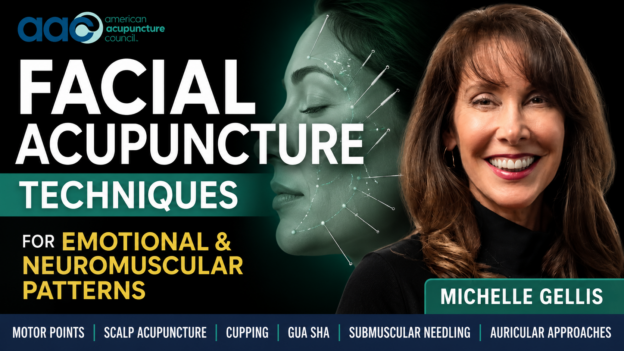
Facial Acupuncture Techniques for Transforming Facial and Emotional Patterns
Facial acupuncture often brings cosmetic treatment to mind. Clinicians also use facial techniques for movement, neuromuscular function, pain, and expression. In this American Acupuncture Council presentation, Michelle Gellis describes a broader clinical framework. She discusses facial motor points, scalp acupuncture, facial cupping, gua sha, submuscular needling, auricular approaches, and body acupuncture.
Transcript: Keep the existing “Click here to download the transcript” link in this location. The current AAC page identifies the transcript as a downloadable Dropbox asset. The page also notes that the transcript may contain spelling or grammatical errors.
What facial acupuncture techniques does the presentation discuss?
Gellis presents the face as part of an interconnected clinical system. She starts with individual muscles of facial expression. She then expands the discussion to scalp, submuscular, auricular, and body acupuncture. Her framework focuses on assessment and treatment selection. The goal extends beyond cosmetic change.
Motor points and facial muscle function
Facial motor points offer one way to work with individual muscles of expression. Gellis describes both underactive and overactive patterns. A muscle may show weak recruitment. It may also remain tense or overused. This approach encourages careful functional assessment before a practitioner chooses a local technique.
Clinicians should separate this neuromuscular rationale from stronger claims about emotion. The anatomy may support a clinical hypothesis. It does not prove that a specific motor point releases a specific emotion.
Scalp, submuscular, and local techniques
The presentation also covers scalp acupuncture and submuscular or intramuscular facial needling. Practitioners may consider these approaches when facial movement changes. Gellis also discusses facial cupping and gua sha. These methods can complement a broader treatment plan.
Each method has a different proposed mechanism. Each also has a different evidence base and risk profile. Practitioners should not treat them as interchangeable.
The lecture places local facial work within a whole-person acupuncture strategy. In traditional Chinese medicine, a practitioner may interpret facial findings through channels, qi, blood, and pattern differentiation. The practitioner may therefore add distal or body points. This framework reflects TCM clinical reasoning. It does not establish a biomedical mechanism.
What does the evidence say about facial feedback and emotion?
Researchers have studied links between facial movement and emotional experience for decades. The evidence supports an association, but the effect appears modest. A 2019 meta-analysis reviewed 138 studies. It found a small overall facial-feedback effect. The authors also found substantial variation across experimental conditions.
A large preregistered multicenter study produced a similarly nuanced picture. Some facial-feedback manipulations increased or initiated happiness. Other manipulations produced less consistent results. These findings support a cautious interpretation.
For clinicians, the evidence does not show that one facial muscle reliably stores or causes one emotion. Facial expression can influence emotional experience and social communication. The effect depends on context and experimental conditions.
What is known about acupuncture for facial conditions?
The strongest related clinical evidence concerns facial nerve disorders. It does not concern cosmetic rejuvenation or emotional transformation. A 2025 overview examined 17 systematic reviews and meta-analyses. The authors found potential benefits for peripheral facial paralysis. However, most underlying evidence had low or very low certainty.
A 2026 network meta-analysis also reported potentially favorable results for acupuncture combined with other traditional interventions. The authors still called for more research. Clinicians should interpret comparative rankings within the limits of the available studies.
Cosmetic facial acupuncture has a smaller evidence base. Recent studies have examined facial acupuncture and acupuncture-based stimulation for outcomes such as wrinkles and skin appearance. These studies do not establish that facial acupuncture reverses aging. They also do not show that every patient will experience durable cosmetic change.
Evidence for facial cupping and gua sha remains less specific. Current research does not justify broad claims about cosmetic or emotional outcomes.
How can clinicians apply these facial acupuncture techniques?
Gellis’s approach offers a useful starting point: assess before selecting a technique. Document facial symmetry, movement, pain, neurologic history, prior procedures, medications, skin integrity, and patient goals.
For cosmetic concerns, clarify the patient’s primary goal. The goal may involve appearance, function, comfort, or several factors. This distinction helps the practitioner set realistic expectations.
For facial weakness, first determine whether the patient needs medical evaluation. Acute facial paralysis does not always mean Bell’s palsy. Professional guidelines recommend evaluation for other causes. Evidence-based Bell’s palsy care may also require timely medical treatment. Acupuncture should not replace appropriate diagnosis or indicated medical care.
Facial treatment also requires clear informed consent. Discuss expected outcomes and uncertainty. Discuss bruising, bleeding, irritation, and other possible adverse effects. Consider referral when a facial concern may reflect an underlying medical condition.
Use sterile, single-use needles. Follow applicable scope-of-practice rules. Follow infection-control requirements. Obtain appropriate training before performing facial needling techniques.
Benefits, limitations, and safety
- Potential benefit: A multimodal approach gives practitioners several options for facial movement, pain, and cosmetic concerns.
- Evidence limitation: Research varies by condition and technique. Evidence for some neuromuscular applications exceeds evidence for broad emotional claims.
- Technique limitation: Current evidence does not establish specific cosmetic or emotional effects for facial cupping, gua sha, or every facial needling approach.
- Safety: Proper acupuncture technique can reduce risk. Poor technique or nonsterile needles can cause infection, tissue injury, and other serious complications.
- Referral: New or worsening neurologic findings need appropriate medical assessment. Ocular symptoms and unexplained facial changes also warrant referral.
Conclusion
Facial acupuncture can support a functional and whole-person clinical approach. Michelle Gellis presents motor points, scalp acupuncture, facial needling, cupping, gua sha, auricular strategies, and body acupuncture as complementary tools.
The evidence supports a careful interpretation. Facial feedback has a measurable but modest research signal. Acupuncture may help some patients with peripheral facial paralysis, but evidence quality remains limited. Cosmetic and emotional claims require more research.
For acupuncturists developing facial services, start with assessment. Set clear treatment goals. Explain uncertainty. Use appropriate technique and infection control. Refer patients when facial findings suggest a neurologic or other medical condition.
Continue Learning with the American Acupuncture Council
Explore related AAC education:
- Treating the Face – Healing the Whole
- Treating Cosmetic and Neuromuscular Facial Conditions with Facial Motor Points
- Submuscular Facial Needling for Cosmetic and Neuromuscular Concerns
- The Face, Emotion, and the Qi Connection
American Acupuncture Council: Explore AAC educational resources and professional risk-management information for acupuncture practitioners.
References
- Coles NA, Larsen JT, Lench HC. A meta-analysis of the facial feedback literature: Effects of facial feedback on emotional experience are small and variable. Psychological Bulletin. 2019;145(6):610-651. PubMed.
- Coles NA, et al. A multi-lab test of the facial feedback hypothesis by the Many Smiles Collaboration. Nature Human Behaviour. 2022;6:1731-1742. PubMed.
- Huang Z, et al. The efficacy and safety of acupuncture treatment for peripheral facial paralysis: an overview of systematic review and meta-analysis. Frontiers in Neurology. 2025. PubMed.
- Li M, et al. Efficacy of acupuncture combined with various traditional Chinese medicine therapies for peripheral facial paralysis: a systematic review and network meta-analysis. American Journal of Otolaryngology. 2026;47(1):104787. PubMed.
- Luo Y, et al. Efficacy and Safety of Transcutaneous Electrical Acupoint Stimulation for Improving Clinical Signs of Facial Skin Aging. Journal of Cosmetic Dermatology. 2026;25(4):e70839. PubMed.
- National Center for Complementary and Integrative Health. Acupuncture: Effectiveness and Safety. NCCIH.
- American Academy of Otolaryngology–Head and Neck Surgery. Clinical Practice Guideline: Bell’s Palsy. AAO-HNS.
- American Academy of Neurology. Update: Steroids and Antivirals for Bell Palsy. AAN.
Educational disclaimer: This article provides professional education. It does not provide medical advice, diagnosis, or a treatment protocol. Base clinical decisions on the individual patient, current evidence, applicable law, scope of practice, and appropriate consultation or referral. Only appropriately trained and licensed practitioners should perform acupuncture procedures.