



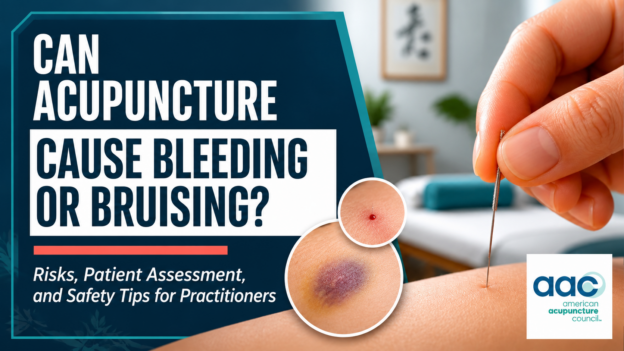
Can Acupuncture Cause Bleeding or Bruising?
Yes. Acupuncture can cause a small amount of bleeding or localized bruising when a needle is inserted or withdrawn. These reactions are recognized in clinical safety research and are usually minor. They are not, however, automatically harmless in every patient: medication use, a bleeding or coagulation disorder, relevant medical conditions, the anatomical site, and the needling technique all influence risk.
For acupuncturists, the practical question is not simply whether a spot of blood is normal. It is whether the patient has been appropriately assessed, the needling approach is suitable, bleeding is controlled, and any unexpected event is documented and managed.
Why can acupuncture cause bleeding or bruising?
Acupuncture needles pass through the skin and may encounter small superficial blood vessels. A small amount of blood at the insertion or withdrawal site can therefore occur. Blood that escapes into nearby tissue may produce a localized bruise or, less commonly, a more noticeable hematoma.
The likelihood of a visible reaction can vary with the location and vascularity of the area, individual tissue characteristics, needle selection, insertion depth and angle, and the degree of manipulation. A small spot of blood does not by itself establish that a treatment was performed improperly. Conversely, persistent bleeding, an expanding hematoma, unusual pain, or symptoms suggesting a deeper injury should not be dismissed as an ordinary treatment response.
How common are bleeding and other acupuncture adverse events?
A 2021 systematic review and meta-analysis of prospective clinical studies found that bleeding was among the more frequently reported minor adverse events. Its pooled estimate was approximately 4.92% of treatments, with a very wide confidence interval (1.18%–11.01%) and substantial between-study heterogeneity. The authors emphasized that studies used differing definitions and methods for recording adverse events; some recorded minor bleeding or local pain that may be considered an expected needling reaction.
The same review estimated serious adverse events at approximately 7.98 per one million treatments. These figures provide context, not a guarantee of safety for an individual patient or a prediction for a particular practice. Different patient populations, practitioner settings, reporting methods, and definitions affect the estimates.
Who may have a higher risk of bleeding or bruising?
Patients taking anticoagulant medication
Anticoagulants reduce blood clotting and can increase the likelihood or duration of bleeding. Examples include warfarin, heparin, and direct oral anticoagulants such as apixaban and rivaroxaban. Medication history should include the drug, dose when known, indication, relevant monitoring information when applicable, and any history of unusual bleeding or bruising.
A large Taiwanese database case-control study published in 2023 examined 13,447,563 acupuncture sessions among 821,946 people. Anticoagulant use was associated with a higher risk of minor bleeding. The study did not find a statistically significant increase in major bleeding for anticoagulant use overall, although certain anticoagulant subgroups had higher observed risks. The findings support careful assessment; they do not establish that acupuncture is universally safe or universally contraindicated for everyone taking these medicines.
Do not advise a patient to stop or change a prescribed anticoagulant or antiplatelet medication to facilitate acupuncture. Any medication decision belongs with the prescribing clinician. When risk is unclear, coordinate with the patient’s medical team and consider whether treatment should be deferred or modified.
Patients with coagulation disorders or relevant medical conditions
Known bleeding disorders, thrombocytopenia, liver disease, a history of unexplained or prolonged bleeding, and other conditions affecting hemostasis warrant additional assessment. The World Health Organization’s 2020 Benchmarks for the Practice of Acupuncture identifies a disturbance of blood coagulation as a contraindication in its benchmark guidance. Practitioners should apply this guidance alongside current clinical information, local regulations, scope of practice, and appropriate medical consultation rather than assuming that every medication-related bleeding risk is identical to a diagnosed coagulation disorder.
Other patient and site considerations
Older or medically complex patients may have multiple factors that influence bruising risk. Needling near visible or palpable superficial vessels, or in areas with greater vascularity, calls for careful anatomical assessment. Ask about prescription medicines, over-the-counter products, supplements, prior bruising, and recent changes in health rather than relying on a brief question about “blood thinners.”
How can acupuncturists reduce preventable bleeding?
Risk reduction begins before the first needle is inserted:
- Take and update a relevant history. Ask about bleeding disorders, liver disease, anticoagulants, antiplatelet agents, supplements, prior complications, and unusual bruising or bleeding.
- Assess the site anatomically. Identify visible or palpable vessels and structures at risk. Select points, depth, angle, and needle specifications with the patient’s condition and anatomy in mind.
- Use appropriate technique. Avoid unnecessary force or aggressive manipulation, and adapt treatment to the patient’s response and clinical circumstances.
- Follow infection-control and needle-handling standards. Use sterile, single-use needles and comply with applicable hygiene and sharps-disposal requirements.
- Explain material risks and obtain informed consent. Discuss the possibility of minor bleeding or bruising and any patient-specific precautions in understandable language.
- Observe and reassess. Inspect needled sites when appropriate, particularly when the patient’s history or treatment location raises concern.
WHO guidance recommends attention when withdrawing needles from body regions prone to bleeding and pressing with a clean swab when needed. It also emphasizes appropriate needle depth, technique, informed consent, and complete treatment records.
What should you do if a patient bleeds after acupuncture?
For slight, localized bleeding, withdraw the needle carefully and apply direct pressure with a clean, dry sterile swab until bleeding stops. Do not rub the site. Reassess the area before the patient leaves. If a bruise or hematoma develops, assess its size, progression, pain, and associated symptoms; follow appropriate clinical protocols and seek medical evaluation when warranted.
Persistent bleeding, rapidly expanding swelling, severe or escalating pain, marked weakness or dizziness, or signs of a significant vascular injury require prompt assessment and escalation. Suspected deep injury or systemic symptoms should not be managed as routine superficial spotting. Follow emergency procedures and arrange urgent medical care when indicated.
Document the patient’s relevant history, the site and technique, the event and its timing, observations, actions taken, the patient’s response, advice or referral, and follow-up. Documentation should be factual and completed in accordance with applicable professional and legal requirements.
Is bruising after acupuncture dangerous?
A small, localized bruise that does not enlarge and resolves without other symptoms is generally a minor reaction. A large or expanding hematoma, persistent bleeding, severe pain, numbness, weakness, or symptoms that suggest a deeper injury require further assessment. Patients should be told how to contact the practitioner and what changes warrant medical attention.
Practitioners should avoid promising that bruising will never occur. Clear pre-treatment communication helps patients distinguish an anticipated minor reaction from a symptom that needs follow-up.
What this means for acupuncture practice
Bleeding and bruising are recognized possible effects of acupuncture, but prevention and response depend on sound clinical judgment. A careful medical and medication history, anatomical knowledge, appropriate needling, informed consent, direct pressure when indicated, and accurate documentation are practical foundations of patient safety.
The American Acupuncture Council (AAC) supports acupuncturists through professional liability coverage and risk-management resources. Practitioners can learn more about AAC claims service and risk management and review AAC policy information to understand available coverage and services. Coverage terms vary; consult the applicable policy and insurer for specific questions.
References
- World Health Organization. WHO Benchmarks for the Practice of Acupuncture. Geneva: WHO; 2020. ISBN 978-92-4-001688-0. WHO publication.
- Acupuncture-related adverse events: systematic review and meta-analyses of prospective clinical studies. BMJ Open. 2021;11:e045961. doi:10.1136/bmjopen-2020-045961.
- Hsieh HT, Chou HJ, Wu PY, Lin SK. Bleeding risk after acupuncture in patients taking anticoagulant drugs: A case control study based on real-world data. Complement Ther Med. 2023;74:102951. doi:10.1016/j.ctim.2023.102951. PMID: 37141924.
Educational disclaimer: This article is for educational purposes and is not a substitute for individualized medical advice, diagnosis, treatment, or consultation with a qualified healthcare professional. Acupuncturists should follow applicable laws, professional standards, scope-of-practice requirements, current clinical guidance, and emergency protocols. Patients should not stop or change prescribed medication without guidance from the prescribing clinician.