
Category Archives: AAC Malpractice Insurance Policy

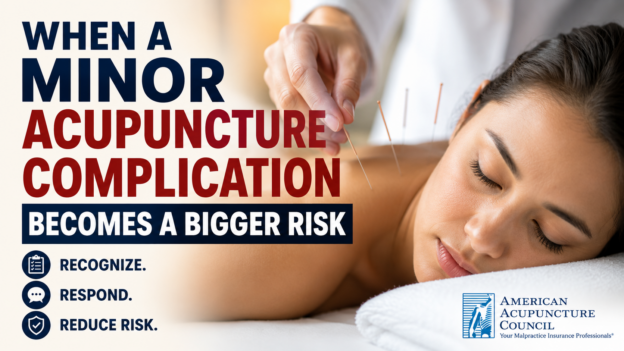
Acupuncture treatment illustrating minor complications and patient safety risk management

Can a Minor Acupuncture Complication Become a Major Problem?

Acupuncture is generally associated with a low rate of serious adverse events, but “minor” does not mean “unimportant.” A small bleed, bruising, dizziness, fainting, or unexpected pain may resolve without lasting harm. However, an event can require additional assessment, affect the patient’s confidence, or become a professional-liability issue if it is not recognized, communicated, documented, or managed appropriately. The goal is not to practice defensively. It is to build a consistent process for patient safety and risk management.

Video: Watch the AAC presentation above. A transcript/download link was not identifiable on the current source page; see the Manual WordPress Tasks below before publication if an original transcript asset exists.

What the evidence says about acupuncture complications

Prospective evidence supports the overall safety of acupuncture while showing that adverse events are not zero. A 2021 systematic review and meta-analysis found at least one adverse event in about 9.31% of patients undergoing an acupuncture series and 7.57% of treatments. The most frequent events were minor, with bleeding, pain, or flare at the needling site accounting for about half of reported events. The review estimated serious adverse events at 7.98 per million treatments, although the authors emphasized substantial heterogeneity in study methods and adverse-event definitions.

A 2024 review likewise concluded that serious acupuncture-related adverse events are rare and identified pneumothorax, nerve injury, heart injury, abdominal-organ injury, infection, and needle breakage among the important serious events reported in the literature. Common minor events included bruising, hematoma, bleeding, dizziness, fainting, tiredness, and residual needling pain.

Case-report literature should be interpreted differently from prospective incidence studies. Case reports can identify rare but important complications, but they cannot establish how frequently those events occur. For example, systematic reviews of case reports have documented pneumothorax and other organ or tissue injuries, reinforcing the importance of anatomy, appropriate needle depth and direction, sterile technique, and clinical vigilance.

When a minor event can become a bigger problem

A minor reaction does not automatically mean negligence or malpractice. The clinical event and the legal question are separate. A patient can experience an expected or recognized adverse reaction even when care was appropriate. Conversely, a seemingly small event can become more consequential when follow-up is missed, warning symptoms are minimized, the patient is not given appropriate instructions, or the record does not accurately describe what occurred.

From a risk-management perspective, the critical transition is often not the initial event but what happens next. Consider a patient who becomes lightheaded after treatment. The immediate response may be straightforward. The risk increases if the episode is not assessed, the patient is allowed to leave before it is appropriate, the event is not documented, or the patient later reports worsening symptoms and cannot understand what happened or whom to contact.

The same principle applies to bleeding, bruising, increased pain, suspected infection, retained or broken needles, or symptoms that could signal a more serious injury. The appropriate response depends on the clinical circumstances and the practitioner’s scope, training, and applicable law.

Five practical risk-management habits

1. Document the treatment. Record the relevant history, examination findings, treatment performed, points or regions treated, patient response, and clinically significant adverse events. AAC emphasizes the importance of accurate patient records because documentation can become important if a complaint or claim later arises.

2. Explain foreseeable reactions. Patients should understand what they may experience after treatment and what symptoms warrant contacting the practice or seeking medical evaluation. Communication should be understandable and consistent with the actual treatment provided.

3. Use informed consent appropriately. AAC advises using a professionally prepared informed-consent process, discussing the form with the patient, answering questions, and noting in the record that the discussion occurred. Requirements vary by state, so practitioners should confirm the rules that apply to their practice.

4. Recognize when referral or escalation is appropriate. Acupuncture practice does not eliminate the need for medical assessment when symptoms fall outside the practitioner’s competence or suggest a potentially serious condition. WHO’s acupuncture benchmarks emphasize stepwise treatment procedures, appropriate infrastructure, and safety practices.

5. Have a plan for complaints and claims. If a patient reports an unexpected injury or threatens a claim, avoid speculation or admissions about legal responsibility. Preserve the clinical record, communicate professionally, and follow the procedures of your professional-liability carrier or legal advisers.

Why prevention and insurance are complementary

Good risk management should come before insurance. Sterile technique, anatomy knowledge, appropriate needle selection and depth, patient screening, informed consent, clear aftercare instructions, accurate documentation, and timely referral all reduce avoidable risk.

Insurance serves a different function. It helps provide financial and legal protection when a claim or other covered proceeding occurs. AAC describes its risk-management and claims service as part of its broader member support, with specialized experience in acupuncture-related professional liability. Coverage terms vary, so practitioners should review the actual policy rather than relying on general statements about insurance.

A practical takeaway for acupuncturists

The safest approach is neither to assume that acupuncture is risk-free nor to treat every adverse event as evidence of malpractice. Instead, treat every unexpected reaction as a clinical communication and documentation opportunity. Assess the patient, respond within your competence and scope, give appropriate follow-up instructions, document what happened, and escalate care when indicated.

That approach protects the patient first. It also creates a clearer record of the care provided if questions arise later. For acupuncture practice owners, a written risk-management process and appropriate professional-liability coverage can provide an additional layer of protection.

Conclusion

Minor acupuncture complications are often transient, but they should never be dismissed. The evidence supports acupuncture as a treatment with relatively uncommon serious adverse events, while also documenting rare but potentially severe complications. For practitioners, the practical lesson is straightforward: use sound clinical technique, communicate foreseeable risks, document care carefully, recognize red flags, and know when referral is necessary. Insurance cannot replace those practices, but appropriate professional-liability coverage can help a practice respond when an unexpected event develops into a complaint or claim.

Learn More from the American Acupuncture Council

Learn more about AAC’s approach to acupuncture risk management, informed consent, and professional-liability protection. Practitioners can review AAC’s risk-management resources and obtain current coverage information directly from the American Acupuncture Council.

References

  1. BMJ Open systematic review and meta-analysis of acupuncture-related adverse events
  2. PubMed: Acupuncture: A Review of the Safety and Adverse Events and the Strategy of Potential Risk Prevention
  3. WHO benchmarks for the practice of acupuncture
  4. PubMed: Adverse events following acupuncture: systematic review of the Chinese literature, 1956–2010
  5. PMC: Adverse Events of Acupuncture: A Systematic Review of Case Reports
  6. ScienceDirect: Pneumothorax associated with acupuncture: A systematic review and analysis

Educational disclaimer: This article is for educational and professional risk-management information only. It is not medical, legal, insurance, or regulatory advice and does not establish a standard of care. Practitioners should follow applicable law, professional standards, scope-of-practice rules, and the terms of their insurance policy, and obtain qualified advice when needed.


acupuncturist insurance policy, acupuncturist insurance

Acupuncture Malpractice Insurance Policy Supports Small Practice Success

Running a small acupuncture practice comes with unique challenges. You’re not just the practitioner—you’re also managing appointments, client relationships, and day-to-day operations. That’s why having the right acupuncture malpractice insurance policy is especially important for solo practitioners and small clinics. With millions of Americans seeking acupuncture each year for pain relief and wellness, even small practices are seeing steady client flow—making proper protection a must.

When you’re operating on a smaller scale, one unexpected claim can have a bigger financial impact. The right coverage helps you stay focused on your work without unnecessary stress.

Why Insurance Matters More for Small Practices

In a small practice, there’s often less margin for error—financially. Unlike larger clinics, you may not have the resources to absorb legal costs or unexpected claims. An acupuncture malpractice insurance policy helps protect you from expenses in relation to client complaints, injuries, or misunderstandings. It acts as a safety net, ensuring that one incident doesn’t disrupt everything you’ve worked hard to build.

Common Risks You May Face

Even with experience and proper technique, risks can still arise in everyday practice:

  • Clients experiencing soreness or unexpected reactions
  • Sensitivity or allergies to oils or treatments
  • Miscommunication about treatment outcomes
  • Slips or falls inside your clinic
  • Disputes that lead to legal claims

Being prepared for these possibilities helps you operate with confidence.

Practical Benefits for Independent Practitioners

For solo acupuncturists and small clinics, the right insurance coverage offers real, day-to-day value:

  • Financial protection against claims and legal fees
  • Support in handling disputes professionally
  • Added credibility when working with clients
  • Peace of mind during treatments
  • Stability for long-term business growth

These benefits allow you to focus on delivering quality care instead of worrying about “what if” scenarios.

Why Specialized Coverage Is Worth It

Generic insurance policies may not fully address the risks associated with acupuncture. Providers that specialize in this field understand the specific needs of small practitioners. They can tailor coverage depending on how you practice—whether you work from a private clinic, shared space, or even a home-based setup. It ensures get the needed coverage without paying for unnecessary extras.

Build Your Practice with Confidence

As a small practitioner, your business depends on your skills, reputation, and consistency. Protecting it with the right insurance is one of the smartest decisions you can make.

—

Call (800) 838-0383 today to learn more about an acupuncture malpractice insurance policy designed for small practices and keep your business moving forward with confidence.

Acupuncturist Need General Liability Insurance

Acupuncturist Need General Liability Insurance

Why do acupuncturist need General Liability coverage?

General Liability covers several risks including:

It expands the definition of Premises Liability to include common areas of the building that you are contracted to be liable and expands the definition of covered persons from the patient to invited guests on the premises.

It can cover personal injury; false imprisonment, lible, and slander.

It can cover medical expenses without regard to fault.

It has enhanced products liability coverage extending the coverage from products used during treatment to include products sold off the shelf of the business.

And the coverage includes fire and water legal liability. If the Named insured is leasing space and they are alleged to have started a fire or broke a water pipe, this section of the general liability policy can cover for the property damage.

The American Acupuncture Council ( AAC) offers an unparalleled track record in acupuncture risk management.

There is a reason acupuncturists have trusted AAC with their business for 50 years.

Not an American Acupuncture Council member? Get a Quick Quote and find out how much you will save! Click here!

Additional Insured vs. Professional Corporation

Additional Insured vs. Professional Corporation

What is the difference between additional insured vs. coverage for professional corporation?

Additional insured is usually a person or corporation that is seeking to be added to the Named Insured’s policy, in case the additional insured (landlord, practice partner, clinic) is named in a cause of action as a consequence of an injury that the Named Insured is accused of causing.

Professional corporation is coverage for a professional corporation the Named Insured is associated with, usually a limited liability corporation (LLC).

Professional corporation coverage is no charge as long as the Named Insured is the majority owner of the professional corporation.

If the Named Insured is not the majority owner, then standard additional insured rates apply.

Remember, the American Acupuncture Council ( AAC) offers an unparalleled track record in acupuncture risk management.

There is a reason acupuncturists have trusted AAC with their business for 50 years.

Not an American Acupuncture Council member? Get a Quick Quote and find out how much you will save! Click here!

Chronic Prostatitis/Chronic Pelvic Pain

Acupuncture and Chronic Prostatitis/Chronic Pelvic Pain Syndrome

Can acupuncture reduce the symptoms of chronic prostatitis?

Chronic prostatitis or chronic pelvic pain syndrome is long-term pelvic pain and lower urinary tract symptoms without evidence of a bacterial infection, and its cause is uncertain.

The National Institutes of Health and other sources estimate that 2-10% of men experience symptoms compatible with chronic prostatitis at some point in their lives.

A review of 3 studies (204 total participants) suggested that acupuncture may reduce prostatitis symptoms, compared with a sham procedure.

Healthcare continues to evolve toward less-invasive, natural, and drug-free methods, with acupuncture now becoming a first-line complementary healthcare choice.

Remember, the American Acupuncture Council (AAC) offers an unparalleled track record in acupuncture risk management.

There is a reason acupuncturists have trusted AAC with their business for 50 years.

Not an American Acupuncture Council member? Get a Quick Quote and find out how much you will save! Click here!

Protection vs Injuries-at-the-Clinic Claims

Acupuncture Liability Insurance: Protection vs Injuries-at-the-Clinic Claims


Why do acupuncturists need coverage under the premises liability insurance (also known as workplace liability insurance)?

Acupuncture liability insurance protects acupuncturists from financial losses due to claims of malpractice and injuries sustained by patients on the clinic premises.

For example, suppose an acupuncture patient falls from the clinic table due to negligence on their part; they might still file a complaint claiming liability on the acupuncturist.

With the growing demand for acupuncture, there is also a great need for acupuncture liability insurance to protect one’s acupuncture practice and reputation.

Remember, the American Acupuncture Council (AAC) offers an unparalleled track record in acupuncture risk management.

There is a reason acupuncturists have trusted AAC with their business for 50 years.

Not an American Acupuncture Council member? Get a Quick Quote and find out how much you will save! Click here!