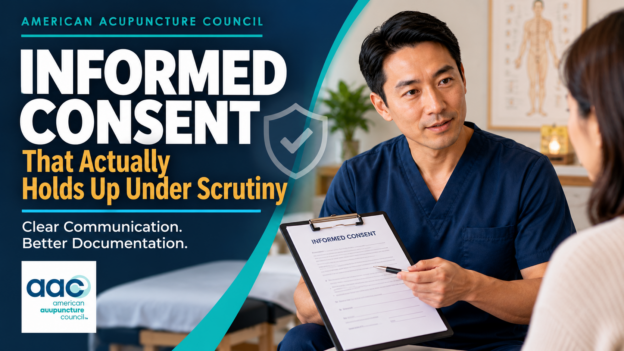
Watch: Informed Consent That Actually Holds Up Under Scrutiny
Related resource: Read AAC’s Informed Consent guidance for additional background on discussing consent with patients and documenting the conversation.
Why Acupuncture Informed Consent Requires More Than a Signature
Informed consent is a communication process that allows patients to make voluntary decisions about their care. The American Medical Association’s Code of Medical Ethics describes core elements that include explaining the proposed intervention, discussing relevant risks and expected benefits, considering alternatives, assessing the patient’s understanding, and documenting the decision. Although this guidance is written for physicians, these principles provide a useful general ethical framework for patient communication.
A signed form can show that a patient completed a document. On its own, however, it may not explain what the practitioner discussed, which questions the patient asked, or whether the information was relevant to the proposed treatment.
For acupuncturists, the goal is to make consent an understandable, patient-centered conversation. The form, discussion, and clinical note should be consistent with one another and reflect the actual encounter.
What Should an Acupuncturist Discuss Before Treatment?
The information needed for informed consent depends on the proposed treatment, the patient’s circumstances, and applicable law. A practical discussion generally addresses the following areas.
1. The purpose and nature of the proposed treatment
Explain what you recommend, why you recommend it, and what the patient can reasonably expect from the intervention. Use plain language and avoid promising a particular outcome. If the diagnosis or likely response to treatment remains uncertain, communicate that uncertainty clearly.
2. Relevant risks and precautions
Discuss material risks associated with the proposed treatment and circumstances that may affect the patient’s risk. Depending on the procedure and clinical context, relevant topics may include temporary soreness, minor bleeding or bruising, dizziness, and uncommon but potentially serious complications.
Explain additional precautions when the patient’s history, medications, or planned technique make them relevant. The conversation should reflect the actual care being considered rather than rely exclusively on generic wording in a form.
3. Expected benefits and reasonable alternatives
Describe the intended benefits without overstating the evidence or guaranteeing results. Where appropriate, discuss other reasonable approaches, referral for additional evaluation, and the option of declining or postponing treatment. Patients need enough information to make a decision consistent with their needs and preferences.
4. Questions and voluntary agreement
Invite questions and check whether the patient understands the information. Give the patient a genuine opportunity to accept or decline the proposed intervention without pressure. If communication barriers arise, use appropriate language assistance or other methods to support understanding.
How to Document Informed Consent in the Clinical Record
Good documentation connects the consent process to the care actually provided. AAC’s Proper Patient Records resource emphasizes accurate histories, clinical findings, treatment plans, patient education, and records that reflect each individual encounter.
After a consent discussion, document the relevant details in accordance with applicable requirements and your practice’s recordkeeping procedures. Depending on the circumstances, the note may include:
- The treatment or procedure discussed and its purpose.
- The material risks, expected benefits, and relevant alternatives explained.
- Important patient-specific precautions discussed.
- Questions raised by the patient and any clarification provided.
- The patient’s decision, including consent, refusal, or a request to defer treatment.
- The consent form completed and retained in the record, where applicable.
- Any follow-up instructions, referrals, or additional discussions needed before treatment.
These are practical documentation considerations, not a universal legal checklist. The specific information required will depend on the circumstances and applicable rules.
When Should Consent Be Revisited?
A consent form completed at an initial visit should not be treated as blanket authorization for every future intervention. Revisit the discussion when a material change makes the previous conversation insufficient for the decision now facing the patient.
Examples may include a substantially different treatment, a new patient risk factor, a significant change in medical history or medication, a newly identified precaution, or an unexpected response that changes the balance of potential benefits and risks. A patient who expresses uncertainty or asks to reconsider should also have the opportunity to revisit the decision.
Consent is an ongoing communication responsibility. The depth of the discussion should be proportionate to the intervention and the patient’s circumstances.
Common Informed-Consent Problems to Avoid
- Relying on a signature alone: Document the meaningful discussion, not merely the existence of a signed form.
- Using overly broad language: Ensure the information is relevant to the treatment and understandable to the patient.
- Making unsupported assurances: Explain uncertainty and material risks without guaranteeing safety or effectiveness.
- Copying identical notes: Electronic templates can help, but the record should accurately reflect the encounter.
- Ignoring changed circumstances: Reassess whether additional discussion is needed when treatment or patient risk changes.
- Overlooking local requirements: Confirm whether written consent, specific disclosures, forms, or additional procedures are required by the applicable jurisdiction.
How Informed Consent Supports Acupuncture Risk Management
Clear consent conversations support patient participation and may help clarify expectations before treatment begins. Accurate records can also help explain what information was provided and how the practitioner responded to the patient’s questions and decisions.
Neither a signed form nor a detailed note guarantees that a malpractice claim will be avoided or resolved in a particular way. Consent is one component of responsible practice, alongside appropriate clinical assessment, treatment within professional scope, safe technique, accurate records, referrals when indicated, and suitable professional liability coverage.
For additional guidance, see AAC’s Documentation and Charting Practices That Protect You and Preventing Acupuncture Malpractice Claims: Documentation, Consent, and Coverage.
Practical Checklist for Your Practice
- Use a professionally prepared consent form appropriate to your services and jurisdiction.
- Discuss the form with the patient before the relevant examination or treatment, as required.
- Explain the proposed intervention, material risks, expected benefits, and relevant alternatives.
- Invite questions and support the patient’s understanding.
- Record the substance of the discussion and the patient’s decision.
- Keep the signed form with the appropriate clinical record.
- Update patient information and revisit consent when circumstances warrant it.
- Review state or local rules and seek qualified legal advice when requirements are unclear.
Build a Consistent Informed-Consent Process
Effective informed consent begins with communication, continues through accurate documentation, and adapts when a patient’s circumstances change. By treating consent as an ongoing professional responsibility, acupuncturists can support informed patient decisions and strengthen their practice’s risk-management procedures.
The American Acupuncture Council provides resources for acupuncturists seeking guidance on professional liability and practice risk management. Explore the AAC resources linked above or visit American Acupuncture Council to learn more about its services.
References and Further Reading
- American Acupuncture Council. Informed Consent. AAC guidance on discussing consent with patients and documenting the conversation.
- American Acupuncture Council. Proper Patient Records. Guidance on patient histories, examinations, treatment plans, and clinical documentation.
- American Medical Association. Code of Medical Ethics, Opinion 2.1.1: Informed Consent. General ethical guidance on disclosure, decision-making, and documentation for physicians.
- American Acupuncture Council. Documentation and Charting Practices That Protect You.
- American Acupuncture Council. Preventing Acupuncture Malpractice Claims: Documentation, Consent, and Coverage.
Educational disclaimer: This article is for general educational and professional risk-management information only. It is not legal advice, does not establish a standard of care, and does not replace applicable laws, licensing-board requirements, professional guidance, or advice from qualified legal counsel. Informed-consent requirements vary by jurisdiction and clinical circumstances. Practitioners should verify the requirements applicable to their practice.