Tag Archives: Informed Consent

Acupuncturist reviewing patient records and malpractice risk management

Acupuncture Malpractice Claims: What Practitioners Need to Know

Acupuncture is generally considered a safe treatment when practiced by appropriately trained professionals, but no clinical procedure is risk-free. For acupuncturists, a patient complaint or unexpected adverse event does not automatically mean malpractice occurred. The more useful question is whether the practitioner followed applicable standards, recognized and managed risk, documented the care, communicated appropriately, and responded properly if a problem developed.

Understanding those responsibilities before a claim arises can help acupuncture practitioners reduce preventable risk and respond more effectively when an unexpected event occurs.

What can lead to an acupuncture malpractice claim?

Acupuncture-related adverse events range from minor, transient reactions to rare but serious injuries. A systematic review of prospective clinical studies found that most reported adverse events were mild, with bleeding, pain, or treatment-site flare among the most common. Serious adverse events were uncommon, although the authors emphasized that appropriate medical competence is necessary when an adverse event requires medical management.

Other published reviews have described reported events including infection, syncope, tissue or organ injury, and other complications. Importantly, a reported adverse event is not the same thing as proof of negligence. Whether a practitioner may be liable depends on the facts, applicable law, the standard of care, causation, and damages.

Where risk management matters most

Patient screening and clinical assessment

Before treatment, practitioners should obtain an appropriate history and assess factors relevant to treatment safety, including medications, allergies, relevant medical conditions, bleeding risk, and other contraindications or precautions within the practitioner’s scope and training. The World Health Organization’s benchmarks for acupuncture emphasize patient assessment, informed consent, controlled needling technique, infection prevention, documentation, and recognition of when referral is appropriate.

Needle technique and treatment safety

Needle depth, location, angle, manipulation, and patient response matter. Extra caution is appropriate around vital organs, major vessels, and nerve structures. Practitioners should use appropriate infection-prevention procedures and follow applicable professional, facility, and regulatory requirements.

The WHO benchmarks specifically recommend informing patients about potential benefits and risks, obtaining informed consent, controlling needle depth near vital structures, ensuring all needles are removed, documenting treatment, and providing appropriate post-treatment advice.

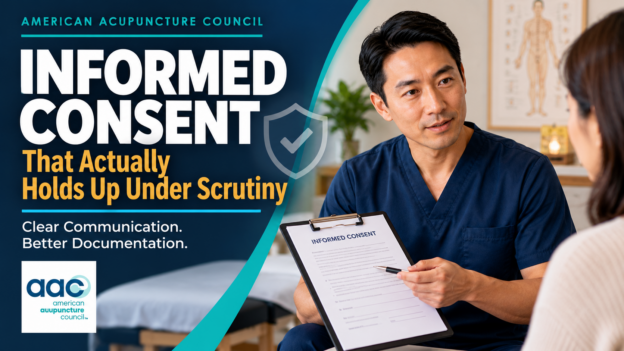
Informed consent

A signed consent form is useful, but informed consent is more than a signature. The patient should receive understandable information about the treatment and material risks relevant to the proposed care, have an opportunity to ask questions, and voluntarily agree to proceed. Requirements vary by jurisdiction and clinical circumstance, so practitioners should confirm the rules that apply to their practice.

Documentation

Good records should allow another qualified professional to understand what the patient presented with, what was assessed, what treatment was provided, how the patient responded, and what follow-up or referral was recommended. AAC guidance recommends documenting history, medications and allergies, examination findings, diagnosis, treatment plan, treatment details, patient education, referrals, re-examinations, and other clinically relevant information.

Records should be contemporaneous, specific to the actual visit, and signed or authenticated as required. Avoid relying on identical “cookie-cutter” notes that do not reflect the patient’s presentation or the treatment actually delivered.

What should you do if a patient reports an injury?

First, focus on patient safety and appropriate clinical evaluation. If symptoms suggest a potentially serious condition or fall outside your competence, arrange appropriate medical assessment or referral.

At the same time, preserve the clinical record and document relevant facts objectively. Do not alter prior notes to make them appear more complete after an event. If a patient threatens a claim, sends a demand, or reports the matter to a licensing authority, promptly follow the reporting requirements and claims procedures associated with your professional-liability policy and obtain appropriate legal guidance.

Avoid speculation about fault or making promises about legal or financial outcomes. A claim is an allegation, not a finding that malpractice occurred.

Why professional liability coverage still matters

Risk management and insurance serve different purposes. Safe technique, patient screening, informed consent, documentation, communication, and timely referral can reduce avoidable risk. Professional liability insurance provides a separate layer of financial and legal protection when a covered claim or proceeding occurs, subject to the policy’s terms, limits, exclusions, and conditions.

AAC describes its professional-liability program as being designed specifically for acupuncturists and states that its claims and risk-management resources include acupuncture-specific experience. Practitioners should review their actual policy and confirm what coverage applies to their services, scope of practice, limits, reporting requirements, and any claims-made or occurrence provisions.

Does an adverse event automatically mean malpractice?

No. An adverse event can occur even when care was appropriate. Conversely, a preventable injury may raise questions about whether the applicable standard of care was met. The distinction requires a fact-specific assessment of the treatment, patient factors, applicable professional and legal standards, causation, and resulting harm.

What can practitioners do now?

  • Review patient intake and screening procedures.
  • Keep informed-consent discussions understandable and document the discussion when appropriate.
  • Document each treatment accurately and promptly.
  • Review infection-prevention and sharps-safety procedures.
  • Know the limits of your training and scope of practice, and establish referral pathways.
  • Make sure your professional-liability coverage matches your current services and practice structure.
  • Know how and when your insurer requires notice of a claim, incident, demand, or other proceeding.

Frequently asked questions

What are common acupuncture-related adverse events?

Published evidence describes minor events such as bleeding, pain, and treatment-site reactions as common, while serious events are uncommon. Infection, syncope, and tissue or organ injury have also been reported.

Can a patient file a malpractice claim even if the practitioner believes the treatment was appropriate?

Yes. A claim is an allegation that must be evaluated under the law and facts applicable to the case. The existence of a claim does not by itself establish negligence.

How important are patient records in a malpractice matter?

They are important because contemporaneous records can show what the patient reported, what the practitioner assessed, what treatment was provided, how the patient responded, and what instructions or referrals were given. Documentation cannot guarantee a particular legal outcome, but incomplete or inaccurate records can make a defensible account of care more difficult.

Does the deadline for filing a malpractice claim vary by state?

Yes. Filing deadlines and procedural requirements vary by jurisdiction and by the type of claim. Practitioners should not rely on a general national deadline; a specific legal matter should be evaluated under the law applicable to that case.

Conclusion

The best response to acupuncture malpractice risk is neither complacency nor alarm. Acupuncture has a substantial safety literature, but preventable complications and allegations of negligence can still create clinical, professional, and financial consequences.

Practitioners can strengthen their position by combining sound clinical technique with careful screening, meaningful informed consent, accurate documentation, appropriate referral, and professional-liability coverage that fits the practice. Those measures help protect patients first—and help practitioners respond responsibly if an unexpected event becomes a complaint or claim.

Learn more from the American Acupuncture Council

If you are reviewing your malpractice coverage or want to understand AAC’s risk-management and claims resources, visit the AAC Claims Service & Risk Management page or review the AAC Policy information. You can also review AAC’s guidance on proper patient records.

Educational disclaimer: This article is provided for general educational and risk-management information. It is not legal advice, medical advice, or a substitute for applicable state law, professional standards, insurer guidance, or advice from a qualified attorney or other appropriate professional. Insurance coverage depends on the actual policy terms, conditions, limits, and exclusions.

References

  1. World Health Organization. WHO benchmarks for the practice of acupuncture. 2021. WHO.
  2. Witt CM, et al. Safety of acupuncture: results of a prospective observational study with 229,230 patients. Forschende Komplementärmedizin. 2009. PubMed.
  3. Chan H, et al. Acupuncture-related adverse events: systematic review and meta-analyses of prospective clinical studies. 2021. PubMed.
  4. Xu J, et al. Adverse effects associated with acupuncture therapies: an evidence mapping from 535 systematic reviews. 2023. PubMed.
  5. American Acupuncture Council. Proper Patient Records.
  6. American Acupuncture Council. Claims Service & Risk Management.
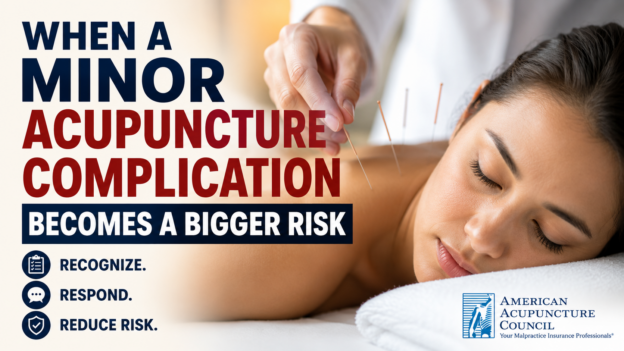
Acupuncture treatment illustrating minor complications and patient safety risk management

Can a Minor Acupuncture Complication Become a Major Problem?

Acupuncture is generally associated with a low rate of serious adverse events, but “minor” does not mean “unimportant.” A small bleed, bruising, dizziness, fainting, or unexpected pain may resolve without lasting harm. However, an event can require additional assessment, affect the patient’s confidence, or become a professional-liability issue if it is not recognized, communicated, documented, or managed appropriately. The goal is not to practice defensively. It is to build a consistent process for patient safety and risk management.

Video: Watch the AAC presentation above. A transcript/download link was not identifiable on the current source page; see the Manual WordPress Tasks below before publication if an original transcript asset exists.

What the evidence says about acupuncture complications

Prospective evidence supports the overall safety of acupuncture while showing that adverse events are not zero. A 2021 systematic review and meta-analysis found at least one adverse event in about 9.31% of patients undergoing an acupuncture series and 7.57% of treatments. The most frequent events were minor, with bleeding, pain, or flare at the needling site accounting for about half of reported events. The review estimated serious adverse events at 7.98 per million treatments, although the authors emphasized substantial heterogeneity in study methods and adverse-event definitions.

A 2024 review likewise concluded that serious acupuncture-related adverse events are rare and identified pneumothorax, nerve injury, heart injury, abdominal-organ injury, infection, and needle breakage among the important serious events reported in the literature. Common minor events included bruising, hematoma, bleeding, dizziness, fainting, tiredness, and residual needling pain.

Case-report literature should be interpreted differently from prospective incidence studies. Case reports can identify rare but important complications, but they cannot establish how frequently those events occur. For example, systematic reviews of case reports have documented pneumothorax and other organ or tissue injuries, reinforcing the importance of anatomy, appropriate needle depth and direction, sterile technique, and clinical vigilance.

When a minor event can become a bigger problem

A minor reaction does not automatically mean negligence or malpractice. The clinical event and the legal question are separate. A patient can experience an expected or recognized adverse reaction even when care was appropriate. Conversely, a seemingly small event can become more consequential when follow-up is missed, warning symptoms are minimized, the patient is not given appropriate instructions, or the record does not accurately describe what occurred.

From a risk-management perspective, the critical transition is often not the initial event but what happens next. Consider a patient who becomes lightheaded after treatment. The immediate response may be straightforward. The risk increases if the episode is not assessed, the patient is allowed to leave before it is appropriate, the event is not documented, or the patient later reports worsening symptoms and cannot understand what happened or whom to contact.

The same principle applies to bleeding, bruising, increased pain, suspected infection, retained or broken needles, or symptoms that could signal a more serious injury. The appropriate response depends on the clinical circumstances and the practitioner’s scope, training, and applicable law.

Five practical risk-management habits

1. Document the treatment. Record the relevant history, examination findings, treatment performed, points or regions treated, patient response, and clinically significant adverse events. AAC emphasizes the importance of accurate patient records because documentation can become important if a complaint or claim later arises.

2. Explain foreseeable reactions. Patients should understand what they may experience after treatment and what symptoms warrant contacting the practice or seeking medical evaluation. Communication should be understandable and consistent with the actual treatment provided.

3. Use informed consent appropriately. AAC advises using a professionally prepared informed-consent process, discussing the form with the patient, answering questions, and noting in the record that the discussion occurred. Requirements vary by state, so practitioners should confirm the rules that apply to their practice.

4. Recognize when referral or escalation is appropriate. Acupuncture practice does not eliminate the need for medical assessment when symptoms fall outside the practitioner’s competence or suggest a potentially serious condition. WHO’s acupuncture benchmarks emphasize stepwise treatment procedures, appropriate infrastructure, and safety practices.

5. Have a plan for complaints and claims. If a patient reports an unexpected injury or threatens a claim, avoid speculation or admissions about legal responsibility. Preserve the clinical record, communicate professionally, and follow the procedures of your professional-liability carrier or legal advisers.

Why prevention and insurance are complementary

Good risk management should come before insurance. Sterile technique, anatomy knowledge, appropriate needle selection and depth, patient screening, informed consent, clear aftercare instructions, accurate documentation, and timely referral all reduce avoidable risk.

Insurance serves a different function. It helps provide financial and legal protection when a claim or other covered proceeding occurs. AAC describes its risk-management and claims service as part of its broader member support, with specialized experience in acupuncture-related professional liability. Coverage terms vary, so practitioners should review the actual policy rather than relying on general statements about insurance.

A practical takeaway for acupuncturists

The safest approach is neither to assume that acupuncture is risk-free nor to treat every adverse event as evidence of malpractice. Instead, treat every unexpected reaction as a clinical communication and documentation opportunity. Assess the patient, respond within your competence and scope, give appropriate follow-up instructions, document what happened, and escalate care when indicated.

That approach protects the patient first. It also creates a clearer record of the care provided if questions arise later. For acupuncture practice owners, a written risk-management process and appropriate professional-liability coverage can provide an additional layer of protection.

Conclusion

Minor acupuncture complications are often transient, but they should never be dismissed. The evidence supports acupuncture as a treatment with relatively uncommon serious adverse events, while also documenting rare but potentially severe complications. For practitioners, the practical lesson is straightforward: use sound clinical technique, communicate foreseeable risks, document care carefully, recognize red flags, and know when referral is necessary. Insurance cannot replace those practices, but appropriate professional-liability coverage can help a practice respond when an unexpected event develops into a complaint or claim.

Learn More from the American Acupuncture Council

Learn more about AAC’s approach to acupuncture risk management, informed consent, and professional-liability protection. Practitioners can review AAC’s risk-management resources and obtain current coverage information directly from the American Acupuncture Council.

References

  1. BMJ Open systematic review and meta-analysis of acupuncture-related adverse events
  2. PubMed: Acupuncture: A Review of the Safety and Adverse Events and the Strategy of Potential Risk Prevention
  3. WHO benchmarks for the practice of acupuncture
  4. PubMed: Adverse events following acupuncture: systematic review of the Chinese literature, 1956–2010
  5. PMC: Adverse Events of Acupuncture: A Systematic Review of Case Reports
  6. ScienceDirect: Pneumothorax associated with acupuncture: A systematic review and analysis

Educational disclaimer: This article is for educational and professional risk-management information only. It is not medical, legal, insurance, or regulatory advice and does not establish a standard of care. Practitioners should follow applicable law, professional standards, scope-of-practice rules, and the terms of their insurance policy, and obtain qualified advice when needed.

Acupuncturist reviewing three questions before buying acupuncture malpractice insurance

3 Questions to Ask Before Buying Acupuncture Malpractice Insurance

3 Questions to Ask Before Buying Acupuncture Malpractice Insurance

Choosing malpractice coverage is about more than finding a low premium. Before buying acupuncture malpractice insurance, ask three practical questions: Does the insurer understand acupuncture, how does the policy respond to claims over time, and what risk-management resources are included? These answers can affect how well the policy fits your practice.

Introduction

Choosing professional liability insurance is a practice-management decision, not simply a price comparison. For acupuncturists, the policy should fit the services you provide, the way your practice is structured, and your plans for changing carriers or eventually retiring. The American Acupuncture Council’s original post highlights three useful questions to ask before purchasing coverage: whether the program has acupuncture-specific experience, whether the policy is occurrence or claims-made, and what risk-management options are available.

Why acupuncture-specific insurance experience matters

A general healthcare policy is not automatically equivalent to coverage designed around acupuncture. Before buying a policy, ask the insurer to explain how it treats the services and modalities you actually provide and whether there are exclusions or underwriting requirements that could affect them.

AAC states that its professional liability program is designed for acupuncture and that coverage can vary according to the practitioner’s scope of practice and the services involved. Its current policy information also describes additional coverage options and a range of liability limits. Those details are reasons to read the actual policy and endorsements rather than relying on a summary or sales quote alone.

Question 1: Does the insurer have experience with acupuncture?

Ask whether the insurer and claims team routinely handle acupuncture professional liability matters. Then ask a more useful follow-up: “What exactly is covered for the services I perform?”

That question is especially important if your practice includes services beyond straightforward needling, such as herbal medicine, cupping, moxibustion, cosmetic or facial acupuncture, injection therapy, or another modality. Coverage depends on the policy language, underwriting, applicable exclusions, and the law and scope of practice where you work.

Question 2: Is the policy occurrence or claims-made?

This is one of the most important technical questions because the policy form determines when coverage can respond. The National Association of Insurance Commissioners explains that claims-made coverage generally responds when a claim is reported while the policy is in force, subject to the policy’s terms and any extended reporting period. Occurrence coverage generally responds based on when the covered event occurred, even if the claim is made after the policy has ended.

With a claims-made policy, ask what happens if you change carriers, stop practicing, or retire. You may need an extended reporting period, commonly called tail coverage, or prior-acts coverage from a new carrier. The exact solution depends on the policy and transition.

AAC’s current FAQ states that its claims-made option converts to occurrence coverage without charge after ten years and that retroactive coverage may be available for practitioners moving from another claims-made policy, subject to underwriting. Because insurance terms can change, practitioners should confirm the current policy wording and transition provisions before relying on those features.

Question 3: What risk-management options are included?

Insurance is only one part of risk management. Ask what resources the insurer provides to help reduce disputes and respond when a complaint develops.

AAC currently offers Preferred and Elite program options. Its FAQ states that the Elite program provides a premium discount when practitioners use approved arbitration and informed-consent forms as part of their intake process. AAC also describes claims and risk-management support for members.

Informed consent should not be treated as a substitute for sound clinical judgment, appropriate documentation, communication, referral, or compliance with state requirements. Likewise, an arbitration agreement may have legal and jurisdiction-specific requirements. Practitioners should use only forms approved for their program and practice and should obtain independent legal advice when appropriate.

What to compare before you buy

Before selecting a policy, compare more than the annual premium. At minimum, review the policy form; per-claim and aggregate limits; covered services and exclusions; defense provisions; prior-acts or retroactive coverage; tail or extended reporting provisions; additional insured and business-entity coverage where applicable; and risk-management resources.

Also ask how a claim or incident should be reported. A policy may impose notice requirements, and failing to follow them can create coverage issues. Keep the policy, endorsements, declarations, and approved forms together with your practice’s insurance records so that your staff can locate them quickly if a problem arises.

Benefits, limitations, and safety considerations

The main benefit of asking these questions is clarity. A policy that looks inexpensive may have a different policy form, exclusions, limits, or transition requirements than another policy. On the other hand, a higher premium does not automatically mean better coverage. The right comparison is between the actual protections and obligations in each policy.

Professional liability insurance also does not replace clinical risk management. Accurate patient histories, examination findings, treatment plans, informed consent, appropriate referrals, and detailed records remain important parts of safe practice. AAC’s guidance on patient records emphasizes documenting the reason for the visit, medications and allergies, clinical findings, diagnosis, treatment plan, and care provided.

Insurance requirements, scope-of-practice rules, arbitration law, and documentation requirements vary by jurisdiction. Practitioners should verify current requirements with the applicable licensing board, insurer, attorney, or other qualified professional.

A practical three-question checklist

Before you buy or renew, ask:

1. Does this insurer have meaningful experience with acupuncture and my specific services?

2. Is the policy occurrence or claims-made, and what happens to coverage for my past work if I change carriers, stop practicing, or retire?

3. What risk-management resources, forms, claims support, and program options are included—and what conditions apply?

Conclusion

The goal is not simply to buy malpractice insurance. It is to understand what you are buying before you need it. For acupuncturists, three questions provide a practical starting point: acupuncture-specific experience, policy form and long-term coverage, and risk-management support.

If you are comparing coverage, review the actual policy documents and ask the insurer to explain anything you do not understand. AAC provides acupuncture-focused professional liability information, coverage options, claims and risk-management resources, and a Quick Quote for practitioners who want to compare their options.

Educational disclaimer

This article is for educational purposes only and does not provide legal, insurance, financial, or clinical advice. Insurance coverage is governed by the actual policy, endorsements, exclusions, and applicable law. State licensing and insurance requirements vary. Consult your insurance professional, attorney, licensing board, or other qualified adviser regarding your specific circumstances.

Related American Acupuncture Council Resources

References

  1. American Acupuncture Council — original article
  2. AAC — Frequently Asked Questions
  3. AAC — AAC Policy
  4. AAC — Coverage Options
  5. AAC — Claims Service & Risk Management
  6. AAC — Importance of Keeping Detailed Patient Records
  7. AAC — The Importance of Patient-Informed Consent
  8. AAC — Acupuncture Malpractice Quick Quote
  9. National Association of Insurance Commissioners — Medical Malpractice Insurance
  10. AMA Insurance — Claims-Made vs. Occurrence Medical Malpractice Insurance
  11. TMLT — Claims-Made vs. Occurrence

Talk With AAC About Your Coverage Options

If you are comparing acupuncture malpractice insurance, AAC can help you review available coverage options and request a Quick Quote. Visit AAC’s Acupuncture Malpractice Quick Quote to begin.

This article is for educational purposes only and does not provide legal, insurance, financial, or clinical advice. Insurance coverage is governed by the actual policy, endorsements, exclusions, and applicable law. State requirements vary.