



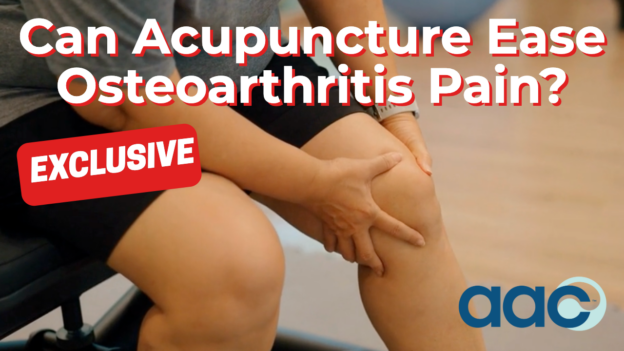
Osteoarthritis pain can limit walking, sleep, work, and everyday independence. For patients seeking nonpharmacologic options, acupuncture may offer modest relief—especially for knee osteoarthritis—when it is used as part of a broader care plan rather than as a replacement for appropriate medical evaluation, exercise, or other indicated treatment.
Can acupuncture ease osteoarthritis pain?
The most defensible answer is: it may help some patients, with the strongest evidence focused on knee osteoarthritis. The National Center for Complementary and Integrative Health states that acupuncture may help relieve osteoarthritis pain and identifies knee pain associated with osteoarthritis among the pain conditions for which acupuncture may be helpful.
The 2019 American College of Rheumatology/Arthritis Foundation guideline conditionally recommends acupuncture for osteoarthritis of the knee, hip, or hand. A conditional recommendation is not the same as a universal endorsement. It means the intervention may be reasonable for selected patients after considering the evidence, patient preferences, accessibility, cost, comorbidities, and alternative options.
Recent reviews continue to report improvements in pain and physical function for knee osteoarthritis, but the magnitude and certainty of benefit vary. Differences in acupuncture technique, treatment dose, comparison groups, trial quality, and the design of sham acupuncture controls make the literature difficult to interpret as a single, uniform body of evidence.
What the evidence means in practice
Acupuncturists should avoid presenting acupuncture as a cure for osteoarthritis or as a treatment that rebuilds cartilage. Osteoarthritis is a chronic joint disorder with structural, mechanical, inflammatory, neurologic, and psychosocial contributors. Symptom improvement does not establish reversal of joint degeneration.
A more accurate patient-facing explanation is that acupuncture may reduce pain and improve function for some people, particularly those with knee osteoarthritis. Response is variable. Some patients notice meaningful changes, while others experience little or no benefit.
Comparisons with sham acupuncture require care. Some studies find small differences between verum and sham acupuncture, while both groups improve compared with baseline or usual care. Sham procedures may not be physiologically inert, and trial context can influence outcomes. These issues do not justify dismissing the evidence, but they do limit strong causal claims about point specificity or mechanism.
Evidence is strongest for the knee
Knee osteoarthritis has been studied more extensively than hip or hand osteoarthritis. Clinicians should not automatically generalize knee findings to every joint. For hip osteoarthritis, hand osteoarthritis, spinal degenerative disease, or mixed pain presentations, the evidence base is more limited or less consistent.
When discussing research, identify the joint studied, the comparator used, the duration of treatment, and whether benefits persisted after treatment ended. This helps patients understand that “acupuncture for arthritis” is not one standardized intervention with one predictable outcome.
Practical implications for acupuncturists
Acupuncture is most appropriately framed as one component of multimodal osteoarthritis management. Depending on the patient, a coordinated plan may include therapeutic exercise, strength training, weight management when relevant, physical therapy, topical or oral medications, bracing, injections, sleep support, behavioral strategies, or surgical consultation.
Before beginning treatment, confirm that the diagnosis is established or that the presentation is suitable for conservative care. Acupuncturists should remain alert to symptoms that require medical assessment, including acute trauma, inability to bear weight, a hot or markedly swollen joint, fever, rapidly progressive symptoms, suspected infection, unexplained weight loss, neurologic deficit, or possible inflammatory arthritis.
Document baseline symptoms and function using repeatable measures. A numerical pain rating alone may miss clinically relevant change. Consider tracking walking tolerance, stair use, sleep interruption, range of motion, sit-to-stand ability, medication use, and validated instruments such as the WOMAC when appropriate to the practice setting.
Set a defined reassessment point rather than recommending open-ended care. The treatment plan should specify frequency, expected time to reassessment, measurable goals, and criteria for modification, referral, or discharge. If meaningful improvement does not occur after a reasonable trial, reconsider the working diagnosis, treatment approach, adherence, comorbid contributors, and need for co-management.
Traditional theory and biomedical interpretation
Traditional Chinese medicine may describe osteoarthritis-related pain through patterns involving Bi syndrome, qi and blood obstruction, cold, dampness, deficiency, or other individualized findings. These are traditional diagnostic frameworks and should not be presented as established biomedical mechanisms.
Biomedical hypotheses include modulation of nociceptive processing, endogenous opioid pathways, autonomic activity, local tissue signaling, and inflammatory mediators. These mechanisms remain areas of active investigation. Mechanistic plausibility is not the same as proof of clinical effectiveness, and animal or laboratory findings should not be used to promise patient outcomes.
Benefits, limitations, and safety
Potential benefits include reduced pain, improved physical function, and support for patients who prefer a nonpharmacologic option or cannot tolerate some medications. Acupuncture may also be integrated with exercise and medical management without requiring the patient to abandon conventional care.
Important limitations include variable treatment response, inconsistent protocols, uncertainty about optimal dose, limited evidence for some joints, and the possibility that observed benefits may be modest. Cost, access, and insurance coverage may also affect whether a trial of care is practical.
Acupuncture is generally considered safe when performed by a qualified practitioner using sterile, single-use needles and appropriate clinical procedures. Common adverse effects include temporary soreness, minor bleeding, bruising, lightheadedness, or fatigue. Serious complications are uncommon but can occur, including infection, nerve injury, or organ puncture associated with improper technique.
Review medications, bleeding risk, pregnancy status, implanted electrical devices when electroacupuncture is considered, immune status, skin integrity, prior joint replacement, and relevant medical conditions. Use informed consent, appropriate clean needle technique, careful positioning, and complete documentation. Coordinate with the patient’s physician or other treating clinician when symptoms change, the diagnosis is uncertain, or the patient is considering changes to prescribed medication.
How to discuss acupuncture with osteoarthritis patients
A balanced explanation can be simple:
“Research suggests acupuncture may reduce pain and improve function for some people with osteoarthritis, especially knee osteoarthritis. The benefit varies, and acupuncture does not reverse joint damage. We will use measurable goals, reassess your response, and coordinate with other care when needed.”
This language supports informed decision-making without minimizing uncertainty. It also avoids guarantees, exaggerated claims, and the implication that acupuncture should replace treatments with stronger evidence for a particular patient.
Conclusion
Acupuncture may be a reasonable adjunct for selected patients with osteoarthritis pain, particularly knee osteoarthritis. The evidence supports cautious optimism—not promises. Acupuncturists can provide higher-value care by using clear outcome measures, realistic treatment trials, appropriate referrals, informed consent, and coordinated management.
Strengthen your risk-management procedures
Clear informed consent, defensible documentation, and appropriate referral decisions are essential when treating chronic musculoskeletal pain. Review the American Acupuncture Council’s informed-consent guidance and risk-management resources for practical support.
References
- National Center for Complementary and Integrative Health. Osteoarthritis: In Depth.
- National Center for Complementary and Integrative Health. Acupuncture: Effectiveness and Safety.
- Kolasinski SL, et al. 2019 American College of Rheumatology/Arthritis Foundation Guideline for the Management of Osteoarthritis of the Hand, Hip, and Knee. Arthritis Care & Research. 2020.
- Liu CY, et al. Clinical effect and contributing factors of acupuncture for knee osteoarthritis: a systematic review and meta-analysis. 2024. PubMed record.
- Wang TQ, et al. Durable effects of acupuncture for knee osteoarthritis: a systematic review and meta-analysis. 2024. PubMed record.
- Lee B, et al. The effect of sham acupuncture can differ depending on the points needled in knee osteoarthritis: a systematic review and network meta-analysis. 2024. PubMed record.
Educational disclaimer: This article is intended for educational purposes for licensed acupuncturists and other healthcare professionals. It does not provide medical or legal advice, establish a standard of care, or replace applicable laws, regulations, professional judgment, patient-specific assessment, or consultation with qualified medical and legal professionals.