
Tag Archives: Evidence-Based Acupuncture

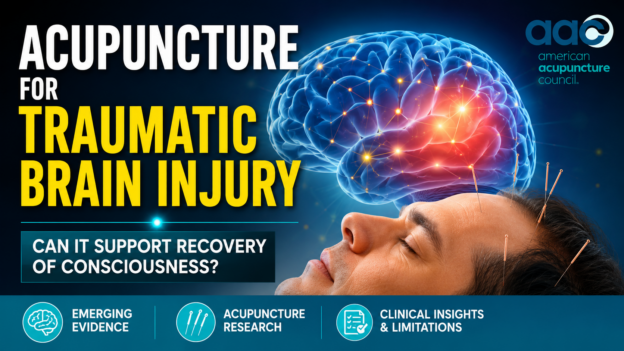
Illustration of the brain representing acupuncture for traumatic brain injury and recovery of consciousness

Acupuncture for Traumatic Brain Injury: Can It Support Recovery of Consciousness?

Acupuncture for Traumatic Brain Injury: Can It Support Recovery of Consciousness?

Traumatic brain injury (TBI) can disrupt consciousness, cognition, movement, communication, behavior, and everyday function. For patients with moderate or severe injury, recovery may be a long rehabilitation process. However, current evidence does not establish acupuncture as a treatment that can “wake up” the brain. Instead, research suggests that acupuncture may have a potential role as an adjunct to conventional medical care and rehabilitation.

What Does the Research Say About Acupuncture for Traumatic Brain Injury?

For context, the AAC presentation highlights a 2023 multi-institutional cohort study that examined recovery of consciousness in adults with acute TBI. The study included 2,163 patients, of whom 237 received acupuncture during the treatment period. In this study, a clinically meaningful improvement was defined as an increase of at least three points on the Glasgow Coma Scale (GCS).

Notably, more patients receiving acupuncture reached that threshold than patients who did not receive acupuncture. Furthermore, after adjustment for measured covariates, acupuncture exposure was associated with greater odds of significant GCS improvement, with an adjusted odds ratio of 2.11 (95% CI 1.31–3.40). Propensity-score matching also favored the acupuncture group.

However, this was a retrospective observational study rather than a randomized clinical trial. The acupuncture group also differed from the comparison group in important ways, including baseline injury severity. Therefore, the association cannot establish that acupuncture caused the observed improvement.

Earlier evidence is encouraging but similarly limited. A 2019 systematic review and meta-analysis included 49 randomized trials involving 3,511 patients with disorders of consciousness after TBI. Overall, pooled analyses favored acupuncture for several outcomes, including GCS, Glasgow Outcome Scale, activities of daily living, and mortality. Nevertheless, the authors also reported substantial concerns about study quality and publication bias. As a result, the size and certainty of the apparent treatment effect remain difficult to determine.

A 2022 Cochrane review reached a more conservative conclusion. It identified only four eligible randomized trials involving 294 participants and found substantial heterogeneity and methodological limitations. Consequently, the review concluded that the evidence was insufficient to make a reliable judgment about acupuncture’s efficacy or safety for acute TBI or TBI rehabilitation.

How Might Acupuncture Fit Into TBI Rehabilitation?

The most defensible clinical position is to view acupuncture as a potential adjunct—not a substitute for emergency treatment, neurological assessment, rehabilitation, or other evidence-based medical care. In other words, acupuncture should be considered within the broader rehabilitation plan rather than as an alternative to established neurological treatment.

In practice, the goals of TBI rehabilitation are broader than consciousness alone. For example, depending on the patient’s injury and stage of recovery, rehabilitation may address cognitive, motor, communication, emotional, behavioral, and functional abilities.

Additionally, there are plausible biological hypotheses for acupuncture’s effects after brain injury. A 2024 systematic review of animal studies identified potential effects involving microglia, astrocytes, neuroinflammation, autophagy, apoptosis, and related cellular pathways. Nevertheless, these findings may only help generate hypotheses. They should not be presented as proven explanations for clinical improvement in people with TBI.

For practitioners, this distinction matters as well. A treatment may be biologically plausible and clinically promising without yet having sufficient evidence to support a strong causal claim. Therefore, the current literature supports continued investigation rather than a claim that acupuncture reliably restores consciousness.

Clinical Priorities for Acupuncturists

  • First, coordinate care with the patient’s medical and rehabilitation team, particularly after moderate or severe TBI.
  • Next, clarify the treatment goal. Consciousness, pain, sleep, mood, mobility, and other post-TBI problems are different clinical targets and require appropriate outcome measures.
  • In addition, document measurable functional outcomes rather than relying only on subjective impressions.
  • Moreover, consider acupuncture an adjunct to, rather than a replacement for, established rehabilitation services.
  • Finally, take the patient’s neurological status, medical stability, medications, and injury history into account when determining whether treatment is appropriate.

Benefits, Limitations, and Safety

Potential Benefits

Importantly, the strongest reason for continued interest is the signal of benefit across several clinical studies, including the 2023 cohort study focused specifically on consciousness. At the same time, these findings need to be interpreted in light of study design and evidence quality.

Acupuncture may also be relevant to symptoms that can accompany TBI. However, evidence for each symptom should be considered separately rather than generalized from studies of recovery of consciousness.

Important Limitations

At present, the evidence base remains heterogeneous. Studies differ in acupuncture methods, treatment schedules, control groups, patient populations, timing after injury, and outcome measures. Because of these differences, results from one study cannot necessarily be applied to every patient with TBI.

Moreover, many trials have methodological weaknesses, and publication bias has been identified. Thus, the available evidence supports continued investigation rather than a definitive claim that acupuncture is an established treatment for disorders of consciousness after TBI.

Safety Considerations

Above all, patients with acute or severe TBI require appropriate medical stabilization and neurological management. Accordingly, acupuncture should never delay emergency evaluation or established treatment.

Before treatment, practitioners should consider bleeding risk, anticoagulant or antiplatelet therapy, infection risk, skin integrity, skull or cervical-spine injuries, positioning needs, altered consciousness, communication limitations, and the patient’s ability to cooperate safely. In addition, practitioners should account for changes in neurological status and any precautions established by the treating team.

When clinical status is complex or changing, coordination with the treating medical and rehabilitation team is appropriate. Ultimately, patient safety and continuity of care should take priority over any complementary treatment goal.

What Should Practitioners Take From the Evidence?

At this point, the answer to “Can acupuncture help wake up the brain after a traumatic brain injury?” is not yet a definitive yes or no. Instead, the current evidence provides a clinically interesting signal, particularly for recovery of consciousness, while leaving important questions unanswered.

More importantly, the evidence does not establish acupuncture as a proven stand-alone treatment for TBI-related disorders of consciousness. Therefore, practitioners should avoid promising restored consciousness or implying that acupuncture can replace neurological or rehabilitation care.

A responsible approach is to use acupuncture within an interdisciplinary rehabilitation plan, define the clinical target, track objective outcomes, and communicate uncertainty honestly. In this way, practitioners can explore the potential value of acupuncture while keeping patient safety and evidence-based neurological care at the center of treatment.

Conclusion

Overall, acupuncture for traumatic brain injury remains an active area of research. Observational and randomized studies suggest potential benefits, but limitations in study quality, heterogeneity, and risk of bias prevent firm conclusions about efficacy. For that reason, the evidence should be viewed as promising but preliminary rather than definitive.

For qualified practitioners, the evidence supports careful adjunctive use and continued research—not promises of restored consciousness. Ultimately, treatment decisions should be individualized, coordinated with appropriate medical and rehabilitation professionals, and guided by measurable clinical outcomes.

Related American Acupuncture Council Resources

For additional AAC education related to neurological practice, see:

Learn More From the American Acupuncture Council

The American Acupuncture Council provides risk-management resources and professional support for licensed acupuncturists. For more information, visit the American Acupuncture Council to learn more about professional resources available to acupuncture practitioners.

References

  1. Lin CC, Chen HY, Tseng CY, Yang CC.
    Effect of Acupuncture on Recovery of Consciousness in Patients with Acute Traumatic Brain Injury: A Multi-Institutional Cohort Study.
    Healthcare. 2023;11(16):2267.
    doi:10.3390/healthcare11162267.
  2. Tan Z, et al.
    Acupuncture to Promote Recovery of Disorder of Consciousness after Traumatic Brain Injury: A Systematic Review and Meta-Analysis.
    Evidence-Based Complementary and Alternative Medicine. 2019;2019:5190515.
    doi:10.1155/2019/5190515.
  3. Wong V, Cheuk DKL, Lee S, Chu V.
    Acupuncture for acute management and rehabilitation of traumatic brain injury.
    Cochrane Database of Systematic Reviews. 2022;3:CD007700.
    doi:10.1002/14651858.CD007700.pub3.
  4. Wu M, Song W, Teng L, et al.
    Exploring the biological basis of acupuncture treatment for traumatic brain injury: a review of evidence from animal models.
    Frontiers in Cellular Neuroscience. 2024;18:1405782.
    doi:10.3389/fncel.2024.1405782.
  5. American Academy of Neurology, American Congress of Rehabilitation Medicine, and National Institute on Disability, Independent Living, and Rehabilitation Research.
    Practice Guideline Update Recommendations: Disorders of Consciousness.
    2018; reaffirmed 2024.
    Guideline page.
  6. Centers for Disease Control and Prevention.
    Recovery from a Moderate or Severe TBI.
    Updated August 6, 2025.
    CDC guidance.

Educational Disclaimer: This article is provided for professional and educational purposes and is not medical advice, a diagnosis, or a substitute for individualized medical evaluation.

Acupuncture practitioners should practice within their scope of licensure and coordinate with appropriate medical and rehabilitation professionals when treating patients with traumatic brain injury. In particular, acupuncture should not delay emergency evaluation or medically indicated treatment.


Acupuncture treatment as part of coordinated primary care

Acupuncture in Primary Care: What the Evidence Supports

Can acupuncture have a place in primary care? For many patients, the most useful answer is not to treat acupuncture as a replacement for conventional medicine, but as a coordinated, evidence-informed option within a broader plan of care.


Watch the video on YouTube

What Does Acupuncture in Primary Care Actually Mean?

Primary care is built around prevention, diagnosis, treatment, continuity, and coordination. Acupuncture can fit into that model when it is used for an appropriate clinical problem and when communication among providers is clear. The goal is not to create a separate system of care. Instead, an acupuncturist can contribute a nonpharmacologic treatment option while the primary care team continues to manage diagnosis, preventive care, medications, referrals, and conditions that require medical evaluation.

This distinction improves patient communication. Rather than promising that acupuncture will treat a disease or replace another treatment, practitioners can explain what the evidence supports, establish measurable goals, and reassess whether treatment is helping.

Where Is the Evidence Strongest?

The strongest primary-care relevance is in chronic pain. The National Center for Complementary and Integrative Health (NCCIH) reports that acupuncture may help with several pain conditions, including back or neck pain and knee pain associated with osteoarthritis. Evidence also supports possible benefit for some headaches and postoperative pain. The size of the benefit varies by condition and comparison group, so these findings should not be generalized to every pain diagnosis.

An influential individual-patient-data meta-analysis combined 39 high-quality randomized trials involving 20,827 patients with chronic musculoskeletal pain, osteoarthritis, headache, or shoulder pain. Acupuncture performed better than both sham acupuncture and no-acupuncture controls. However, the difference from sham was smaller than the difference from no treatment. That is clinically important: the overall treatment effect likely reflects both needling-specific effects and contextual effects of care, rather than supporting the claim that acupuncture is either a miracle treatment or merely a placebo.

A 2025 systematic review of clinical practice guidelines provides a more cautious picture. Across 17 guidelines covering osteoarthritis, low back pain, neck pain, and shoulder pain, 60% of recommendations supported acupuncture, although most were weak or conditional. Other recommendations were neutral or advised against it. Guideline support is therefore meaningful but not uniform.

Beyond Pain: Use Condition-Specific Evidence

Acupuncture has also been studied for symptoms outside musculoskeletal pain. NCCIH notes evidence for treatment-related nausea and vomiting in cancer care, although the relationship to current standard antiemetic treatment remains an important limitation. Evidence for anxiety and general well-being is less definitive. Practitioners should therefore avoid presenting a broad list of conditions as though the evidence is equally strong for all of them.

How Can Acupuncturists Integrate With a Primary Care Team?

Successful integration depends as much on workflow as on clinical evidence. An earlier review of acupuncture in primary care described two practical models: a coordinated referral relationship with a trusted acupuncturist, or acupuncture delivered within a primary care setting by appropriately trained clinicians. More recent implementation research shows that integration is affected by individual, interpersonal, organizational, and policy-level barriers.

For an independent practice, the most practical starting point is a clear referral pathway. The acupuncturist should know when to communicate with the referring clinician, what information to return, and when a patient needs medical reassessment. A concise treatment summary can include the presenting problem, relevant findings, treatment provided, response, and follow-up recommendations.

For an integrated clinic, the 2021 experience of an acupuncture program embedded in a federally qualified health center is instructive. In that observational study, more than 74% of patients receiving acupuncture had a pain diagnosis, and the clinic’s acupuncture program generated revenue that exceeded its costs by 4%. The authors also identified reimbursement as an ongoing challenge. This is a single-site observational study, not proof that every primary-care acupuncture program will be financially viable.

What Should Practitioners Measure?

Integration is easier to evaluate when treatment goals are specific. Outcomes might include pain intensity, physical function, headache frequency, sleep disruption, activity tolerance, medication use, or a validated patient-reported outcome measure.

Set a baseline, agree on what meaningful improvement would look like, and reassess at defined intervals. If the patient is not improving, reconsider the diagnosis, treatment plan, referral needs, or whether continued acupuncture is justified.

Benefits, Limitations, and Safety

Potential Benefits

Acupuncture can provide a nonpharmacologic option for selected conditions, may improve pain or function for some patients, and can be combined with exercise, rehabilitation, medication, and other appropriate care. It may be particularly useful when a patient prefers a non-drug option or needs additional symptom-management strategies.

Limitations

Studies use different acupuncture protocols, treatment doses, comparators, and outcome measures. Sham acupuncture is not necessarily physiologically inert, which complicates interpretation. Average research results also cannot predict an individual patient’s response. Cost, access, reimbursement, and local scope-of-practice rules can further affect implementation.

Safety

Acupuncture is generally considered safe when performed by a qualified practitioner using sterile, single-use needles and appropriate technique. Minor bleeding, bruising, or soreness can occur. Serious complications are uncommon but can include infection, bleeding, nerve injury, and organ injury when treatment is improperly delivered. Patient history should therefore address relevant medications, bleeding risks, pregnancy, immune status, implanted devices when electroacupuncture is considered, and other factors that may change risk.

Acupuncture should not delay evaluation of severe, worsening, unexplained, or potentially urgent symptoms. AAC’s risk-management guidance also emphasizes informed consent, thorough history and examination, treatment rationale, individualized documentation, and appropriate referral when necessary.

What Does This Mean for Practice?

The most defensible position is straightforward: acupuncture can be part of primary care when appropriately selected, safely delivered, and coordinated with the patient’s healthcare. Evidence is strongest for several chronic pain conditions, but it does not support treating acupuncture as a universal therapy or substitute for necessary diagnosis and treatment.

For acupuncturists, that means communicating in clinically useful terms, documenting why care was selected, tracking outcomes, knowing referral thresholds, and making collaboration part of the treatment plan when another clinician manages the underlying condition.

Conclusion

Acupuncture does not have to compete with primary care to contribute to it. For selected patients, particularly those with chronic pain, it can serve as one component of coordinated, patient-centered care. The strongest case for integration is not built on broad claims. Instead, it is built on appropriate patient selection, evidence-informed expectations, measurable outcomes, safe practice, and communication across disciplines.

Protect the Practice Behind the Care

Good clinical care also requires sound risk-management practices. The American Acupuncture Council provides malpractice coverage and practice-support resources for acupuncturists.


Get an AAC Quick Quote

References

  1. National Center for Complementary and Integrative Health.
    Acupuncture: Effectiveness and Safety.
    NCCIH.
  2. Vickers AJ, Vertosick EA, Lewith G, et al.
    Acupuncture for Chronic Pain: Update of an Individual Patient Data Meta-Analysis.
    Journal of Pain. 2018;19(5):455–474.
    PubMed.
  3. Ho L, et al.
    Systematic review of clinical practice guidelines on acupuncture for chronic musculoskeletal pain.
    BMC Complementary Medicine and Therapies. 2025;25:322.
    PubMed.
  4. Zahm A.
    Integrating Acupuncture into Primary Care.
    Journal of Alternative and Complementary Medicine. 2021;27(5):384–389.
    PubMed.
  5. Mao JJ, Kapur R.
    Acupuncture in Primary Care.
    Primary Care: Clinics in Office Practice. 2010;37(1):105–117.
    Full text.
  6. Centers for Medicare & Medicaid Services.
    National Coverage Determination 30.3.3: Acupuncture for Chronic Lower Back Pain.
    CMS.
  7. American Acupuncture Council.
    Proper Patient Records.
    AAC.
  8. American Acupuncture Council.
    Informed Consent.
    AAC.

Educational disclaimer: This article is provided for general professional education and does not constitute medical, legal, regulatory, billing, coding, or insurance advice. Acupuncturists should follow applicable federal and state laws, licensing-board requirements, scope-of-practice rules, professional standards, payer policies, and their own clinical judgment. Patients should seek appropriate medical evaluation for severe, persistent, worsening, or unexplained symptoms.

Acupuncturist inserting a thin needle during treatment for musculoskeletal pain

Can Acupuncture Help Relieve Pain? What the Evidence Shows

Can acupuncture help relieve pain? The most accurate answer is that it may help some patients with certain pain conditions, but the results depend on the diagnosis, treatment context and outcome being measured.

Research is strongest for several chronic musculoskeletal pain conditions, including back or neck pain and knee pain associated with osteoarthritis. Acupuncture should be presented as one possible component of an individualized pain-management plan—not as a guaranteed cure or a replacement for necessary medical evaluation.

The video introduces acupuncture as a long-established practice that involves inserting very thin needles at selected points. It also summarizes the central clinical question: how well does acupuncture fit within modern pain care?

What the Evidence Says About Acupuncture for Pain Relief

The evidence does not support one universal conclusion for every form of pain. Results vary by condition, study design, comparison group, treatment protocol and follow-up period.

The National Center for Complementary and Integrative Health reports that acupuncture may be helpful for several pain conditions, including back or neck pain, knee pain associated with osteoarthritis and postoperative pain. It may also help with joint pain associated with aromatase-inhibitor therapy in people treated for breast cancer.

One influential individual-patient-data meta-analysis evaluated acupuncture for chronic back and neck pain, osteoarthritis, chronic headache and shoulder pain. Its updated analysis found that acupuncture produced better outcomes than both no-acupuncture controls and sham acupuncture, although the difference between acupuncture and sham treatment was smaller than the difference between acupuncture and no treatment.

That distinction matters. It suggests that acupuncture’s overall clinical effect may include both needling-specific effects and contextual effects associated with receiving care, such as patient expectations, therapeutic interaction and nonspecific physiological responses. It does not establish that acupuncture is merely a placebo, nor does it prove that every proposed mechanism is correct.

How Might Acupuncture Influence Pain?

No single mechanism fully explains acupuncture’s effects. Current research suggests that needling may influence sensory processing, peripheral and central nervous-system activity, endogenous pain modulation and other physiological pathways involved in pain perception.

These proposed mechanisms remain areas of active study. Practitioners should avoid presenting an unconfirmed mechanism as settled fact. Traditional East Asian medicine frameworks may appropriately inform clinical assessment and treatment, but biomedical mechanism claims should reflect the strength and limits of contemporary evidence.

Benefits and Limitations of the Evidence

For appropriately selected patients, acupuncture may offer several practical advantages:

  • It provides a nonpharmacologic option within multimodal pain care.
  • It may reduce pain or improve function for some chronic pain conditions.
  • Treatment can be individualized according to patient presentation and clinical response.
  • It may be considered alongside exercise, rehabilitation, medical care and patient self-management.

The evidence also has important limitations. Acupuncture trials differ in point selection, treatment frequency, practitioner technique, duration and control interventions. Sham acupuncture is not necessarily physiologically inert, which complicates interpretation. Average trial results also cannot predict how a specific patient will respond.

Practitioners should therefore discuss acupuncture as a reasonable therapeutic option when supported by the patient’s condition and evidence—not as a certain or permanent solution. Meaningful outcomes may include changes in pain intensity, physical function, sleep, medication use or the ability to perform daily activities. Treatment goals should be established in advance and reassessed over time.

Is Acupuncture Safe?

Acupuncture is generally considered safe when performed by a properly trained practitioner using sterile, single-use needles and appropriate clinical procedures. Minor effects such as temporary soreness, bruising or light bleeding may occur.

Serious adverse events are uncommon, but they are possible. Reported complications include infection, nerve or tissue injury and organ injury associated with improper needling. Risk depends partly on practitioner training, anatomical knowledge, technique, patient health and adherence to infection-control standards.

Before treatment, acupuncturists should obtain an appropriate health history and assess factors that may alter risk, including anticoagulant use, bleeding disorders, pregnancy, immune compromise, implanted electrical devices when electroacupuncture is considered and conditions requiring medical referral.

Acupuncture should not delay evaluation of new, severe or unexplained pain. Progressive neurological deficits, major trauma, chest pain, suspected infection, unexplained weight loss and other warning signs require appropriate referral or emergency care.

Practical Guidance for Acupuncturists

Evidence-based communication begins with realistic expectations. Explain which outcome is being targeted, how progress will be measured and when the treatment plan will be reconsidered.

Good clinical and risk-management practices include:

  • Completing and documenting a relevant history and examination.
  • Recognizing red flags and referring when the presentation falls outside the practitioner’s scope.
  • Obtaining informed consent that addresses expected benefits, alternatives and material risks.
  • Recording the diagnosis or clinical rationale, treatment delivered and patient response.
  • Using sterile, single-use needles and established clean-needle procedures.
  • Reassessing treatment when measurable improvement does not occur.
  • Coordinating with other healthcare professionals when clinically appropriate and authorized by the patient.

Documentation should show why acupuncture was selected, what treatment goals were established and how the patient responded. The American Acupuncture Council’s guidance on proper patient records provides additional risk-management context.

The Bottom Line

Acupuncture can be a reasonable option for pain relief, particularly for selected chronic pain conditions, but the evidence is condition-specific and the magnitude of benefit varies. The strongest patient conversations acknowledge both the potential value and the uncertainty.

Qualified practitioners can support safe, responsible care by setting measurable goals, screening for red flags, documenting clinical decisions and incorporating acupuncture into a broader plan when appropriate.

Strengthen Your Clinical Risk-Management Practices

Clear consent, thorough documentation and appropriate referral decisions protect patients and practices. Explore the American Acupuncture Council’s claims service and risk-management resources.

Explore AAC Risk Management

References

  1. National Center for Complementary and Integrative Health. Acupuncture: Effectiveness and Safety.
  2. National Center for Complementary and Integrative Health. Chronic Pain and Complementary Health Approaches.
  3. Vickers AJ, Vertosick EA, Lewith G, et al. Acupuncture for Chronic Pain: Update of an Individual Patient Data Meta-Analysis. Journal of Pain. 2018;19(5):455–474.
  4. American Acupuncture Council. Acupuncture Research for Chronic Pain.
  5. American Acupuncture Council. Proper Patient Records.

Educational disclaimer: This article is provided for general professional education and does not constitute medical, legal, regulatory, billing or insurance advice. Acupuncturists should follow applicable laws, regulations, licensing-board requirements, professional standards and their own clinical judgment. Patients should seek appropriate medical evaluation for severe, persistent, worsening or unexplained pain.