



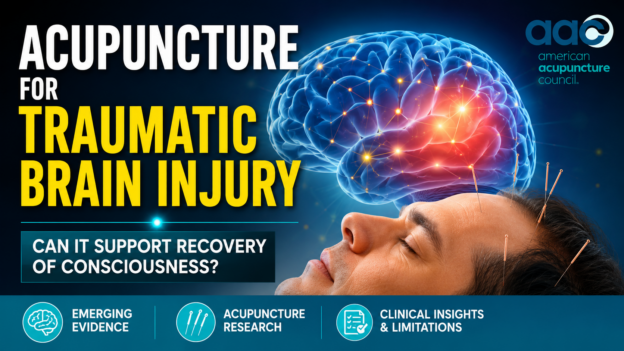
Acupuncture for Traumatic Brain Injury: Can It Support Recovery of Consciousness?
Traumatic brain injury (TBI) can disrupt consciousness, cognition, movement, communication, behavior, and everyday function. For patients with moderate or severe injury, recovery may be a long rehabilitation process. However, current evidence does not establish acupuncture as a treatment that can “wake up” the brain. Instead, research suggests that acupuncture may have a potential role as an adjunct to conventional medical care and rehabilitation.
What Does the Research Say About Acupuncture for Traumatic Brain Injury?
For context, the AAC presentation highlights a 2023 multi-institutional cohort study that examined recovery of consciousness in adults with acute TBI. The study included 2,163 patients, of whom 237 received acupuncture during the treatment period. In this study, a clinically meaningful improvement was defined as an increase of at least three points on the Glasgow Coma Scale (GCS).
Notably, more patients receiving acupuncture reached that threshold than patients who did not receive acupuncture. Furthermore, after adjustment for measured covariates, acupuncture exposure was associated with greater odds of significant GCS improvement, with an adjusted odds ratio of 2.11 (95% CI 1.31–3.40). Propensity-score matching also favored the acupuncture group.
However, this was a retrospective observational study rather than a randomized clinical trial. The acupuncture group also differed from the comparison group in important ways, including baseline injury severity. Therefore, the association cannot establish that acupuncture caused the observed improvement.
Earlier evidence is encouraging but similarly limited. A 2019 systematic review and meta-analysis included 49 randomized trials involving 3,511 patients with disorders of consciousness after TBI. Overall, pooled analyses favored acupuncture for several outcomes, including GCS, Glasgow Outcome Scale, activities of daily living, and mortality. Nevertheless, the authors also reported substantial concerns about study quality and publication bias. As a result, the size and certainty of the apparent treatment effect remain difficult to determine.
A 2022 Cochrane review reached a more conservative conclusion. It identified only four eligible randomized trials involving 294 participants and found substantial heterogeneity and methodological limitations. Consequently, the review concluded that the evidence was insufficient to make a reliable judgment about acupuncture’s efficacy or safety for acute TBI or TBI rehabilitation.
How Might Acupuncture Fit Into TBI Rehabilitation?
The most defensible clinical position is to view acupuncture as a potential adjunct—not a substitute for emergency treatment, neurological assessment, rehabilitation, or other evidence-based medical care. In other words, acupuncture should be considered within the broader rehabilitation plan rather than as an alternative to established neurological treatment.
In practice, the goals of TBI rehabilitation are broader than consciousness alone. For example, depending on the patient’s injury and stage of recovery, rehabilitation may address cognitive, motor, communication, emotional, behavioral, and functional abilities.
Additionally, there are plausible biological hypotheses for acupuncture’s effects after brain injury. A 2024 systematic review of animal studies identified potential effects involving microglia, astrocytes, neuroinflammation, autophagy, apoptosis, and related cellular pathways. Nevertheless, these findings may only help generate hypotheses. They should not be presented as proven explanations for clinical improvement in people with TBI.
For practitioners, this distinction matters as well. A treatment may be biologically plausible and clinically promising without yet having sufficient evidence to support a strong causal claim. Therefore, the current literature supports continued investigation rather than a claim that acupuncture reliably restores consciousness.
Clinical Priorities for Acupuncturists
- First, coordinate care with the patient’s medical and rehabilitation team, particularly after moderate or severe TBI.
- Next, clarify the treatment goal. Consciousness, pain, sleep, mood, mobility, and other post-TBI problems are different clinical targets and require appropriate outcome measures.
- In addition, document measurable functional outcomes rather than relying only on subjective impressions.
- Moreover, consider acupuncture an adjunct to, rather than a replacement for, established rehabilitation services.
- Finally, take the patient’s neurological status, medical stability, medications, and injury history into account when determining whether treatment is appropriate.
Benefits, Limitations, and Safety
Potential Benefits
Importantly, the strongest reason for continued interest is the signal of benefit across several clinical studies, including the 2023 cohort study focused specifically on consciousness. At the same time, these findings need to be interpreted in light of study design and evidence quality.
Acupuncture may also be relevant to symptoms that can accompany TBI. However, evidence for each symptom should be considered separately rather than generalized from studies of recovery of consciousness.
Important Limitations
At present, the evidence base remains heterogeneous. Studies differ in acupuncture methods, treatment schedules, control groups, patient populations, timing after injury, and outcome measures. Because of these differences, results from one study cannot necessarily be applied to every patient with TBI.
Moreover, many trials have methodological weaknesses, and publication bias has been identified. Thus, the available evidence supports continued investigation rather than a definitive claim that acupuncture is an established treatment for disorders of consciousness after TBI.
Safety Considerations
Above all, patients with acute or severe TBI require appropriate medical stabilization and neurological management. Accordingly, acupuncture should never delay emergency evaluation or established treatment.
Before treatment, practitioners should consider bleeding risk, anticoagulant or antiplatelet therapy, infection risk, skin integrity, skull or cervical-spine injuries, positioning needs, altered consciousness, communication limitations, and the patient’s ability to cooperate safely. In addition, practitioners should account for changes in neurological status and any precautions established by the treating team.
When clinical status is complex or changing, coordination with the treating medical and rehabilitation team is appropriate. Ultimately, patient safety and continuity of care should take priority over any complementary treatment goal.
What Should Practitioners Take From the Evidence?
At this point, the answer to “Can acupuncture help wake up the brain after a traumatic brain injury?” is not yet a definitive yes or no. Instead, the current evidence provides a clinically interesting signal, particularly for recovery of consciousness, while leaving important questions unanswered.
More importantly, the evidence does not establish acupuncture as a proven stand-alone treatment for TBI-related disorders of consciousness. Therefore, practitioners should avoid promising restored consciousness or implying that acupuncture can replace neurological or rehabilitation care.
A responsible approach is to use acupuncture within an interdisciplinary rehabilitation plan, define the clinical target, track objective outcomes, and communicate uncertainty honestly. In this way, practitioners can explore the potential value of acupuncture while keeping patient safety and evidence-based neurological care at the center of treatment.
Conclusion
Overall, acupuncture for traumatic brain injury remains an active area of research. Observational and randomized studies suggest potential benefits, but limitations in study quality, heterogeneity, and risk of bias prevent firm conclusions about efficacy. For that reason, the evidence should be viewed as promising but preliminary rather than definitive.
For qualified practitioners, the evidence supports careful adjunctive use and continued research—not promises of restored consciousness. Ultimately, treatment decisions should be individualized, coordinated with appropriate medical and rehabilitation professionals, and guided by measurable clinical outcomes.
Related American Acupuncture Council Resources
For additional AAC education related to neurological practice, see:
- Acupuncture and Traumatic Brain Injury
- Acupuncture and Decreased Stroke Risk in Patients with Traumatic Brain Injury
- Yamamoto New Scalp Acupuncture with David Bomzon
Learn More From the American Acupuncture Council
The American Acupuncture Council provides risk-management resources and professional support for licensed acupuncturists. For more information, visit the American Acupuncture Council to learn more about professional resources available to acupuncture practitioners.
References
- Lin CC, Chen HY, Tseng CY, Yang CC.
Effect of Acupuncture on Recovery of Consciousness in Patients with Acute Traumatic Brain Injury: A Multi-Institutional Cohort Study.
Healthcare. 2023;11(16):2267.
doi:10.3390/healthcare11162267. - Tan Z, et al.
Acupuncture to Promote Recovery of Disorder of Consciousness after Traumatic Brain Injury: A Systematic Review and Meta-Analysis.
Evidence-Based Complementary and Alternative Medicine. 2019;2019:5190515.
doi:10.1155/2019/5190515. - Wong V, Cheuk DKL, Lee S, Chu V.
Acupuncture for acute management and rehabilitation of traumatic brain injury.
Cochrane Database of Systematic Reviews. 2022;3:CD007700.
doi:10.1002/14651858.CD007700.pub3. - Wu M, Song W, Teng L, et al.
Exploring the biological basis of acupuncture treatment for traumatic brain injury: a review of evidence from animal models.
Frontiers in Cellular Neuroscience. 2024;18:1405782.
doi:10.3389/fncel.2024.1405782. - American Academy of Neurology, American Congress of Rehabilitation Medicine, and National Institute on Disability, Independent Living, and Rehabilitation Research.
Practice Guideline Update Recommendations: Disorders of Consciousness.
2018; reaffirmed 2024.
Guideline page. - Centers for Disease Control and Prevention.
Recovery from a Moderate or Severe TBI.
Updated August 6, 2025.
CDC guidance.
Educational Disclaimer: This article is provided for professional and educational purposes and is not medical advice, a diagnosis, or a substitute for individualized medical evaluation.
Acupuncture practitioners should practice within their scope of licensure and coordinate with appropriate medical and rehabilitation professionals when treating patients with traumatic brain injury. In particular, acupuncture should not delay emergency evaluation or medically indicated treatment.