



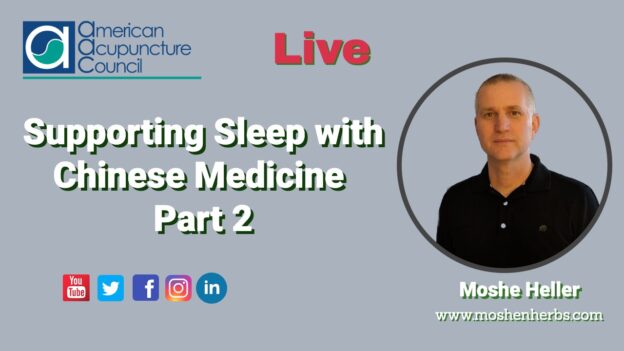
Insomnia can involve difficulty falling asleep, repeated awakenings, waking too early, or sleep that feels unrefreshing. In this American Acupuncture Council presentation, Moshe Heller discusses how practitioners may use traditional Chinese medicine (TCM) pattern differentiation to organize treatment strategies for sleep disturbances. The framework is educational, not a substitute for an individual assessment or evidence-based insomnia care.
Transcript: Read or download the original presentation transcript. AAC notes that the transcript may contain spelling, grammatical, and terminology errors; consult the video when interpreting the presentation.
How TCM pattern differentiation frames insomnia
Heller emphasizes distinguishing the main sleep complaint—difficulty initiating sleep, difficulty maintaining sleep, early waking, or vivid and disturbing dreams—and then assessing the full presentation rather than selecting a formula based on insomnia alone. The patterns below summarize the presentation’s traditional framework. They are TCM diagnostic concepts, not biomedical diagnoses or proof that a specific mechanism causes insomnia.
Heart–kidney disharmony and yin deficiency
In the presentation, frequent awakenings after initially falling asleep are associated with a pattern described as heart–kidney disharmony or yin deficiency with yang rising. Other traditional signs discussed include night sweats, dry mouth, palpitations, anxiety, a red tongue with little coating, and a thin, relatively rapid pulse. Heller identifies Tian Wang Bu Xin Dan as a formula traditionally considered in this pattern and mentions combinations such as Kidney 3, Heart 7, Heart 6, Kidney 7, and Spleen 6.
Heart and liver blood deficiency
Difficulty falling asleep and dream-disturbed sleep are discussed in relation to a traditional blood-deficiency pattern, with possible pallor and a pale tongue. Heller names Suan Zao Ren Tang and discusses Spleen 6 and Heart 7, with Stomach 36 as a possible supporting point in the TCM framework. He also highlights suan zao ren (Ziziphus seed) as an herb traditionally used in sleep formulas.
Heart qi and blood deficiency with unsettled shen
For a presentation involving palpitations, being easily startled, and unsettled sleep, Heller describes Hu Po Yang Xing Dan (also referred to in the talk as amber-nourishing-heart pill). He discusses Heart 7, Pericardium 6, Bladder 15, and sometimes Bladder 20. The talk also mentions children with attention and sleep concerns; this should not be interpreted as evidence that this formula treats ADHD or that it is appropriate for children without a qualified, individualized assessment.
Liver qi constraint with heat or fire
Heller describes a more agitated presentation, with irritability, anger, anxious rumination, and difficulty falling asleep, through the TCM concept of liver qi stagnation that may transform into heat or fire. He identifies Chai Hu Long Gu Mu Li Tang and mentions Liver 3, Gallbladder 34, and Heart 7 as examples of a traditional treatment strategy.
Phlegm or phlegm-heat disturbing the shen
Restless sleep, vivid or repetitive dreams, chest oppression, a sensation of phlegm in the throat, nausea, bitter or sweet taste, a slippery pulse, and a greasy tongue coating are discussed as possible signs within this traditional pattern. Heller mentions Wen Dan Tang and, when heat is prominent, Huang Lian Wen Dan Tang. Point examples include Pericardium 5, Stomach 40, and Heart 8 or Heart 7.
What does current evidence say?
Research on acupuncture and Chinese herbal medicine for insomnia is promising in some analyses, but limitations matter. The U.S. National Center for Complementary and Integrative Health (NCCIH) summarizes a 2021 review of 11 acupuncture studies involving 775 participants that suggested possible improvement, while noting that the studies were small, varied in methods, and generally low quality. NCCIH also reports that evidence reviews of auricular acupuncture have important quality limitations. These findings do not establish acupuncture as a replacement for recommended insomnia treatment.
A 2015 systematic review and meta-analysis of Chinese herbal medicine included 79 trials and 7,886 participants. It reported possible improvements in subjective sleep measures, but substantial heterogeneity and methodological weaknesses limited confidence in the size and generalizability of effects. A later network meta-analysis of Chinese herbal medicines also reported potentially favorable findings, but rankings across trials cannot establish that a particular formula is appropriate for an individual patient or prove superiority in routine practice.
For chronic insomnia in adults, the American Academy of Sleep Medicine strongly recommends multicomponent cognitive behavioral therapy for insomnia (CBT-I). Sleep hygiene can support a broader plan, but guidelines advise against using sleep hygiene alone as treatment for chronic insomnia. Acupuncture or TCM care, when appropriate, should be discussed as complementary care and coordinated with the patient’s medical team.
Clinical application: assessment before formula selection
- Characterize the sleep problem. Ask about onset, awakenings, early waking, duration, daytime impairment, schedule, and the patient’s goals. A sleep diary may help track patterns and response over time.
- Screen for other causes and red flags. Consider sleep apnea, restless legs, pain, mood symptoms, medication or substance effects, shift work, and other medical contributors. Encourage medical evaluation for persistent symptoms, significant daytime impairment, breathing pauses, or other concerning features.
- Use pattern differentiation as a clinical framework, not a shortcut. The patterns and formulas in the video are examples. They should not replace a comprehensive history, examination, individualized diagnosis, or follow-up.
- Coordinate care. Do not advise patients to stop prescribed medication or delay evaluation. Consider referral to a clinician trained in CBT-I for chronic insomnia.
Herbal safety and scope of practice
Chinese herbal formulas can have adverse effects, interact with prescription and nonprescription medicines, and vary in quality and composition. NCCIH warns that some TCM products have been contaminated with toxic compounds, heavy metals, pesticides, or microorganisms, and that substitution or manufacturing errors have caused serious complications. Before recommending or dispensing herbs, review the patient’s medication list, allergies, pregnancy or breastfeeding status, relevant medical conditions, product quality, and applicable scope-of-practice requirements. Use reputable products and appropriate monitoring; consult a pharmacist or other qualified clinician when interaction risks are uncertain.
Acupuncture also requires appropriate training, clean-needle technique, and attention to anatomical safety. Patients should understand expected benefits, uncertainty, alternatives, and the need for medical evaluation when indicated.
Key takeaway
Heller’s presentation offers a traditional pattern-based way to think about sleep complaints and examples of associated formulas and acupuncture points. For contemporary practice, use that framework alongside careful assessment, transparent discussion of evidence limits, herbal safety screening, and coordination with evidence-based insomnia care. Chronic insomnia should not be managed with sleep-hygiene advice or a formula alone when further evaluation or CBT-I is indicated.
Continue learning with AAC
Explore more educational resources from the American Acupuncture Council blog, including Supporting Sleep with Chinese Medicine, Part 1 (confirm the target URL before publication). For information about professional liability coverage, visit the American Acupuncture Council website.
References
- National Center for Complementary and Integrative Health. Mind and Body Practices for Sleep Disorders: What the Science Says.
- National Center for Complementary and Integrative Health. Sleep Disorders and Complementary Health Approaches: Usefulness and Safety.
- Edinger JD, Arnedt JT, Bertisch SM, et al. Behavioral and psychological treatments for chronic insomnia disorder in adults: an American Academy of Sleep Medicine clinical practice guideline. J Clin Sleep Med. 2021;17(2):255–262. Full text.
- Ni X, Shergis JL, Guo X, et al. Updated clinical evidence of Chinese herbal medicine for insomnia: a systematic review and meta-analysis of randomized controlled trials. Sleep Med Rev. 2015. PubMed.
- Chinese herbal medicine for insomnia: a systematic review and network meta-analysis. 2025. PubMed. Interpret comparative rankings cautiously in light of study limitations and clinical context.
Educational disclaimer: This article is for professional education and general information only. It does not provide individual medical advice, establish a diagnosis, or replace appropriate medical assessment and treatment. Clinical decisions must be based on the individual patient, practitioner qualifications, applicable law, current evidence, and professional judgment.