Disclaimer: The following is an actual transcript. We do our best to make sure the transcript is as accurate as possible, however, it may contain spelling or grammatical errors.Due to the unique language of acupuncture, there will be errors, so we suggest you watch the video while reading the transcript.
Hi, my name is Moshe Heller and I’m from Moshen Herbs. I want to thank the American Acupuncture Council for today’s show, and today I’m going to be speaking about supporting the immune system with Chinese medicine in winter. So can we start the slides? Good. This today’s topic will be how can we support the immune system with Chinese medicine in the winter months.
Click here for the best Acupuncture Malpractice Insurance
And I wanted to just note that I, in my office I’ve been seeing a lot of flu patients and this year there’s actually a lot of stomach flu going around in winter, which is usually strange because usually this is a summer flu. But I have been seeing a lot of. Winter flus also.
Just wanted to re remind everybody that as practitioners we always should tell our patients that when they feel that a cold is coming on, when they’re feeling not right, that it is the best time to come for treatment. Rather than not, because a lot of patients might say, oh, it’s just a bit of a cold, so I don’t wanna come in.
Actually this is the best time to give treatment is when things are starting up. I also wanted to remind everybody that there is a link between our immune system, our neurological is system, and our gastrointestinal system. So this connection is what we work on in Chinese medicine in general.
So it’s really important to remember that when we’re talking about an immune system issue, we need to also look at the gastrointestinal system and. Talk about diet and our neurological system, meaning how can we prevent stress and and stay in a more calm state. Also wanted to remind everybody that this.
Idea comes from this concept that in our gastro in our digestive system in Chinese medicine, spleen and stomach are in charge of creating this are way chi are defense chi and our nutritive chi, which are really important to support our immune system. So when we’re looking at.
Supporting the immune system. These are things that we need to take into account. First before we go into treatment of the flu, I wanted to discuss prevention. Because prevention is always the best way to provide support rather than treating the disease itself. The most famous preventative or supporting the immune system formula in Chinese medicine is called Yan.
And Moshen herbs has a variation of that. Which is called shield, and it is, basically an enhanced Yan that helps to boost the immune system and prevent occurrence of colds and flus. Some classical practitioners might also use yin chaan and a low dose as a preventative formula, or the formula.
Shia Huang supporting the xang level. In order to prevent an invasion of a pathogenic influence. The shield is based on, as I said, ying sun. And I combine it with kuang to support or harmonize the ying and the way and therefore support the immune system. We also added a little bit of CIA and Chen p or what is called sometimes too urchin tongue. And that’s to transform dampness because dampness definitely hinders our ability to produce to hinders our immune system. So we wanna stay damp or phlegm free, so too cured. Or urchin tongue is the formula for that.
Finally we added Gogan tongue to harmonize the muscle layer and linger to support the immune system. It’s an adaptogenic m mushroom that really helps with the immune system. Here’s a look at how shield looks like and then. In terms of acupuncture, I, what would correlate to that is points like stomach 36 and CV six.
Supporting the qi. UB 12 is like the back shoe of wind and helps to support that and also UB 13 to support the lung. These are all really important points to use as preventative. And we of course we can use OX on stomach 36 to strengthen the overall chi. Avoiding phlegm producing foods is something that we should recommend to our patients and is also very important.
When we’re treating a pathogenic influence, we need to consider a lot of times where is the pathogen and how do we need to address it. But we can use points like large intestine four and triple burner five, and as well as g gov governing vessel 14 and gallbladder 20. And we can also treat by using cupping and of course.
Supporting the avoiding phlegm producing food not enough to stress that. In terms of formula selections, we have a variety of formulas. Yin chaan is for the start of a wind heat sung to yin in on the contrary use. Is when wind, heat is causing cough. So cough is a big sign for San Ang is when there is a deficiency and the wind cold concurrently and ling.
I usually think of it when we have a sore throat involved because it has herbs that relieve toxicity from the throat. Ing ng tongue is a, is also when cough is involved, but a little more. With some cold, damp in involvement. Defend is a new formula from Moshen herbs that combines yin, chaan and san together and creates.
This general formula for the beginning of the cold, and I added conning tongue here, or curing pill, which many years ago was called curing pill, but now we find it as conning tongue is the formula for a stomach flu. And it works fantastically and it comes in patent and you can find it in Chinese stores or many other distributors of Chinese.
Herbal formulas. This is concludes all the the information I wanted to give you for today, I will still, I wanna thank the American Acupuncture Council again for letting me present this. And I think it’s really important information. And if you want more information about supporting the immune system, please log into the website on the slide.
Click here for the best Acupuncture Malpractice Insurance
Disclaimer: The following is an actual transcript. We do our best to make sure the transcript is as accurate as possible, however, it may contain spelling or grammatical errors. Due to the unique language of acupuncture, there will be errors, so we suggest you watch the video while reading the transcript.
Greetings, friends and colleagues. It’s Sam Collins, the coding and billing expert for acupuncture, the profession, of course, the American Acupuncture Council. Of course, I’ve got a little update coming up because obviously many of you have been contacting me, network members, and even others have contacted me.
Click here for the best Acupuncture Malpractice Insurance
Say, Hey, Sam, what’s going on? I notice. That they’re not paying for exams and they’re also still recouping. We’re gonna talk a little bit about that, but we have to update from what we did in April. So let’s go to the slides. Let’s talk about what’s going on with recoupment and standard episode of care specific to acupuncturist and frankly non-physician providers.
So you’ll see here is a letter dated June 23rd from Tri West, and it says, we received the above claim. Let me bring it so I can pull it up. And it says. Try West. Receive the above-mentioned claim for your often notice I highlighted in yet it says evaluation and management procedure codes are not paid for this rendering provider specialty.
This is the latest thing we’re seeing. It appears, and I’ve seen it absolutely published way that to me would make it more, but it appears they have taken the ability for acupuncturists to be. Separate exams when it comes to the va. That of course is very frustrating because of course is an exam necessary thing.
Of course, I to determine the need for care you to determine the continuation of care. So what’s occurring, I think is maybe A-D-O-G-E cut here that they’re eliminating the payment for exams. That doesn’t mean you don’t need do one, they’re just not. For it. I think it’s probably we’re seeing the patient for the overall payments, but they’re not covering it.
We’ll see directly. Now the word that they did this in ap, what I’ve seen Pub in their newsletter is not quite clear enough for me. So I’m waiting to see the full publishing and episode of care, but I’m sure many of you have met. Now. Here’s gonna be the pushback if the exam after April when they published it.
They’re gonna be damn behind it because published, however. But then I want you all to think of standard episode of Care for Acup Occupy. Whenever you notice the standard episode of care, you’ll notice whether it’s going to be initial chronic follow-ups. They include e and M codes. You’ll see really, 9 9 0 2 to 2 0 5 9 9 2 1 to 2 1 5, and I bet probably your authorization as well.
So my argument’s gonna be, they’re saying they’re not gonna cut well if it’s after April, send an updated authorization’s not listed. I’m waiting to see that, then I would say, okay, but if it’s prior dispute’s gonna be, how did you send me an authorization? Clearly indicates exams and they’re, now, I’m not gonna pay for it now, it appears after April.
This is gonna true. But prior, it’s gonna be a pushback. Now that very frustrating. Of course it is. But I’m gonna ask you, is it worth it to still be part of it? I do, because think of the overall payment on a VA patient. You’re getting 12 visits to start, probably eight and eight to follow up. Assuming you’re doing three sets of acupuncture and a therapy or two, that’s maybe 110 to $150 of reimbursement.
Am I going to take away potentially, three to $4,000 a payment? Because they’re not gonna pay for a couple of exams. I prefer they do, but I’m gonna say I’m not gonna go that far. It’s something I think though we’re gonna be fighting. I shouldn’t say think. I know we’re gonna be fighting as a profession on a national level along with chiropractors and physical therapists, because this affects them too.
Because this goes against the equality provision. Equality says that if it’s within scope and you pay, other providers have to pay you because this is not Medicare. Now that’s gonna be a little bit of a fight, and that’s not gonna happen in short term. So when you get this, I do think we should dispute it.
I would certainly push back if it were pre-AP April, that they should, if it’s after April, not so much. Of course, if you’re a network member with me, reach out. We’ve got some letters for that as well. But I do wanna highlight also beyond that, just a couple of quick updates. Let’s talk about what’s happening and what’s gone on with doing.
Things with 9 7 0 3 9 or 1 3 9, and that’s of course what a lot of offices have used for cupping. Remember that was removed more than a year ago, so please do not use that code for cupping. It is not appropriate. Do not list it. They may pay it, but they’re gonna recoup it. So do not, if you’re gonna do cupping, use 9 7 0 1 6, which is a vaso pneumatic device.
It’s not a high payer. It’s about 11 to $15, but at least you are being paid for it. But again, do not use 9 7 0 3 9 and if they are recouping that, if it’s pre 2024. I would argue they can’t, but if it’s after 2024, they can. Now some people have argued. What about statute of limitations? Statute of limitations, I would argue certainly does apply.
Unfortunately, you know what I’ve realized or what I’ve learned, the statute of limitations for the VA is actually six years, so we’re not gonna win on that one as far as this goes. The other thing here is, and this has come up recently because obviously a lot of you are using paint indexes or similar.
To verify how the patient’s improving. I recently had an office, or actually a few that they were denied few further care because they weren’t showing at least a seven point difference on the general pain index. I really like the general pain index. It’s certainly the similar to the pain interference.
Make sure though, if you’re using it. If you’re doing it once a month, there’s gotta be at least a seven point change to be considered significant. Now, most of you, I hope, are getting bigger than seven point changes, frankly, but if you’re not realize it’s going to be a problem ’cause they’re gonna push back, which means you also have to focus in what if I’m using the pain scale?
That also has a limitation, which means it’s gotta be three points or more. Obviously if I say I’m a seven, I go to a six. That means I’m better, but it’s not considered significant. So if they start at seven, the next time you do it to really be considered significant, say on re-exam, it’s gotta be four.
So a three point difference, I would say. Then obviously those two factors are important. If you’re not getting at least seven or three, you better focus in on something about an activity, particularly a home or work activity that couldn’t do before. What they care about is the patient getting better.
Because remember, once they’re stabilized, they have to be on a continua care with flare up. So keep in mind, Acture works well. We need to demonstrate it. Show me on this general index pain scale or function, how much improvement there is. Now this brings me to, for some of you, and I’ve had this question a lot, is being part of the VA worth it?
Does it cost anything to join? No. Do the patients sometimes have some hassles getting authorization? Yes, that’s true. But when you’re paid. Let’s go over it. If you’re getting a standard episode of care for 12 and eight visits, just say the first two 20 visits in a year, considering just the treatment, that’s probably 2000 to $2,500 now, even with taking out exams.
Is that worth it to me? Absolutely. However, am I frustrated with the exam part not being paid? I. But at the same token, that’s not gonna stop me, but this is where if you’re not part of your state and national association, this is where we need to belong. ’cause this is where we need to push back because how are they treating us differently?
Now the downside is they are doing it to chiropractors. To physical therapists as well as massage therapists. So it’s not just you. But at the same token, I think it’s valid to say that it should be covered. ’cause how are you supposed to determine care without an exam because they’re doing this based on a Medicare rule?
Medicare only sets the fees for the va. It’s not the protocol. ’cause if that were true, they shouldn’t pay for acupuncture at all unless it were chronic low back pain. And under supervision, so we know that they’re just choosing and picking certain ones. So I think we’re gonna have a pretty good pushback.
But I do still, it is worth it if you’re thinking, I’m not so sure. We are doing next month in August. A whole seminar on the va, what to do, how to make it work for you, make sure you tune into that. Otherwise, I’m gonna say to everyone, we always wanna be resource. If you’re having issues, reach out to our Connect Acupuncture council.
The next specifically, we highlight updates right on our website. And if you’re a member, it allows you to have direct interaction with me via calls and zooms. And otherwise, until next time to our friend, be well.
Click here for the best Acupuncture Malpractice Insurance
Is acupuncture effective in reducing postoperative complications in fracture patients?
Bone fracture is a common orthopedic condition that affects millions of people worldwide.
Patients with fractures often have a risk of developing complications, including pain, inflammation, infection, delayed healing, thrombosis, and organ failure.
A study evaluated individuals hospitalized for their first fracture surgery.
Patients who received three or more acupuncture treatments within one week were compared to those who received none and found a significantly higher survival probability in the acupuncture group.
The study concluded acupuncture appeared to have the potential to reduce postoperative complications in bone fracture patients.
Further large-scale studies are needed to provide stronger evidence.
Remember the American Acupuncture Council (AAC) offers an unparalleled track record in acupuncture risk management.
There is a reason acupuncturists have trusted AAC with their business for 50 years.
Not an American Acupuncture Council member? Get a Quick Quote and find out how much you will save! Click here!
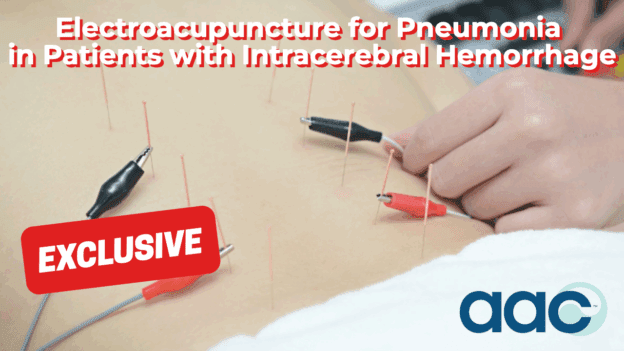
How effective is electroacupuncture for patients with intracerebral hemorrhage?
Pneumonia is a serious postoperative complication of hypertensive intracerebral hemorrhage.
The most common causes of intracerebral hemorrhage are high blood pressure (hypertension) and head trauma.
A study of 80 patients with intracerebral hemorrhage complicated with pneumonia were randomly placed in either the electroacupuncture group (electroacupuncture treatment and routine basic treatment) or the control group (routine basic treatment).
After 14 days of intervention, the patients in the electroacupuncture group showed better symptom and sign scores, including blood oxygen saturation levels, lowered levels of inflammatory factors and white blood cell count, and higher effective rates than those in the control group.
Remember, the American Acupuncture Council (AAC) offers an unparalleled track record in acupuncture risk management.
There is a reason acupuncturists have trusted AAC with their business for 50 years.
Not an American Acupuncture Council member? Get a Quick Quote and find out how much you will save! Click here!
Can acupuncture reduce the symptoms of urinary incontinence?
Urinary incontinence (the loss of bladder control) affects an estimated 25 million adults in the United States, and is more prevalent in women.
Stress incontinence is a type of urinary incontinence that occurs when movement (coughing, laughing, running, etc) puts pressure on the bladder, causing urine to leak.
A study of approximately 500 women with stress incontinence received electroacupuncture treatment (18 sessions over 6 weeks) and had reduced urine leakage.
Approximately two-thirds of the women experienced a 50 percent or greater decrease in urine leakage.
Healthcare continues to evolve toward less-invasive, natural, and drug-free methods, with acupuncture now becoming a first-line complementary healthcare choice.
Remember, the American Acupuncture Council (AAC) offers an unparalleled track record in acupuncture risk management.
There is a reason acupuncturists have trusted AAC with their business for 50 years.
Not an American Acupuncture Council member? Get a Quick Quote and find out how much you will save! Click here!
When we practice, we will start with the Western medical perspective and this lecture we’ll discuss facial anatomy. And then also the morphological changes that occur. The face ages over time.
Disclaimer: The following is an actual transcript. We do our best to make sure the transcript is as accurate as possible, however, it may contain spelling or grammatical errors.Due to the unique language of acupuncture, there will be errors, so we suggest you watch the video while reading the transcript.
Hi, my name is Dr. Shellie Goldstein. I’m an acupuncturist specializing in cosmetic facial acupuncture. And I would like to thank the American Acupuncture Council for allowing me to be here today. It’s always a pleasure. Today’s presentation is the anatomy of facial aging. This is actually very important, particularly for cosmetic facial acupuncturist, because although we are practicing traditional Chinese medicine we always need to take into account the anatomy of the face and the way that it changes over time.
So this is. Presentation is almost the foundation of our sense skills and being able to get great results. When we practice, we will start with the Western medical perspective and this lecture we’ll discuss facial anatomy. And then also the morphological changes that occur. The face ages over time.
And then we will touch on Eastern medicine, acupuncture strategies for treating the aging face. And throughout my series with the AAC, we will break these down into smaller formats and address them individually. But today is just an overall of what you need to do in order to, and know in order to understand other lectures.
When we think about facial aging, from the perspective of Western medicine, we’re really talking about this biological process that happens with the resulting of a gradual reduction and the structural component cell function and the Chinese medicine. We think more in terms of the G and the energy and the organ systems.
Whereas from a Western perspective, we’re really going to look at the anatomical features of the face. And then the morphological changes that we see as the face ages over time. And when we think about a young phase that has a normal volume, nice and full with very well-defined contours along the jaw line and the cheekbones, that type of thing.
And then as we age these regional facial aesthetics, these units that we’re talking about begin to change. And from a Western medical perspective, those changes are mainly due to a number of factors, a reception of the bone fat tissue changes. Muscle attenuation or the changes that occur with the muscles of the face.
And then the skin gets thinner. The skin gets flacid. It develops elastosis and then we have ligaments in our face that we’ll talk about. And as those shift, they also reposition the soft tissue that it attaches to. When we look at the facial planes, we look at them and two different systems.
We look at them horizontally, and then we look at them vertically. So horizontally, we talk about the upper face, which includes the hairline and the upper hairline to the inner campus area at the top of the eyebrow. And the mid face is referred to from the inner campus plane to right below the nose. The
And then the lower face is considered right below the nose to the jaw area. And then we look at them from a vertical center line as well. So we have the very center, the vertical center line, and then moving out to the center of the pupil is the next vertical line. And then the third vertical line is right in front of the ear lobe.
So we’d go from upper to middle to lower upper face, maybe. Lower phase. And then from the center line, moving out to the center of the pupil and then directly in front of me. And these are fairly standard. There are obviously some changes that occur with different types of faces. So say a Caucasian face may have a narrow or nasal base and a larger tip projection that intercampus area widens at when compared to other faces.
Whereas in Eastern Asian face is going to have a very somewhat weaker facial structure framework. It’s a little more. Delicate. It’s a little wider, a little rounder. The eyebrows are a little bit higher. The lips are a little fuller. The nasal, the bridge is a little bit lower. And then the flaring of the nasal Alia or exists more with an Eastern Asian face.
And then the Malheur prominence in the mid face. This Malheur area. Right along here is more prominent. Lips are more protuberant and then the chin is a little more pushback or receipted for a Latino or Hispanic face. Typically the bises a zygomatic distance right in here is a little wider. The maxillary protrusion is a little wider.
The nose is a little wider and then the chin is a little more receded. And then an African-American faces much has a much broader nasal. I decreased nasal projection. The Bilac by maxillary protrusion exists where the orbital is a little more pro per ptosis, a little bit lower. And then the tissue is a little plumper, a little bit softer.
The lips are a little more prominent and there’s an increase in facial convexity. So there are so much changes, although we’re still dividing them up and along the same trajectories, both horizontally and for. When the face ages it moves from when you think of a young face, it has a very wide, upper number, upper face and upper mid face, and a more narrow and pointed lower face.
And when we look at the younger face, what we see is our eye goes directly to the upper portion of the face. So we look at eyes, we’re looking at a very high cheap, but when we look at a nice wide area and the upper face and the upper mid face, and then as we age, it moves, the weight of the face actually moves.
It drops. LA drops and then turn becomes more medial. So that in this case, as with the aging face, the weight of the face actually moves down. We start to lose, you can see along here, we lose the definition along the dry area. And the weight of the face moves from say upper and outer. So it up and wide to more medially, and.
This creates a lot of changes in the face. Then what are going to look at that right now? We know we have bone and then above the bone, we have soft tissue and in order to really get effective treatment results, we really need to understand the relationship between Eastern medicine. And the biomedical anatomy with regard to the morphological or the psychodynamic facial changes that were time.
So let’s break these down and let’s look at them as they exist from bottom to top. So deep search deep to the surface. We have bone, the basic structure of our face that holds the shape of our. On top of bone, we have muscle on top of muscle. We have fat and then superficially, we have skin. So let’s look at them.
Let’s look at what happens with bone first as we age bone resorbs, which means that it starts to break down and it breaks down from the openings that exist. So for example, the eyes get a little bit wider. The eye socket gets wider. And we’re looking at this boat. This is a CT image of two females. This one on the left.
She’s between 20 and 40. This is someone who is over 65 on the right. And you can see, and the earlier one you can see a nice squared face, open eyes. Here’s the nasal bone and it’s nice and thick and foam. And look what happens over time. The openings start to open up and get white. The F as the face itself starts to get smaller.
So the openings get wider. The skull itself starts to shrink. So it gets smaller. You can actually see it starting to push down. When the skull starts to push down, what happens? You lose the form. So the mid area, the maxillary area get shorter. The mandibular bone, the mandibular area starts to break down too.
It starts to push forward to, you can actually see this rotation, this inward medial rotation of bone that you see changes in dentation. And so we see the height of the face starts to decrease the eye socket, start to expand. You get temporal hollowing. Here’s the temple there starts to break down and get hollow.
And the piriform, this is the nasal pyriform. This is the openings that we were talking about. The nasal pyriform gets wider and we get the resorbtion of the breakdown of the mandible read in here, along the base, the maxilla on the top. And then this causes changes in your teeth, changes of indentation.
It starts to push for. And then the entire face starts to rotate and protrude. And this is what it looks like. What we begin to see as eye sockets, start to increase the nasal pyriform starts to widen the mandible. And here starts to shorten the mandibular length starts to break, to lengthen and shorten as well.
The nose starts to change and the maxillary area right in here, this angle starts to get change. You start to see changes in the height of everything which pushes the teeth. When that happens, this is what so the darker areas is where the bone is starting to break down. What happens to all of the soft tissue on top.
All of that tissue starts to, it has it’s losing its support. It’s losing its underlying foundation. So in even in a healthy tissue, it’s going to start to stag. It doesn’t have the foundation anymore. So it starts to sag and drop and move medially. As we saw. On top of bone, we have muscles. Now the faces unique, the face has two site types of muscles.
It has superficial muscles and it has deeper. The deeper muscles generally attached, like on the body from bone to bone, our bone to muscle and the deeper muscles in the face are primarily located in the mid face, this mid area. And they’re designed to move bone and it’s attachment. So primarily what we’re talking about.
Is the mandible. The mandible is the only loose bone on the body. Everything else is connected. And so the main purpose of the deep muscle muscles of the face is actually to move bone. And it’s primarily for chewing for moving the mandible back and forth and for chewing. Now the muscles on the superficial muscles are a little different.
We call them the muscles of expression are medic muscles memetic, and these muscles are different than the rest of the muscles on the face and the deep muscle the deep muscles of the face and on the body, them a medic muscles are designed to move other muscles and move the skin. So rather than moving both.
Or bony attachments, they’re going to move muscles and they’re going to move school. They’re very flat and you can see them in this cadaver. There here’s a medic muscle right here. There’s one around the eyes. There’s one here in the cheek area. Here’s one right here and then around the mouth and then the participant muscle along the neck and with age rather than atrophy, they attenuate.
So what does that mean? We think of muscles atrophying over time. And it’s mainly from lack of use, but when you think about the muscles of their face, We use them all the time. We use them with our expressions. We use them when we talk, we are eyes they’re opening and closing all the time. We are constantly using the muscles of our face.
So they don’t they don’t really atrophy. They attenuate. And when we see a tango what that means is they get short. So they move, they reduce in their amplitude of movement and they get stiff and straight. And instead of being nice and flexible and moist and resilient, they start to straighten, they start to stiffen, they get stuck or they reduce an amplitude, so they don’t move as well.
And that limited amplitude of these mimetic muscles leads to a more permanent or more contrasting. Position. Whereas we, if you look in an aging person and it looks like their muscles are frozen, they aren’t moving, they aren’t moving back and forth or contracting and relaxing. They’re stuck in their position.
And when these muscles get thinner and tighter and stiffer or straighter the skin on top of them starts to crease our we start developing a facial asymmetry and when we get wrinkles. So a lot of this is combining the changes in structure and the bone plus the changes or the attenuation of the mimetic muscles of the face.
And then we see systemic changes in the integumentary system. The integumentary system is made up of three layers. It’s made up the subcutaneous or the fat layer it’s made up of the dermis, the mid layer. And it’s made up of the epidermis, which is the very surface area of our standards. What we see when we look in the mirror or when we’re looking at.
Let’s start in the deeper layer in the subcutaneous or that fat layer. We have two layers on the body, the face we have the deeper layer and we have a more superficial layer and they look different. You hear in this cadaver, we can see on the on the surface of the the left side, this is the, it’s a little lighter yellow color, and it sits on the surface.
Whereas the deep fat is a little darker in color and it’s deeper underneath the surface of this. Regardless see that as we look at the phase and as we look at the fat in our face, the fat is what provides the structure or the plumping plumpness of. Some people have more than others, as you can see. I don’t have a lie.
But they’re all of these fat pads, we think of them as being all across the face in a uniform position. But in fact, that’s not the case. They are actually separated by ligand implements. So they’re partitioned in sex, sectioned off and held into place with ligaments. As we age changes occur.
And those, the fat we call it descent and deflate, which means that it moves as it breaks down. It starts to lose its form. It lose its integrity and then it moves. And oftentimes it moves under the eye socket. And in this fold between the nose and the corner of the mouth, it’s called the nasal labial fold.
And we see as people get older, This area begins to thick, and it’s not a wrinkle it’s actually partially due to the movement of the tissue and the muscles immediately towards the nasal labial fold. But it can also be due to fat right in here that is moving from the center of the face, into that area.
And it’s also due to just simple loss of fat in the mid-face area, so that we see a flattening or a deflating. In the mid-face area, but then we also have the illusion of being thicker in the nasal Lavia. Also what we see as changes in the upper area, the forehead, the periorbital area, the temporal area.
We start to see a breakdown of fat into this area. And then some of this also lands along the jaw. And that is partially what happens when we start to lose our jaw area are the cut that we see in our general area. We may think that it’s all skin that is starting to fall down. And in fact, some of that may be due to fat, build up along this jaw area that creates that asymmetry from side to side, but also that loss of definition in the jaw area.
On top of the fat layer or the adipose tissue of the deeper areas. We see the dermal layer. The dermal is right here in the middle. And then on top of that is the. And the dermal area is where the health of the cells develop cells begin their growth cycle at the base of the dermal area. And they begin to float up their base.
Then this nutrient of hyaluronic acid and fluid proteins, vitamins, everything that we need in order to create healthy cells occurs on the German. And floats up to the top, moves up to the dermal layer, the epidermal layer, and then spreads off. So not only do we have a number of nutrients and bathing solutions in this dermis, but we also have our our rector Pillai muscles, their muscles that we feel when we get the chills and our, and the hair starts to stand up on our.
I sweat glands, a number of sebaceous oil glands, a number of different vital substances are in the dermal area out of this. It’s composed of a papillary layer, which is a loose meshwork of thin connective tissue. And then the deeper area is the thicker layer of connective tissue. And if you look in this side image, this is connective tissue.
We’ll go into this a little more deeply, but it’s a very loose matrix, a loose structure, whereas the lower areas a little bit. And then on top of that area is the epidermis. The remembering the epidermis is that theory surface layer of the skin it’s made up of a number of different layers, seven different layers.
On the very top are dead cells. They’re filled with keratin. It’s what we slough off and we fully ate our skin. And then as we move deeper to the dermal layer, the cells are a little bit healthier. They’re a little bit plumper. They’re a little thicker. They have a little more, most moisture in them. And then as they move through the dermal cells, move through the dermal layer into the epidermis.
They start to thin out, they start to flatten. They lose their moisture. And then at the very surface is the dead keratin cells. As we age a number of things happen, one is the health of the cells that are floating up from the dermal layer up to the surface, the cell health and the dermal layer starts to change.
We start to lose the water content. They start to be a little thinner, a little drier. So they’re not as healthy as they move up to the surface. Also the structure of the dermis. Remember we spoke about that connective tissue starts to lose its integrity. Collagen and elastin are the main components that hold up the integrity of the dermal layer.
When that starts to become disorganized and break down, we actually lose the integrity of that entire dermal layer. Think of a mattress that’s thick, and as we lie on it over and over, it gets a little bit thinner and. Like we lose the integrity of our mattress. Over time, we lose the integrity of that dermal layer and then cells on the top are thinner.
They are dryer though, less subtle, they’re less plump and the entire area sinks. So here’s the mattress, here’s the sinking of the skin and the mattress. And it looks like their wrinkles been. In fact, it’s just loss of college and loss of integrity and skin aging on the surfaces. Remember that connect that.
In that connective tissue. So connective tissue is throughout fascia is a type of connective tissue and it is the most abundant form of collagen fibers in, in, in the tissue of the skin. There’s fascia on the face, which attaches to the bone, the lining of the one, the periosteum, and it encapsulates and protects the muscles and the deeper layers of.
Tissue. And then there’s a superficial and that superficial, it’s like a thin layer of say sticky film or saran wrap. So it’s a little sticky and it attaches to the muscles and then the muscles attached to the skin. And every time a muscle moves, it causes the skin to move. And that’s how we get our expressions.
And then. All of these are in a horizontal plane and then running in a perpendicular plane are our retaining ligaments. There are a number of different retaining ligaments in the face. Remember they surround and encapsulate fat, but they also are like little plugs. They hold all of the loose tissue.
That’s running in a horizontal plane. They hold it all together. So what happens as they age? They start to attenuate as well. They start to dry out. They start to thicker, they lose their integrity. And as all of the horizontal tissue starts to shift, starts to dry out. Remember turn more immediately the these re retaining ligaments start to move as well.
So again, everything moves medially, and again, we start to lose our Mallory projection, and this is what we. If you look at this is on this end on the, to the left is aging as a young face from the frontal and then side view. As we age, we can start to see shortening in the far ahead, we start to lose or flattening in the mid phase and then loss of definition along the jawline, as you can see.
So let’s look at this. So here is a younger face. Nice to see the height up here. Eyes wide, open forehead. Nice and relaxed. Now look, this is what happens as we start to age, remember everything starts to drop down, move more, more immediately. We develop that nasal labial foam. We develop a long here, the repositioning of fat loss of structure.
Everything starts to fall and then loses it. Here we see this side is a younger face. B is the older face. Can you see how the mid face starts to flatten? We start to see a deeper nasal labial fold. We start to see loss of collagen and elastin, particularly in around the mouth and loss of definition along the job.
I hear it as a. Here’s a younger face. Hirsi is the older face deepening and the nasal labial fold loss of definition. The jaw line, the corners of the mouth start to turn down. This is another conversation about muscles and the effect that muscles have on the phase. Particularly the mimetic muscles.
And then in terms of treatment, how are we going to treat this? We see this changes starting to happen. We see the the changes that are starting to occur. Some that you can change. You can’t really change bone loss. These the, that have already lost some bone. It’s very hard to change, but we can make a.
And we can do that with our acupuncture treatments. So in the link shoe, there are a numerous discussions about needling guidelines specific to the layers of the face, the skin, the flesh between the areas between that flesh and the channels and around the muscles at the local level. In the link shoe, they talk about the skin, the flesh, the muscles, the tendons, and meridians all occupied different places in the body and that different diseases respond to different methods.
And when we talk about diseases in this case, what we’re talking about is. And if illness are aging is superficial, the different needling that we do, it will penetrate and injure the good flesh. If we do not treat it at the superficial layer or we miss it, then we’re not going to get the right results.
So when we treat what we’re treating, as we talk about the superficial layers, we’re talking about the epidermis and the dermis. So when we’re actually treating them, we have to angle the needle in a way that we’re actually treating the epidermis and the dermis. So we’re actually aligning that. Very flat.
When we talk about angle of insertion, what we’re talking about is relative to the skin surface. So we would lay that needle right at the surface of the skin, and we say five to 15 degrees and we can treat the superficial wrinkles. We can treat skin atrophy. Pain. There are a lot of pain receptors in the dermal layer of the skin.
And so we can actually help treat pain by laying that needle in a very superficial layer. We can use it with intradermals. A Japanese style of acupuncture is very good for addressing for our purposes. Introducing. Japanese acupuncture to treat the epidermal and dermal layer of the skin. If we want to move a little bit deeper into the hypodermis or the fat layer, we’re going to angle it a little bit deeper, not much because remembering if you actually place your hand on the surface of your skin, if you push a little bit, you’re already at the bone.
So it’s very superficial, very shallow. So we’re going to angle the needle at a 15 to 20 degree angle. We use it for skin atrophy for any type of fat atrophy or deflating. It’s really good for prevention. For aging on the deeper channels at the muscle. If we want to address the muscle layer, we’re going to name and go that needle on a 45 to 60 degree angle.
Really good for treating muscle attenuation trumps. Muscle trauma or prevention. And then for the bone, we’re going to go right or into treating the meridians. We’re going to go at the angle of the bone, which are the more 90 degree angle. So that’s also great for prevention, any Meridian problem or trauma to the face.
So here’s an example. This is a different protocol or a protocol. This is just an example of how we might use and to the muscles in the neck area at a 45 degree angle. If we’re going to treat the meridians, we might go right into the acupuncture points on the face, a shallow noodling into wrinkles and the, into the dermis and the epidermis treating the muscles, the corrugator muscle.
You can see this deep corgi. Fold, and then 90 degrees into the meridians. And this would be a before and after picture of what you can expect to see, say, and this is a 10 treatment series. So that’s it for today. There again, I have a number of different lectures for you where we take a deeper dive into the individual.
So thank you very much. Again, thank you to the AAC for allowing me to present today. Stay tuned next week for Sam Collins. He’ll be presenting next Wednesday. He’s always exciting. Very interesting to listen to. And see you again. Thank you.
This website uses cookies to improve your experience. We'll assume you're ok with this, but you can opt-out if you wish. Cookie settingsI ACCEPT
Privacy & Cookies Policy
Privacy Overview
This website uses cookies to improve your experience while you navigate through the website. Out of these cookies, the cookies that are categorized as necessary are stored on your browser as they are essential for the working of basic functionalities of the website. We also use third-party cookies that help us analyze and understand how you use this website. These cookies will be stored in your browser only with your consent. You also have the option to opt-out of these cookies. But opting out of some of these cookies may have an effect on your browsing experience.
Necessary cookies are absolutely essential for the website to function properly. This category only includes cookies that ensures basic functionalities and security features of the website. These cookies do not store any personal information.
Any cookies that may not be particularly necessary for the website to function and is used specifically to collect user personal data via analytics, ads, other embedded contents are termed as non-necessary cookies. It is mandatory to procure user consent prior to running these cookies on your website.