Why do acupuncturists need acupuncture liability insurance?
One of the top reasons acupuncturists need acupuncture liability insurance is protection from malpractice claims.
Malpractice claims against acupuncturists are significantly lower than for other healthcare providers.
However, even when no error is committed, an acupuncturist is still vulnerable to patients who claim malpractice because of the following: improper needle insertion, failure to sterilize needles, and ignoring contraindications.
With acupuncture liability insurance, acupuncturists can have the protection to cover any legal expenses if malpractice claims reach a court battle.
Remember, the American Acupuncture Council (AAC) offers an unparalleled track record in acupuncture risk management.
There is a reason acupuncturists have trusted AAC with their business for 50 years.
Not an American Acupuncture Council member? Get a Quick Quote and find out how much you will save! Click here!
Disclaimer: The following is an actual transcript. We do our best to make sure the transcript is as accurate as possible, however, it may contain spelling or grammatical errors.Due to the unique language of acupuncture, there will be errors, so we suggest you watch the video while reading the transcript.
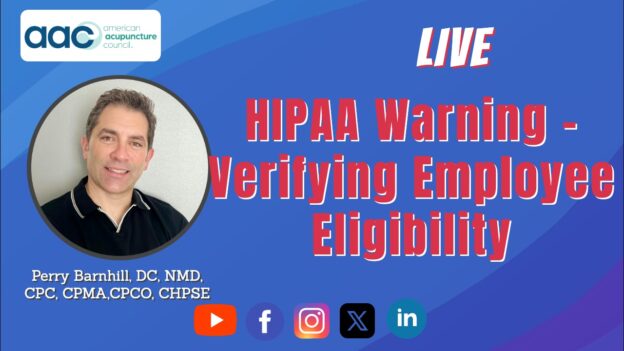
Hi everybody. This is Perry Barnhill with the Fearless Acupuncturist. Today we are gonna talk about OIG and an exclusion list and what it means to you and why you need to be aware of it. Wanna give a big thanks to the American Acupuncture Council? Go to slideshow please.
Click here for the best Acupuncture Malpractice Insurance
Okay, here we go. Understanding and using the OIG exclusion list. This is about performing certain exclusion checks. On your staff regarding the Office of Inspector General. Let’s talk about that. This is something that we want to check every single month. Now put it in perspective here for you.
We got Health and Human Services at the top, HHS, you’ve heard of that. And then we have OIG, the Office of Inspector General. Now they’re very closely related to the OCR, which is the Office of Civil Rights, and this is where all the HIPAA stuff comes in. These two are basically sisters to each other, and they’re so important that you need to be aware of.
That’s why we’re talking about this right now. What is the OIG exclusion list and why do we need to check it? Okay, so here’s what it is. The exclusion list is a list of individuals that the government collects that basically shouldn’t be employed in your office. If you’re accepting any federally funded programs such as Medicare, for example, or even if you’re in some acupuncture networks for P-P-O-H-M-O or insurance networks.
Now, if they’re on this list. Is something we need to be aware because we may not keep them employed. This is something we want to ensure compliance with Medicare, Medicaid, like I said, certain contract requirements by regularly verifying employees. Who do we need to check? Okay, now everybody that we need to check is pretty much anybody in our office that’s involved in any kind of patient care or has any kind of access to protected health information.
So you got your staff that’s involved with your patient care. Any employees handling any kind of billing procedures or protocols, personnel. Anybody who has access to protective health information, I’m not talking about a janitorial service or a cleaning service. Those folks though, if you don’t know already, they need or you need to have them fill out certain forms such as non-disclosure statements and agreements.
Because even janitors that come into our office may accidentally see protected health information. And that’s something just on a side note that you need to be aware of and you should have protected and you should be speaking to them about. The Medicare exclusion list. This is a list of an OIG website that I want you all to go to.
Here it is exclusion dotig.hhs.gov. You need to go here, and this is where you need to start doing some check-in. Go in there and enter your employee’s last name and first name, and if you need to, because some people have similar names or same names, use additional details such as their date of birth. If you have other providers in the office, you need to check on them as well to narrow the results.
So how do we interpret these results if their name actually pops up? The good news is if it doesn’t pop up, they’re good to go. You don’t need to worry about it, but if one of your employees or your personnel’s name pop up, make sure you click to verify and redo, review additional details again to make sure it’s not the same person that you have in your office.
So you can enter date of birth NPI numbers if they’re providers for confirmation. And believe it or not, there’s another exclusion list that I want you to check. Even though I’m talking about this and there seems like it’s overwhelming, at least a little bit. It’s easy. It’s very fast. You literally go to those websites, you check in their names.
It pops up very fast, and their name’s either on there or it’s not on there. I. The other one is the SAM exclusion list. This is the next website you want to go to and just double check and make sure nobody in your office is on this list. sam.gov. Just go there. Check how to search is very similar.
You use the entity verification search function and again, you enter the information of the employee’s name or any personnel that you have in your office to make sure they’re not on that list. Some verification tips. Provide as much identifying information as possible. Again, to make sure maybe you got two people with the same name, confirm the details and make sure that they match.
The last thing I want y’all to check is your state-based exclusion checklist. So we got the government, we got the SAM list and then also double check any kind of exclusion list. And again, just to reiterate this, if you accepting any federally funded programs, you have to make sure that none of your employees or anybody in your office is on this list or even other providers.
’cause if they’re on this list and you hire them and they’re employed and they find out. You can get in some big trouble and the fines are pretty steep. So again, where to check for state specific list? Use your state specific portal. Alrighty, and make sure that they’re not on that list as well. How to search?
Very similar. Locate the sections for OAG provider sanctions and you enter your employee’s name and other identifying details if needed and if possible, reviewing the information. Check details again to ensure that it matches the individual. Again, making sure it’s not the person in your office. Maybe they got a same name, and I know I said that a thousand times, but just double check.
Note any active sanctions or exclusions relative to state Medicaid programs. Here’s some best practices for verification. Always verify with multiple data points for the reasons we’ve just talked about. Cross-reference your results. Check the OIG, the Sam and State Base to confirm accuracy and just as important, make sure you document everything as if it’s not documented, they will say, you never ever did it. So make sure you do that and make sure you do it monthly. The importance of regular exclusion lists, compliance meets Medicare, Medicaid, and also many insurance contracts. You have to make sure they’re on this list. Risk management helps prevent potential fraud and abuse.
’cause if those folks are on this list, it’s likely they have some kind, they’ve been convicted of some kind of criminal action, and there’s something going on that you definitely may not want them in your office. All right? Quality insurance ensures that other qualified personnel have access to sensitive patient care and information.
So you gotta be safe there. You gotta protect that information. So here’s some next steps. Just to recap, use OIG website and Medicare exclusion list checks to make sure they’re not on the list. The SAM exclusion list. And also check your state. Record this in your manual. Make sure you record it in your manual.
’cause again, like I said, if it’s not checked, it’s not done and you need to do it monthly. It doesn’t take long. So just make sure you get in there and you get that done. Additional resources, I’ve went over these, but here’s a screen just to check again, different spots you can check. If you don’t know if you’re HIPAA compliant, the likelihood is that you’re probably not.
Many providers may have a form or two in the office, and they think that means that they’re HIPAA compliant. So this is why we came up with the checklist here. Go over this checklist. Look at the boxes here. If you’re not checking every box, the likelihood is very high. Likelihood is that you’re not HIPAA compliant.
Make sure you do so because the fines associated with any HIPAA noncompliance are very scary. You can scan the QR code as well. If you want to schedule a demo, you can go to fearless provider.com right here as you see, and we can go over a demo with you, show you how the program looks, what exactly it looks like on the inside, how to navigate it, how to have your staff navigate if you choose not to.
If you wanna just get started, you can go to fearless acupuncturist.com. You can get started that way as well. If you want to contact me. If you wanna reach out to me ’cause you have questions or concerns or anything like that, please feel free to do i’m more than happy to jump on the phone and jump on the site, go over a demo with you and answer any questions that you may have.
You can contact me at Dr. perry@betterhipaablueprint.com. Also, you can scan the QR code here as well. If you got questions, reach out to me please. I am more than happy to help any and all of you. In the meantime, everybody, have an amazing day and we will talk to you soon.
Click here for the best Acupuncture Malpractice Insurance
Disclaimer: The following is an actual transcript. We do our best to make sure the transcript is as accurate as possible, however, it may contain spelling or grammatical errors.Due to the unique language of acupuncture, there will be errors, so we suggest you watch the video while reading the transcript.
Click here for the best Acupuncture Malpractice Insurance
Disclaimer: The following is an actual transcript. We do our best to make sure the transcript is as accurate as possible, however, it may contain spelling or grammatical errors. Due to the unique language of acupuncture, there will be errors, so we suggest you watch the video while reading the transcript.
Hey friends, it’s Sam Collins, your coding and billing expert for acupuncture. You of course, as the profession, the American Acupuncture Council, the network, all of that. We’re here to always support you and help you. And one of the things we’ve had some issues coming up is what about audits? Now that many of you are billing more, you might think, uhoh, I’m gonna be audited.
Click here for the best Acupuncture Malpractice Insurance
First thing I’ll tell you is generally you’re not gonna be audited. Very few offices get audited, but we want to talk about when you do what to be prepared for, what do you wanna do preemptively? I don’t want to be reactive, let’s be proactive. So let’s talk about what to do. And particularly if you’re insured with the American Acupuncture Council, they’re really gonna help you.
So let’s go to the slides. Let’s talk about what do you do if you are audited? You’re gonna get that dreaded letter, you’re gonna get it and you’re gonna feel this overwhelming sense of dread. The first thing I’ll tell you, do not panic. You are a good provider. [00:01:00] You’re there offering your best practice of services.
You’re being helpful. Realize that as soon as someone audits you, I’m also upset like, how dare you think? Because what are they looking for in an audit? You often think of, oh, did I do something wrong? You’ve done nothing wrong. Not at all. It just means maybe they wanna look. Sometimes it’s you’re just lucky or unlucky.
’cause they’re gonna look, there’s a certain amount of government oversight that requires that to make sure that services that are being paid are provided. So do not panic. Read it carefully. The requests, what are they looking for? What type of claim is it? Is it personal injury? Is it insurance? Just what type of claim?
That can tell you a little bit, but also take a look at what data they’re requesting. Sometimes they’re just looking at data to make sure that the services were provided. Think of it, if you’ve never dealt with a VA patient in a weird way, they audit everything you do because they require you send chart notes.
You know what they’re looking for in the chart notes. Honestly, just making sure you did the services. They’re not there looking at the necessity as much as people think they’re looking to make sure, did you do [00:02:00] them and is there a decent outcome? Think of what patient or patients they’re looking for.
Often you might just get a one-off that’s just verifying something. If you get several, that could be a little bit more that they’re looking at, but at nothing I would be overly nervous about. Make sure if you’re a network member with me, get in contact with me when you get this. Let’s review it. Let me audit first often.
You’re gonna be just fine. In fact, I’m gonna say nine outta 10 times for most of you. So think of what are they gonna look for when they’re audit? Just your records. So it is important that you document the services you’ve done. Remember, that’s what notes are there for, to tell that story of the patient.
What do they come in with? How did we help them? What did we do? And what was the outcome? So verify. Basically, if what I billed for is on the claim. If you bill for three sets of acupuncture, I hope there’s three sets in there. You build for a therapy or ENM. That’s all it is. In other words, just make sure the services are there.
So when you feel audit, don’t panic, if you get audited by the IRS. You know what I say? Big deal. Did you lie on your tax form? Did you claim something you [00:03:00] didn’t have? Did you not claim income? If they were to come to me and say, Hey Sam, it looks like you donated money, a certain amount of money to the church.
I sure did. Here’s my receipt. I have no panic whatsoever, but I wanna talk about what things can set you up so you can start to be. A little bit preemptive, or at least be aware what is gonna get. One thing that will definitely get you looked at more than others if you bill high level e and m codes.
Now as an acupuncturist, is it appropriate to bill a high level e and m codes? In some instances, it absolutely is. Think of a patient coming in, maybe they’re post-surgical, maybe they’ve got a lot of issues, might that history be a little bit longer? So therefore, these codes can be based on time. So therefore, if you’re using a 2 0 4.
2 0 5, you better document. How much time did I spend the why? Or is it something that’s severe? I’m not panic about it, just make sure it’s done. Now, here’s one area that definitely can, acupuncturist can run into problems. You cannot bill an e and m code daily. And I’ve had offices that billing and go Sam, I’ve been billing it, they’ve been paying it.
I’m like, I know, [00:04:00] but someone’s eventually gonna look and go, wait a minute, this is every day. Remember, the acupuncture code does include. A small e and m code, A little. How are you doing today? So there’s an embedded exam as part of the acupuncture. This is part of the reason we put modifier 25. Modifier 25 is that indication.
It’s above and beyond. Now realize it’s gonna happen sometimes. What if a person comes on Monday with headaches and then comes on Friday with low back pain? I think it’s appropriate for another exam on Friday because that’s different from the headache. But is that common? No. Most often you’re not gonna see them that frequently.
The other is billing more than four services. Now I do think it’s fairly routine for an acupuncturist to do two, maybe even three sets of acupuncture pretty routinely, which means nothing wrong with that. I think that’s reasonable. But think of therapies a the OR two after. Sure. But what if you’re billing like four additional units of therapies?
That’s like a three or $400 visit. That’s pretty expensive. So I think probably not to say never, but realize that might get [00:05:00] you looked at. ’cause they’re gonna just make sure hey, if you’re billing for that many, did you do them? And then of course, just care. That’s long term. Now keep in mind, medical necessity is the least audited factor when it comes to most services delivered by an acupuncturist.
It really is. I’m not panicked about that as much as people think I’m more panicked to make sure were the services delivered. So again, long-term care or extended care for non-complicated, eh, if it’s a flare up, I’m not gonna be as much of an issue there. Just make sure that it’s reasonable. Okay? But here’s one area.
What if a patient makes a complaint? What if you have an ex staff that’s disgruntled because you fired them? Realize, never compromise yourself with a patient or a staff. Make sure everything’s above board, because now if you have not, it puts you in a vulnerable PO position because you’re knowingly doing something not right.
So don’t give that power away. Make sure everything you do there, if someone makes a complaint. So be it. They can complain. Doesn’t make it right, it just [00:06:00] means they weren’t happy. Okay, so here’s something, take an example. Here’s an Anthem policy that says, now just go to the where it says, as part of our own comp on ongoing claims data, we previously contact you regarding your use of acupuncture services.
And they talk about the letter and it says you indicate, you know that you continue to bill outside the expected ranges. This office is billing three sets every time. Is that necessarily outside of the expected ranges? Maybe slightly. I’m never gonna say, don’t do what you think is necessary, because take a look at the second paragraph in the red, it says, we recognize that many factors may impact the coding of acupuncture services.
In other words, they’re letting you know, okay, you’re billing above. Do you have a reasoning why it cannot be? That’s my style. If someone has a hangnail, okay, I would expect not as many sets of acupuncture compared to severe low back pain. So long as you’ve got that in mind, I think you’re perfectly fine.
I have no issue. For me, it’s always about document what’s there. Because by [00:07:00] example, UnitedHealthcare does this quite a bit where they come back and you’ll see here the coding of the acupuncture code 9 7 8 1 3 and 9 7 8 1 4 both indicate not supported. The medical records do not support. 9 7 8 1 3 was performed.
The documentation submitted does not indicate the time spent with personal one-on-one contact, so you’re gonna notice they’re telling you exactly why the time spent and they say it with each code. So what does it mean? I bet the notes are pretty good. In fact, I know they were, but they didn’t indicate time because notice 9 9 2 1 3, they paid that because what does it say?
It’s supported. They also paid the infrared heat because they indicate it where they did it and the severity of the exam. What I will tell you the big issue for most acupuncturists, please make sure you understand. You must document time, face-to-face for each set of acupuncture. Do make sure for audit protection of yourself, where the services reasonable necessary.
I think that’s always gonna be true. But more importantly, does the e and m [00:08:00] code match? And of course, face-to-face time and points must be there. That’s probably the biggest fault I have. Part of that is ’cause I teach at a lot of schools, frankly, and the schools still sometimes fight back on that. Time is not that important.
I don’t care what we think. It’s what the rule says. Please put time. And of course, if you’re doing therapies and you should to some extent, the what, why, and where you did it I think are important to do. And of course, make sure there’s outcome. Here’s the good news. You know why medical necessity often is never an issue for acupuncture because your pain management, and so long as you’re showing you’re making the patient improve or dealing with flareups pretty much a non-issue.
I can tell you if your notes are just average. Not great, but not terrible, but not great if you show a good outcome. Those are great notes. Here’s why. What is an insurance? What is a patient paying you to do? Make them better. Demonstrate that’s always gonna put you in the right position. Good documentation.
Practice helps ensure that your patients receive appropriate care, okay? And from any other provider can [00:09:00] rely on your records to know what was done. Bottom line is. A couple of things to be careful. Remember inducements and kickbacks, that’s where you get issues from your patients. Make sure if you write off their deductible.
That may be helpful to them, but if they’re mad at you, could they turn you into their insurance company for an inducement? They could. So don’t leave yourself vulnerable. If it’s a hardship, make it a hardship. And do remember incident two and supervision of staff? For the most part, acupuncturists do not have an ability to supervise an unlicensed staff person.
Meaning you cannot have just a massage therapist doing something under your license. There’s a few states that do Massachusetts and part in Arizona come to mind, but most states, whatever you do and bill for, you’ve gotta do unless you have another licensed acupuncturist. So be mindful you cannot have someone else do services that also is not an acupuncturist.
Bottom line, keep it simple. Ackman’s razor. Simple answer. A provider can read your notes and identify the service. If you told me I spent 22 minutes face-to-face and I inserted needles into, UB 34 and heart [00:10:00] seven. That would be adequate. Now, you might think, Sam, that can’t possibly take 22 minutes.
It’s not just about the time of insertion. Remember, as soon as you go in the room with a patient and say, hi, Mr. Jones, how are you feeling today? The time of acupuncture starts. So it’s all that stuff that you do leading up to the insertion plus the insertions, plus the removal, plus the counseling is all there.
So that’s what we’re documenting. But the other thing I want you to keep in mind though is what if you get an audit and you’re a little panicky? I don’t know. I’m scared in this way. Don’t be scared, particularly if you have coverage through the American Acupuncture Council. I wanna highlight to many of you, and I’m not sure why many of you don’t just use this one ’cause it’s simple and straightforward, has great coverage.
And you’ll notice here I put the arrows, you have covered proceedings up to $30,000 or 50, depending board defense, audit, defense. They’re not gonna pay the fine, if you will. If you get that, you know what they’re gonna do. Pay for your defense. I can tell you in my experience in dealing with these. We win [00:11:00] 90% of the time because often they’re looking at something, they’re like, oh, wait a minute.
Let’s look at it with another set of eyes. Make sure you’ve got yourself in place to be protected. I’m gonna tell you, the American Acupuncture Council, myself as the network provider is here to support you. We want you to deliver good services. In fact, if you’re not practicing. We don’t have a business.
We are here to support you. We wanna make sure you’re doing the optimum to make your practice successful, which means I work on the money side. If you want to help to learn how to make more money, take a look at the network service with me and I’ll guarantee you’ll be doing better. Until next time, my [00:12:00] [00:13:00] friends.
Click here for the best Acupuncture Malpractice Insurance
Why do acupuncturists need an acupuncture malpractice insurance policy?
Serious complications from acupuncture are rare, but they do happen even when performed by a trained professional using sterile needles.
The most common side effects are minor and transient, like soreness, bleeding, or bruising.
However, potential serious complications include infection, accidental organ puncture, nerve or blood vessel damage, and allergic reactions.
A key answer for reducing risks in your acupuncture practice is a comprehensive acupuncture insurance plan, which includes general & professional liability, business personal property, and property damage coverage, helping to protect you financially from mishaps, lawsuits, or other claims.
Remember, the American Acupuncture Council (AAC) offers an unparalleled track record in acupuncture risk management.
There is a reason acupuncturists have trusted AAC with their business for 50 years.
Not an American Acupuncture Council member? Get a Quick Quote and find out how much you will save! Click here!
This website uses cookies to improve your experience. We'll assume you're ok with this, but you can opt-out if you wish. Cookie settingsI ACCEPT
Privacy & Cookies Policy
Privacy Overview
This website uses cookies to improve your experience while you navigate through the website. Out of these cookies, the cookies that are categorized as necessary are stored on your browser as they are essential for the working of basic functionalities of the website. We also use third-party cookies that help us analyze and understand how you use this website. These cookies will be stored in your browser only with your consent. You also have the option to opt-out of these cookies. But opting out of some of these cookies may have an effect on your browsing experience.
Necessary cookies are absolutely essential for the website to function properly. This category only includes cookies that ensures basic functionalities and security features of the website. These cookies do not store any personal information.
Any cookies that may not be particularly necessary for the website to function and is used specifically to collect user personal data via analytics, ads, other embedded contents are termed as non-necessary cookies. It is mandatory to procure user consent prior to running these cookies on your website.