Tag Archives: American Acupuncture Council

AACHeller07092025HD Thumb

Bones and Hormones in Chinese Medicine – Moshe Heller


for letting me speak today about Bones and Hormones in Chinese medicine.

Click here to download the transcript.

Disclaimer: The following is an actual transcript. We do our best to make sure the transcript is as accurate as possible, however, it may contain spelling or grammatical errors.  Due to the unique language of acupuncture, there will be errors, so we suggest you watch the video while reading the transcript.

Hi, my name is Moshe Heller. I am from Moshen Herbs, and I wanted to thank the American Acupuncture Council for letting me speak today about Bones and Hormones in Chinese medicine. And so let’s go to the slides. So I wanted to speak about this subject because I actually had three cases that I had in the my office lately.

Click here for the best Acupuncture Malpractice Insurance

And. Those three cases all had to do with bone and they were different. And we’ll talk about that in a second. But there were also some similarities that I wanted to bring out. So the first case was this 14-year-old little. Guy who came to me with this, with an a genetic issue where his mandibular condyle and the Corona process of the left side were underdeveloped and did not fully grow as much as the other side.

So there was an imbalance, and when he was chewing, it caused him a lot of pain. Actually on the opposite side, on the right side ’cause there was a little more pressure on that aspect. He also felt that he was smaller than his peers. He really had a lack of appetite. And although he and although he gets tired easily.

Get a Quick Quote and See What You Can Save

He does not really complain of being fatigued or having low energy. He has regular bowels, although he may miss a day here and there and he has some seasonal allergies, but hardly gets sick. So that was the presentation and it clearly shows an. Points toward a weakness in the spleen.

And that is something that we might address in this case as a main sort of issue. In the, in, in the case. The second case was a 6-year-old woman with a fracture. She fell and broke her wrist. Wrist and wanted came in to promote the healing and help in the healing process of her bone.

Although she had hot flashes and reported having gluten sensitivity and therefore bowels tend to be soft and and frequent, she was otherwise healthy. In that case although we might want to address this hot flashes, meaning that somehow points toward some yin vacuity and.

Issues of reg yin regulation and yin and yang regulation. The main point thrust in this case would be probably to promote the movement of qian blood to the area to promote healing. So we’ll see. Some more focus on moving qian blood. And the last case was this 45-year-old woman with osteopenia which means that the bones are becoming more.

Brittle and having less calcium in them. And she did experience early menopause. She was 45 and already had not been menstruating for a couple of years. Having hot flashes, sleep issues, low back pain, and tended to be constipated. So in general, what we see in her in this case is that we would.

Might focus on strengthening the kidney and and and yin in her case. So we see three cases here. All related to, bone structure and in all three cases we might use a different focus focal point to address them. And so I. I wanted to point out the similarities or the ideas similar ideas that we’re addressing in all three cases.

And for that I wanted to review the relationship of the bone to the organ organs and ubstance and substances in our body in Chinese medicine. And I, created these seven idea seven concepts that we need to maintain when we are working on. On Bones. The first one is Jing. We have, and we’ll talk a little bit about Jing in a second and what that means.

Jing and kidneys work together. The spleen is a, is energy needs to be evaluated and making sure that it is strong and effective because in order to build yin. Or Jing, the spleen needs to be strong. Then we also need to work on liver and heart. That also relates to circulation of Q and blood respectively.

So making sure the liver chi is flowing harmoniously and the heart chi is not blocked and therefore chi and blood. Are flowing and harmoniously in our body. That’s really super important to, to support bone growth and also of course, evaluating the chi and blood is sufficient and not deficient in any way, shape or form.

And also the last point. Is the triple burner, which ties everything together. The triple burner function should be very also in in balanced and uninhibited in order for it for the triple burner to control or support the formation of Yin and bone and Jing. And that is also through the relationship of the triple burner.

To the Yuan Chi. So it is the distributor of Yuan Chi throughout the body, and that’s an important concept to remember. I also wanted to make sure that we are remembering that their, the cycles of Jing are really especially significant in the beginning and at the end of our cycles. We have in the females a seven year Jing cycle and and for males of course, eight year cycles, and we can see that we’re the idea, the concept is we’re born with a hundred percent Jing and then we’re at, when we at the end of life, we end with. Zero Jing. So we are expending Jing throughout our life. And by the way, there’s an opposite curve where sheen on the other hand, we are born with zero sheen and end up when we end up our life with a hundred percent.

She. So it’s an opposite curve, but the most important thing I want to say is that. Especially at the beginning and at the end of this Jing Cycles, when we when we have issues with those aspects, we should be thinking of. So when there are issues with a Jing cycle, especially beginning and end whether there’s a somebody born with a weakness of Jing or.

The Jing has not been or has been expanded and there’s not enough jing at the end of life. Always the herb of choice or my thinking is always because it deals, it is addresses these imbalances in the be begin, beginning and end of life. When we’re thinking of building jing, usually it requires a multifaceted approach.

So Jing is very deep. Therefore we cannot just, put a few points and expect an increase in the gene. And although we believe that we are born with a certain amount of prenatal gene, there is a concept of postnatal gene. And postnatal gene is is influenced by or can be created when our life is balanced in all aspects.

Whether it’s diet, rest, activity, emotional, everything is balanced, then we have surpluses usually in production, and therefore we can keep them or make postnatal jing that supports and reduces the amount of the. Prenatal gene that we use on a daily basis. So when we’re thinking about this multi faceted approach, we should think of both acupuncture, herbs, diet and exercise, and emotional balance in life and how we can support that.

Acupuncture wise, we always think of. UB 11 as the point we, it’s influential point of bones and essence. So when we’re trying to bring more essence to the body, UB 11 is a point to we might think of and of for of course also. The influential point of essence is gallbladder 39, and of course we need to think of kidney points.

Kidney three as more of a yin point. Kidney seven is both yin and young. That’s why I always think of her as a supported support that it supports. Jing Postnatal, Jing Production and Kidney Nine helps to also support postnatal kidney Jing production. Herbs. We look at herbs that are usually black and dark.

And because then that points towards this kind of ability to support the Jing. As I said, Sudi Huang is one, but also HW. And Huang Jing. Huang Jing is a very important because it’s actually a chee to, and it allows the spleen chi to produce more jing. It’s a very powerful herb that we should always remember when we.

When we’re addressing Jing, Ruon, GR is another one, and Gu, both are Jing tonics and strengthen the kidney and the Jing. And are very important to, to include also from a dietary point of view, bone broth is extremely important and balancing this activity and rest and emotional state are all part of this process.

If the spleen is weak, nothing happens. Meaning we cannot transform our food and our tea and our thought and our anything. It creates a stagnation. And therefore, when we are addressing Jing, we cannot forget the spleen, especially when we’re talking to kids. Especially in this first case, although he’s 14-year-old, he’s in his moving him to his.

Second, he’s in the end of the second cycle of life. Still his spleen is showing weakness and therefore we need to fortify the spleen and work on, on strengthening his spleen so he can actually, I. Transform the Gucci and make actual excess high quality, separating the pure from the impure and creating high quality product that can be also transformed into postnatal jing.

So we think of points like spleen three, stomach 36, CV 12, and new B 20 to strengthen. The spleen as well as formulas example, formulas like Ong Ichi, tongue to uplift the spleen, qi or ling ba tongue if there’s a dampness hindering the function of the spleen. I. So these are just example. We always need to support diet and make sure that they’re not that they’re eating spleen strengthening food and supportive lifestyle for that.

So we also need to make sure that chi and blood are not deficient and are flowing freely. Chi and blood is something that we should have abundance of, and if there’s anything hindering in the production or the circulation, we need to address it. Making sure that the liver and heart functions are ble balanced and that’s something you need to check.

And we also, in terms of herbs, we might include things in a formula that we are addressing in each one of those cases. For example we could use a thing orb call, herb example is Git, which moves the blood and also can be used for cases in cases of va vacuity or Hui, which is another very important blood mover that helps with bone repair and building.

Woo. Yao is another QI regulator that I wanted to also point out ’cause it helps to move the qi, but it also warms the kidney. And if we want the kidney to be able to support bone building, that’s another herb we might be thinking of. And to conclude all this what we covered the triple burner ties, everything together makes everything possible.

So the it ta it, it plays an important part in the process of regulation, distribution, especially when we’re talking about kidney function. We can use herbs that affect the triple burner open or regulate herbs like WWE Zoo. We can include that in a formula that builds bone to help that things move freely.

Or a point like bladder 22, which is the black shoe of the triple burner. That to help that. Triple burner function and to regulate all three burners and making sure the kidney is gene is distributed where it needs to go. So the relationship between bones and hormones, that’s that’s another link between in the triple burner and from a Chinese medical perspective, there’s a close relationship between those two concepts.

I always think that essence and Jing. Has a relationship to the hormonal balance in our body. And a lot of times when we see hormonal shifts, we’ll see temperature fluctuations. And so it’s really important to understand that the manifestation of imbalances of hormones will. Manifest with heat, usually whether it’s deficient or excess somewhere in the body.

And we see that very clearly in, beginning in adolescence. There’s, we are seeing it in the beginning of life. We’re seeing it clearly in adolescence when there’s hormonal changes in heat, comes up. And we have acne and and a lot of smelly sweating as examples. And then in menopause, again, hot flashes of feeling imbalances in temperature.

So balancing in and yang in the end is what is important for all these things. I would like to again thank the acupuncture council for letting me present this. And I have the information here in the slide if anybody wants to connect with us with more information. And thank you again for the time.
Click here for the best Acupuncture Malpractice Insurance

Get a Quick Quote and See What You Can Save

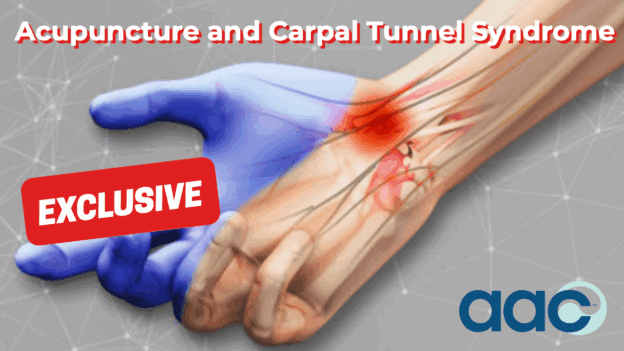
Acupuncture and Carpal Tunnel Syndrome

Acupuncture and Carpal Tunnel Syndrome

Can acupuncture reduce the symptoms of carpal tunnel syndrome?

Carpal tunnel syndrome impacts 4 to 10 million Americans (average age between 40 and 50 years old), according to the Rheumatology Research Foundation.

In a study 80 participants with carpal tunnel syndrome were randomly assigned to one of three interventions: (1) electroacupuncture to the more affected hand; (2) electroacupuncture at “distal” body sites, near the ankle opposite to the more affected hand; and (3) local sham electroacupuncture using non-penetrating placebo needles.

Both local and distal acupuncture were better than sham acupuncture at producing desirable changes in the wrist.

Healthcare continues to evolve toward less-invasive, natural, and drug-free methods, with acupuncture now becoming a first-line complementary healthcare choice.

Remember, the American Acupuncture Council (AAC) offers an unparalleled track record in acupuncture risk management.

There is a reason acupuncturists have trusted AAC with their business for 50 years.

Not an American Acupuncture Council member? Get a Quick Quote and find out how much you will save! Click here!

AACCollins07022025HD Thumb

VA Recoupment & SEOC Updates – Sam Collins

That they’re not paying for exams and they’re also still recouping. We’re gonna talk a little bit about that, but we have to update from what we did in April.

Click here to download the transcript.

Disclaimer: The following is an actual transcript. We do our best to make sure the transcript is as accurate as possible, however, it may contain spelling or grammatical errors. Due to the unique language of acupuncture, there will be errors, so we suggest you watch the video while reading the transcript.

Greetings, friends and colleagues. It’s Sam Collins, the coding and billing expert for acupuncture, the profession, of course, the American Acupuncture Council. Of course, I’ve got a little update coming up because obviously many of you have been contacting me, network members, and even others have contacted me.

Click here for the best Acupuncture Malpractice Insurance

Say, Hey, Sam, what’s going on? I notice. That they’re not paying for exams and they’re also still recouping. We’re gonna talk a little bit about that, but we have to update from what we did in April. So let’s go to the slides. Let’s talk about what’s going on with recoupment and standard episode of care specific to acupuncture and frankly non-physician providers.

So you’ll see here is a letter dated June 23rd from Tri West and it says, we received the above claim. Let me bring it so I can blow it up. And it says. Try West. Receive the above-mentioned claim for your offer. And notice I highlighted and yes says evaluation and management procedure codes are not paid for this rendering provider specialty.

Get a Quick Quote and See What You Can Save

This is the latest thing we’re seeing. It appears, and I’ve seen it absolutely published way that to me would make it more, but it appears they have taken the ability for acupuncturists to be paid. Separate exams when it comes to the va. That of course is very frustrating because of course is an exam necessary thing.

Of course, I to determine the need for care, to determine the continuation of care. So what’s recurring I think is maybe a Leo GE cut here at they’re eliminating the payment for exams. That doesn’t mean you don’t need one, they’re just not. Pay for it. I think it’s probably worth seeing the patient for the overall payments, but they’re not covering it.

We’ll see directly. Now the word that they did this in April, what I’ve seen when their newsletter is not quite clear enough for me. So I’m waiting to see the full publishing standard episode of care, but I’m sure many of you have met. Now. Here’s gonna be the pushback if the exam after April when they published it.

They’re gonna be am behind it because published, however, then I want you all to think of standard episode of Care for Acup Occupy. Whenever you notice the standard episode of care, you’ll notice whether it’s going to be initial chronic follow ups. They include e and M codes. You’ll see really, 9 9 0 2 to 2 0 5 9 9 2 1 to 2 1 5, and I bet pro your authorization has so my argument’s gonna be, they’re saying they’re not gonna cut well, if it’s after April, send an updated authorization, not listed, I’m waiting to see that, then I would say, okay, but if it’s prior dispute’s gonna be, how did you send me an authorization?

Clearly indicates exams and they’re, now, I’m not gonna pay for it. Now, it appears April. This is gonna true. But prior to, it’s gonna be a pushback. Now, is that very frustrating? Of course it is. But I’m gonna ask you, is it worth it to still be part of it? I do, because think of the overall payment on a VA patient.

You’re getting 12 visits to start, probably eight and eight to follow up. Assuming you’re doing three sets of acupuncture and a therapy or two, that’s maybe 110 to $150 of reimbursement. Am I going to take away potentially, three to $4,000 a payment? Because they’re not gonna pay for a couple of exams.

I prefer they do, but I’m gonna say I’m not gonna go that far. It’s something I think though we’re gonna be fighting. I shouldn’t say think. I know we’re gonna be fighting as a profession on a national level along with chiropractors and physical therapists, because this affects them too. Because this goes against the equality provision.

Equality says that if it’s within scope and you pay, other providers have to pay you because this is not Medicare. Now that’s gonna be a little bit of a fight, and that’s not gonna happen in short term. So when you get this, I do think we should dispute it. I would certainly push back if it were pre-AP April, that they should, if it’s after April, not so much.

Of course, if you’re a network member with me, reach out. We’ve got some letters for that as well. But I do wanna highlight also beyond that, just a couple of quick updates. Let’s talk about what’s happening and what’s gone on with doing. Things with 9 7 0 3 9 or 1 3 9, and that’s of course what a lot of offices have used for cupping.

Remember that was removed more than a year ago, so please do not use that code for cupping. It is not appropriate. I. Do not list it. They may pay it, but they’re gonna recoup it. So do not, if you’re gonna do cupping, use 9 7 0 1 6, which is a vaso pneumatic device. It’s not a high payer. It’s about 11 to $15, but at least you are being paid for it.

But again, do not use 9 7 0 3 9 and if they are recouping that, if it’s pre 2024. I would argue they can’t, but if it’s after 2024, they can. Now some people have argued. What about statute of limitations? Statute of limitations, I would argue certainly does apply. Unfortunately, you know what I’ve realized or what I’ve learned, the statute of limitations for the VA is actually six years, so we’re not gonna win on that one as far as this goes.

The other thing here is, and this has come up recently because obviously a lot of you are using pain indexes or similar. To verify how the patient’s improving. I recently had an office, or actually a few that they were denied few further care because they weren’t showing at least a seven point difference on the general pain index.

I really like the general pain index. It’s certainly the similar to the pain interference. Make sure though, if you’re using it. If you’re doing it once a month, there’s gotta be at least a seven point change to be considered significant. Now, most of you, I hope, are getting bigger than seven point changes, frankly, but if you’re not realize it’s going to be a problem ’cause they’re gonna push back, which means you also have to focus in what if I’m using the pain scale?

That also has a limitation, which means it’s gotta be three points or more. Obviously if I say I’m a seven, I go to a six. That means I’m better, but it’s not considered significant. So if they start at seven, the next time you do it to really be considered significant, say on re-exam, it’s gotta be four.

So a three point difference, I would say. Then obviously those two factors are important. If you’re not getting at least one three, you better focus in on something about activity, particularly a home or work activity that couldn’t do before. What they care about is the getting better. Because remember, once they’re stabilized, they have to be on a continua care with flareups.

So keep in mind, acupuncture works well. We need to demonstrate it. Show me on this general PEX pain scale or function, how much improvement there is. Now, this brings me to, for some of you, and I’ve had this question a lot, is being part of the VA worth it? Does it cost anything to join? No. Do the patients sometimes have some hassles getting authorization?

Yes, that’s true. But when you’re paid. Let’s go over it. If you’re getting a standard episode of care for 12 and eight visits, just say the first two 20 visits in a year, considering just the treatment, that’s probably 2000 to $2,500 now, even with taking out exams. Is that worth it to me? Absolutely.

However, am I frustrated with the exam part not being paid? I am. But at the same token, that’s not gonna stop me, but this is where if you’re not part of your state and national association, this is where we need to belong. ’cause this is where we need to push back because how are they treating us differently?

Now the downside is they are doing it to chiropractors. I. To physical therapists as well as massage therapists. So it’s not just you. But at the same token, I think it’s valid to say that it should be covered. ’cause how are you supposed to determine care without an exam because they’re doing this based on a Medicare rule?

Medicare only sets the fees for the va. It’s not the protocol. ’cause if that were true, they shouldn’t pay for acupuncture at all unless it were chronic low back pain and under supervision. So we know that they’re just. Choosing and picking certain ones. So I think we’re gonna have a pretty good pushback, but I do still, it is worth it if you’re thinking, I’m not so sure we are doing next month in August, a whole seminar on the va, what to do, how to make it work for you, make sure you tune into that.

Otherwise, I’m gonna say to everyone, we always want to be resource. If you’re having issues, reach out to American Acupuncture Council. The next specifically, we highlight updates right on our website. And if you’re a member, it allows you to have direct interaction with me via calls and zooms. And otherwise, until next time to my friend, be well.

Click here for the best Acupuncture Malpractice Insurance

Get a Quick Quote and See What You Can Save

IBS

Acupuncture and Irritable Bowel Syndrome (IBS)

Acupuncture and Irritable Bowel Syndrome (IBS)

Can acupuncture reduce the symptoms of irritable bowel syndrome (IBS)?

IBS affects between 25 and 45 million people in the United States and is a major women’s health issue, with 2 in 3 IBS sufferers being female.

A 2021 review and analysis of 24 studies in 3,220 people with IBS found that in studies comparing acupuncture to various medications, acupuncture was more effective in relieving IBS symptoms.

When used in combination with other treatments, including medicines or herbs, acupuncture helps to improve their effectiveness in treating IBS symptoms.

Healthcare continues to evolve toward less-invasive, natural, and drug-free methods, with acupuncture now becoming a first-line complementary healthcare choice.

Remember, the American Acupuncture Council (AAC) offers an unparalleled track record in acupuncture risk management.

There is a reason acupuncturists have trusted AAC with their business for 50 years

Not an American Acupuncture Council member? Get a Quick Quote and find out how much you will save! Click here!

AACGELLIS06252025HD Thumb

Treating The Face, Healing the Whole Part 2 – Michelle Gellis

So there are quite a few neuromuscular conditions that affect the face, such as Bell’s Palsy, Ramsey Hunt Syndrome, synchronic cys, stroke, TMJ, trigeminal Neuralgia,…

Click here to download the transcript.

Disclaimer: The following is an actual transcript. We do our best to make sure the transcript is as accurate as possible, however, it may contain spelling or grammatical errors.  Due to the unique language of acupuncture, there will be errors, so we suggest you watch the video while reading the transcript.

Hi, my name’s Michelle Gellis. I am an acupuncture physician, and I would like to thank the American Acupuncture Council for this opportunity for me to present to you today on treating the face a multidimensional approach. So today we’re going to do part two. And you can go ahead and go.

So a little bit about me. I’m currently on the doctoral faculty at Jossane University. Before that, I was a faculty member and clinic supervisor at the Maryland University of Integrative Health from 2003 until 2021. I am a published author and contributor to the Journal of Chinese Medicine and I’m a regular columnist for acupuncture today.

Click here for the best Acupuncture Malpractice Insurance

And I’ve been treated teaching facial acupuncture classes internationally since 2005. My book Treating the Face was released in November of 2024. It is a 500 page 15 chapter, hard cover book, and it covers all aspects of treating the face. I’m going to talk mostly about the information that’s in chapter six, and that is neuromuscular facial conditions.

So when we think about facial acupuncture, we tend to think about cosmetic facial acupuncture. But facial acupuncture is really about a holistic approach to not just treating the face. Cosmetically, but also all different aspects of treating the face. So there are quite a few neuromuscular conditions that affect the face, such as Bell’s Palsy, Ramsey Hunt Syndrome, synchronic cys, stroke, TMJ, trigeminal Neuralgia, Ms.

Get a Quick Quote and See What You Can Save

Whoops. Ms. Ptosis, HEFA spasm, myasthenia gravis, shingles, and facial ticks, just to name a few. And many of these are very unique to the face itself. And. Since I specialize in treating the face, after a few years of doing cosmetic acupuncture, I started getting people calling me, asking me if I could help them with a lot of these neuro conditions.

And through studying and doing a lot of research. I and some trial and error. I learned that the best way to really manage these conditions is through a multifaceted approach using scalp, acupuncture, submuscular needling, facial motor points, facial cupping. And so I’m gonna touch on these, the.

And so Scalp acupuncture is based on neuroanatomy. It is not based on acupuncture points. And you have to measure the scalp appropriately. And there’s a motor area and there’s a sensory area, and the bottom two fifths of each one of these lines, the sensory area is not shown on this picture. The. The bottom two fifths corresponds to the face, and so you would needle this area and stimulate it either with electro acupuncture or with manual stimulation in order to help with either motor conditions such as Bell’s palsy or with sensory conditions such as trigeminal neuralgia.

Facial motor points. This is from an old medical textbook. These are the motor points that have been discovered on the face, head and neck. And in part one of this talk I talked about using motor points for cosmetic concerns, but facial motor points are wonderful for neuromuscular concerns because what a motor point is the most electrically acceptable part.

The muscle where the motor neuron goes into the muscle, and by stimulating it, you can cause the muscle to get back into normal functioning. And the reason why this is important for the face, besides the functioning of opening the lid or closing the lid, the. Skin on the face is directly attached to the muscle.

So if someone’s face is paralyzed and is drooping in one area by getting the muscle back into normal functioning, by stimulating the motor point, the skin itself will. Snap back and be working in a more normal fashion with the muscle. So I do have examples of a couple of motor points. This was a student of mine in class and she had.

Had Bell’s Palsy many years ago and was still having trouble cursing her lips, whistling spitting like when she’d brush her teeth. And so I did the Mentalis Motorpoint and as soon as I put the needle in. Her chin started to twitch and then when I stimulated the point, it really started to jump.

And then after the treatment, she reported that she was able to make a lot of facial expressions that she hadn’t been able to make in the past.

Next example I have is a student in a class I was teaching in London and he had been in a bike accident and he had some neuropathy and a little ptosis on his left eyebrows and. I put this needle and stimulated it. So this is the motor point for the frontals. It’s gallbladder 14.

Sorry, that was so loud. But you could see the needle moving back and forth when, once it was put in the muscle, which meant it was starting to wake up. Submuscular needling is another technique that I use, which involves needling underneath and in some instances through a muscle in order to.

Blood and cheese circulation into the muscle itself. And I have a little demo here, which I.

Facial cupping and GU can also be very beneficial. For neuromuscular facial conditions, as long as your patient can tolerate it. These techniques are very gentle if done properly, and can help with blood and cheese circulation into the face. It can help with any sort of fascial adhesions. That is because over time.

If a muscle in the face isn’t used, the fascia can become stiff, and by using the cups it can help with lymphatic, the lymphatic system of the face, and it’s also very relaxing and very enjoyable for your patients. I am gonna talk really quickly about Bell’s Palsy. Bell’s Palsy is the most common cause of facial paralysis, usually temporary, and it’s caused by a disruption of the facial nerve, which causes either weakened or paralyzed facial muscles.

So here’s one patient you can see. This entire when asked to smile, they can only, she can only smile on one side of her face and the other side is completely paralyzed. This was a patient of mine. I only focused on her eyes, but I asked her to close her eyes. You can see one eye closed and the other one.

She could not close it at all. And then I did some submuscular needling and some acupuncture points and used gallbladder 14 as a motor point, did some scalp acupuncture for the face, and, after one month,

you can see she can close her eyes. Still a little difficult, but she had complete recovery.

So I do offer many different classes on. Facial and cosmetic acupuncture, you might wanna check those out. You can scan the QR code or go to my website, facial acupuncture classes.com and you can find me on social under my name, Michelle Gellis, or I have a Facebook group called Facial Acupuncture.

Very active group. Thank you so much.

Click here for the best Acupuncture Malpractice Insurance

Get a Quick Quote and See What You Can Save

Acupuncture and Urinary Incontinence

Can acupuncture reduce the symptoms of urinary incontinence?

Urinary incontinence (the loss of bladder control) affects an estimated 25 million adults in the United States, and is more prevalent in women.

Stress incontinence is a type of urinary incontinence that occurs when movement (coughing, laughing, running, etc) puts pressure on the bladder, causing urine to leak.

A study of approximately 500 women with stress incontinence received electroacupuncture treatment (18 sessions over 6 weeks) and had reduced urine leakage.

Approximately two-thirds of the women experienced a 50 percent or greater decrease in urine leakage.

Healthcare continues to evolve toward less-invasive, natural, and drug-free methods, with acupuncture now becoming a first-line complementary healthcare choice.

Remember, the American Acupuncture Council (AAC) offers an unparalleled track record in acupuncture risk management.

There is a reason acupuncturists have trusted AAC with their business for 50 years.

Not an American Acupuncture Council member? Get a Quick Quote and find out how much you will save! Click here!