Tag Archives: American Acupuncture Council

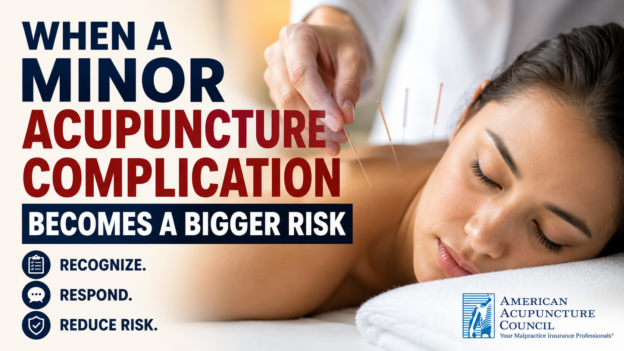
Acupuncture treatment illustrating minor complications and patient safety risk management

Can a Minor Acupuncture Complication Become a Major Problem?

Acupuncture is generally associated with a low rate of serious adverse events, but “minor” does not mean “unimportant.” A small bleed, bruising, dizziness, fainting, or unexpected pain may resolve without lasting harm. However, an event can require additional assessment, affect the patient’s confidence, or become a professional-liability issue if it is not recognized, communicated, documented, or managed appropriately. The goal is not to practice defensively. It is to build a consistent process for patient safety and risk management.

Video: Watch the AAC presentation above. A transcript/download link was not identifiable on the current source page; see the Manual WordPress Tasks below before publication if an original transcript asset exists.

What the evidence says about acupuncture complications

Prospective evidence supports the overall safety of acupuncture while showing that adverse events are not zero. A 2021 systematic review and meta-analysis found at least one adverse event in about 9.31% of patients undergoing an acupuncture series and 7.57% of treatments. The most frequent events were minor, with bleeding, pain, or flare at the needling site accounting for about half of reported events. The review estimated serious adverse events at 7.98 per million treatments, although the authors emphasized substantial heterogeneity in study methods and adverse-event definitions.

A 2024 review likewise concluded that serious acupuncture-related adverse events are rare and identified pneumothorax, nerve injury, heart injury, abdominal-organ injury, infection, and needle breakage among the important serious events reported in the literature. Common minor events included bruising, hematoma, bleeding, dizziness, fainting, tiredness, and residual needling pain.

Case-report literature should be interpreted differently from prospective incidence studies. Case reports can identify rare but important complications, but they cannot establish how frequently those events occur. For example, systematic reviews of case reports have documented pneumothorax and other organ or tissue injuries, reinforcing the importance of anatomy, appropriate needle depth and direction, sterile technique, and clinical vigilance.

When a minor event can become a bigger problem

A minor reaction does not automatically mean negligence or malpractice. The clinical event and the legal question are separate. A patient can experience an expected or recognized adverse reaction even when care was appropriate. Conversely, a seemingly small event can become more consequential when follow-up is missed, warning symptoms are minimized, the patient is not given appropriate instructions, or the record does not accurately describe what occurred.

From a risk-management perspective, the critical transition is often not the initial event but what happens next. Consider a patient who becomes lightheaded after treatment. The immediate response may be straightforward. The risk increases if the episode is not assessed, the patient is allowed to leave before it is appropriate, the event is not documented, or the patient later reports worsening symptoms and cannot understand what happened or whom to contact.

The same principle applies to bleeding, bruising, increased pain, suspected infection, retained or broken needles, or symptoms that could signal a more serious injury. The appropriate response depends on the clinical circumstances and the practitioner’s scope, training, and applicable law.

Five practical risk-management habits

1. Document the treatment. Record the relevant history, examination findings, treatment performed, points or regions treated, patient response, and clinically significant adverse events. AAC emphasizes the importance of accurate patient records because documentation can become important if a complaint or claim later arises.

2. Explain foreseeable reactions. Patients should understand what they may experience after treatment and what symptoms warrant contacting the practice or seeking medical evaluation. Communication should be understandable and consistent with the actual treatment provided.

3. Use informed consent appropriately. AAC advises using a professionally prepared informed-consent process, discussing the form with the patient, answering questions, and noting in the record that the discussion occurred. Requirements vary by state, so practitioners should confirm the rules that apply to their practice.

4. Recognize when referral or escalation is appropriate. Acupuncture practice does not eliminate the need for medical assessment when symptoms fall outside the practitioner’s competence or suggest a potentially serious condition. WHO’s acupuncture benchmarks emphasize stepwise treatment procedures, appropriate infrastructure, and safety practices.

5. Have a plan for complaints and claims. If a patient reports an unexpected injury or threatens a claim, avoid speculation or admissions about legal responsibility. Preserve the clinical record, communicate professionally, and follow the procedures of your professional-liability carrier or legal advisers.

Why prevention and insurance are complementary

Good risk management should come before insurance. Sterile technique, anatomy knowledge, appropriate needle selection and depth, patient screening, informed consent, clear aftercare instructions, accurate documentation, and timely referral all reduce avoidable risk.

Insurance serves a different function. It helps provide financial and legal protection when a claim or other covered proceeding occurs. AAC describes its risk-management and claims service as part of its broader member support, with specialized experience in acupuncture-related professional liability. Coverage terms vary, so practitioners should review the actual policy rather than relying on general statements about insurance.

A practical takeaway for acupuncturists

The safest approach is neither to assume that acupuncture is risk-free nor to treat every adverse event as evidence of malpractice. Instead, treat every unexpected reaction as a clinical communication and documentation opportunity. Assess the patient, respond within your competence and scope, give appropriate follow-up instructions, document what happened, and escalate care when indicated.

That approach protects the patient first. It also creates a clearer record of the care provided if questions arise later. For acupuncture practice owners, a written risk-management process and appropriate professional-liability coverage can provide an additional layer of protection.

Conclusion

Minor acupuncture complications are often transient, but they should never be dismissed. The evidence supports acupuncture as a treatment with relatively uncommon serious adverse events, while also documenting rare but potentially severe complications. For practitioners, the practical lesson is straightforward: use sound clinical technique, communicate foreseeable risks, document care carefully, recognize red flags, and know when referral is necessary. Insurance cannot replace those practices, but appropriate professional-liability coverage can help a practice respond when an unexpected event develops into a complaint or claim.

Learn More from the American Acupuncture Council

Learn more about AAC’s approach to acupuncture risk management, informed consent, and professional-liability protection. Practitioners can review AAC’s risk-management resources and obtain current coverage information directly from the American Acupuncture Council.

References

  1. BMJ Open systematic review and meta-analysis of acupuncture-related adverse events
  2. PubMed: Acupuncture: A Review of the Safety and Adverse Events and the Strategy of Potential Risk Prevention
  3. WHO benchmarks for the practice of acupuncture
  4. PubMed: Adverse events following acupuncture: systematic review of the Chinese literature, 1956–2010
  5. PMC: Adverse Events of Acupuncture: A Systematic Review of Case Reports
  6. ScienceDirect: Pneumothorax associated with acupuncture: A systematic review and analysis

Educational disclaimer: This article is for educational and professional risk-management information only. It is not medical, legal, insurance, or regulatory advice and does not establish a standard of care. Practitioners should follow applicable law, professional standards, scope-of-practice rules, and the terms of their insurance policy, and obtain qualified advice when needed.
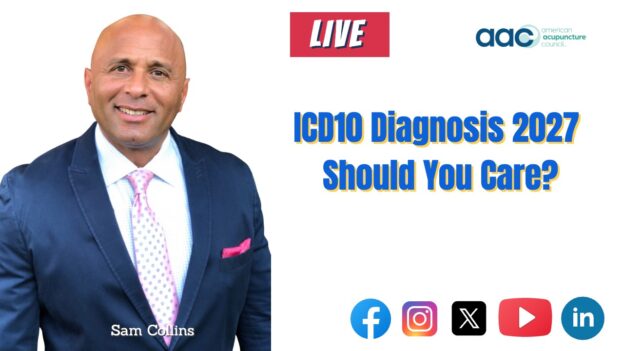

ICD10 Diagnosis 2027 Should You Care?

ICD10 Diagnosis 2027 Should You Care?


Realize when it comes to diagnosis, best practice coding for an acupuncturist, pain. Don’t get fancy. Pain works.

Click here to download the transcript.

Disclaimer: The following is an actual transcript. We do our best to make sure the transcript is as accurate as possible, however, it may contain spelling or grammatical errors. Due to the unique language of acupuncture, there will be errors, so we suggest you watch the video while reading the transcript.

Hey, greetings to my acupuncture providers. It’s Sam Collins, the coding and billing expert for you acupuncturists, and of course, the American Acupuncture Council and our network. As always, I wanna make sure you’re up to date. Hey, it is the 1st of September. What’s gonna be changing? Oh, diagnosis codes will update October 1st.

Click here for the best Acupuncture Malpractice Insurance

Get a Quick Quote and See What You Can Save

So let’s talk about it. Let’s go to the slides. Let’s look at what’s going on for 2027, what’s changing. The one thing we’re always careful with, we’re not big on hyperbole. We always wanna make sure we understand the coding, the codes that are important to your profession, and I’m always gonna be a little acu-centric.

Realize when it comes to diagnosis, best practice coding for an acupuncturist, pain. Don’t get fancy. Pain works. Realize you can have lots of diagnosis for the back, spondylosis, disc degeneration, on and on it can go, but yet it still comes back to pain. That’s the beauty and the genius. Realize that pain, symptoms, or neuromusculoskeletal diagnosis are always gonna be the most common payable codes.

There are certainly a lot of programs now that do pay for others, and I want you to be aware, but I wanna focus in on making sure are we getting paid? Do we have the right code? Of course, as is every year, there’s updates to diagnosis codes. This year is no different. So the 2027 diagnosis codes actually begin October 1st.

So here’s a good sort of riddle you can have. When do the 2027 diagnosis codes begin? And of course, most people would say 2027.” Technically, no. They begin October 1st. Now, as always, I’m going to be very acu-centric. You know what I care about? How does it affect us in the acupuncture field? Of course, there’s almost 75,000 codes.

You’re thinking, “Whoa. Are you ever gonna use that many?” Nah. You’re probably gonna use probably on a regular basis 10, and maybe occasionally a few more, with 5 of them being most often. So what I care about is the ones that affect us. We could look and say wait a minute” There’s 190 new codes, 30 deletions, four revisions.

Does that make a difference? Let’s take a look at the overview. There are gonna be changes to infectious diseases. Metabolic conditions, injuries or toxic effects, and this is ingesting things. Pregnancy-related, but pregnancy-related for more obstetrics, if you will. Oncology codes, but not related to what we would do ever, even though it might be pain, and then pelvic conditions, again, unrelated.

So the truth is, no significant changes except one, plantar fasciitis, and I’m not saying you can’t code plantar fasciitis. You can, but you might be coding foot pain anyway. So I will tell you, there’s no changes for high volume pain or neuromusculoskeletal codes. However, I wanna focus on, do I have the best codes?

Let’s look at the changes. The old code, or if you will, the code that’s being deleted, M72.2 plantar fascial fibromatosis, is the code that’s current. So if someone has plantar fasciitis now, that’s the code we use. Beginning October 1st, we’re gonna switch to the new codes, and you notice there’s three.

One says, plantar fascia, plantar fascial fibromatosis, unspecified foot. Let me tell you, never gonna use that code because can you imagine saying they’ve got it, but I don’t know which foot”? Of course you know. Is it the right or the left? Notice the code ends in one is the right, one that ends in two is the left.

Bottom line, keep it simple. If they have it in both feet, put both codes. If they have it in one, put that one code. Now, I have some acupuncturists say Sam, I’m not even gonna code that. Could I just code foot pain?” Technically, you could. Remember, pain is always gonna be a fallback. So here’s the new codes.

You’ll see here we’ve updated them. This is a list, and what I have here is a big list. I’m not showing the whole thing, but a big list of the common codes payable to acupuncture. I’m gonna give you an opportunity for all of you to get it because what this list is the list of payable codes by insurance.

Now, I will warn you, it is a big list. It’s about nine pages. It’s gonna have codes that are payable by insurance, but I’m gonna argue, or not argue, but I will state to you All the codes are payable by insurance, but not all are payable by all insurance. So you do wanna have a little bit of nuance there.

That’s one of the things our seminars note. But you wanna make sure if you’re gonna choose a code to bill insurance, I’m gonna suggest pick from this list because this is the list that there’s references to every carrier. So I’m just highlighting here, this is part of the extremities with the plantar fasciitis, but notice there’s other codes on the list, such as chronic pain, acute pain, and so on.

So to get that list, here’s what you do. Pull out your phone, use this QR code. I’ll leave it up for a moment. What you’re gonna get is a quick bounce back just asking for some information, and off it’ll come to you. It’ll be a nice PDF that you can use on your phone or also on your desktop. What it is, though, is a usable format that actually you could search.

Remember, if you go to the little magnifying glass, click in the click on that, type in a keyword, it’ll bring up every time that code is there. So if you wanna look up cervical, type cervical, and all the codes that have cervical will come up, or lumbar, whatever the case may be. What I wanna make sure is that you should be choosing codes that are specific and come from a reference as opposed to thinking, “Oh, I’m not sure.”

Now, again, always defaulting to pain is still fine, but I’m gonna say a little bit more specificity always can be helpful. What I do wanna talk about, though, a little bit more beyond that is just some recent things about the state of the profession. Here’s what I’m excited about, and I wanna show you something Acupuncture utilization has more than doubled in the last 20 years.

Now, we still treat a small part of the population, but I’m excited about that. Part of the reason, commercial plans now include the benefit. In fact, how many are familiar that Aetna now has mandatory acupuncture if it’s a commercial plan? Medicare Advantage plans, the Part C, have acupuncture. And what about complementary care networks?

They’re out there. Now, here’s something, and I want to show you where I got this. The American Journal of Managed Care from February of this year, this is a group that’s a, support group for the managed care industry that talks about how to position their business. And it says, “The most successful acupuncture providers will likely be those who combine clinical specialization, measurable outcomes, payer knowledge, and strong referral.”

This tells me where we should be looking. Specialization. You cer- deal with certain things. You’re focused on outcomes, and you understand what the payers allow. It says, “The market is moving toward greater acceptance, but payers are also becoming more focused on authorization,” meaning understanding diagnosis restrictions, utilization, and proof of functional improvement.

It then goes on to talk about, according to the CC, CDC, opioid prescribing is declining. If you think about why is the VA beginning to use acupuncture, it reduces the need for opioids 50%. It’s showing, “Our findings indicate,” and again, this is the Journal of Managed Care, “a large commercial insurer is increasingly covering acupuncture for its beneficiaries.

Unlike Medicare Part B, which limits coverage for chronic low back pain, these insurers are reimbursing acupuncture for a more myriad of conditions.” Think of for those of you in Massachusetts, they cover any diagnosis. And it says here, look at this, “Insurers should consider systemic reviews, meta-analysis, and other rigorous studies when expanding acucover, acupuncture coverage to new indications.”

Why is that? Their business strategy will be one that if they include more acupuncture, they will get more insurance. It says, “The greatest growth opportunity for acupuncture is not simply expanding the number of services offered. It’s positioning acupuncture as a measurable, evidence-informed component of conservative pain management in integrated healthcare.

Providers who understand payer requirements, document objective fun- functional improvement, and build strong referral relationships will be the best positioned for growth.” These are insurance companies that are then dictating how they’re going to do it. I want you to get on board. Doesn’t mean you have to bill all insurances, but I would certainly say I would cherry-pick a few.

Remember, though cash is king, I get that, you always wanna make sure, am I there to make sure I understand the insurance side? What I will tell all of you is I wish you really well. I hope you do fantastic. If you’ve never been to one of the HJ- or excuse me, American Acupuncture Council seminars, we’re here for you to help.

We’re always a support. Our network is there for you as well. And that’s more than just insurance. Diagnosis coding, small update this year, not a big deal. But make sure that if you need information or help, AAC is always there for you, and of course, I am as well. Until next time, my friends.

Click here for the best Acupuncture Malpractice Insurance

Get a Quick Quote and See What You Can Save

Acupuncturist reviewing three questions before buying acupuncture malpractice insurance

3 Questions to Ask Before Buying Acupuncture Malpractice Insurance

3 Questions to Ask Before Buying Acupuncture Malpractice Insurance

Choosing malpractice coverage is about more than finding a low premium. Before buying acupuncture malpractice insurance, ask three practical questions: Does the insurer understand acupuncture, how does the policy respond to claims over time, and what risk-management resources are included? These answers can affect how well the policy fits your practice.

Introduction

Choosing professional liability insurance is a practice-management decision, not simply a price comparison. For acupuncturists, the policy should fit the services you provide, the way your practice is structured, and your plans for changing carriers or eventually retiring. The American Acupuncture Council’s original post highlights three useful questions to ask before purchasing coverage: whether the program has acupuncture-specific experience, whether the policy is occurrence or claims-made, and what risk-management options are available.

Why acupuncture-specific insurance experience matters

A general healthcare policy is not automatically equivalent to coverage designed around acupuncture. Before buying a policy, ask the insurer to explain how it treats the services and modalities you actually provide and whether there are exclusions or underwriting requirements that could affect them.

AAC states that its professional liability program is designed for acupuncture and that coverage can vary according to the practitioner’s scope of practice and the services involved. Its current policy information also describes additional coverage options and a range of liability limits. Those details are reasons to read the actual policy and endorsements rather than relying on a summary or sales quote alone.

Question 1: Does the insurer have experience with acupuncture?

Ask whether the insurer and claims team routinely handle acupuncture professional liability matters. Then ask a more useful follow-up: “What exactly is covered for the services I perform?”

That question is especially important if your practice includes services beyond straightforward needling, such as herbal medicine, cupping, moxibustion, cosmetic or facial acupuncture, injection therapy, or another modality. Coverage depends on the policy language, underwriting, applicable exclusions, and the law and scope of practice where you work.

Question 2: Is the policy occurrence or claims-made?

This is one of the most important technical questions because the policy form determines when coverage can respond. The National Association of Insurance Commissioners explains that claims-made coverage generally responds when a claim is reported while the policy is in force, subject to the policy’s terms and any extended reporting period. Occurrence coverage generally responds based on when the covered event occurred, even if the claim is made after the policy has ended.

With a claims-made policy, ask what happens if you change carriers, stop practicing, or retire. You may need an extended reporting period, commonly called tail coverage, or prior-acts coverage from a new carrier. The exact solution depends on the policy and transition.

AAC’s current FAQ states that its claims-made option converts to occurrence coverage without charge after ten years and that retroactive coverage may be available for practitioners moving from another claims-made policy, subject to underwriting. Because insurance terms can change, practitioners should confirm the current policy wording and transition provisions before relying on those features.

Question 3: What risk-management options are included?

Insurance is only one part of risk management. Ask what resources the insurer provides to help reduce disputes and respond when a complaint develops.

AAC currently offers Preferred and Elite program options. Its FAQ states that the Elite program provides a premium discount when practitioners use approved arbitration and informed-consent forms as part of their intake process. AAC also describes claims and risk-management support for members.

Informed consent should not be treated as a substitute for sound clinical judgment, appropriate documentation, communication, referral, or compliance with state requirements. Likewise, an arbitration agreement may have legal and jurisdiction-specific requirements. Practitioners should use only forms approved for their program and practice and should obtain independent legal advice when appropriate.

What to compare before you buy

Before selecting a policy, compare more than the annual premium. At minimum, review the policy form; per-claim and aggregate limits; covered services and exclusions; defense provisions; prior-acts or retroactive coverage; tail or extended reporting provisions; additional insured and business-entity coverage where applicable; and risk-management resources.

Also ask how a claim or incident should be reported. A policy may impose notice requirements, and failing to follow them can create coverage issues. Keep the policy, endorsements, declarations, and approved forms together with your practice’s insurance records so that your staff can locate them quickly if a problem arises.

Benefits, limitations, and safety considerations

The main benefit of asking these questions is clarity. A policy that looks inexpensive may have a different policy form, exclusions, limits, or transition requirements than another policy. On the other hand, a higher premium does not automatically mean better coverage. The right comparison is between the actual protections and obligations in each policy.

Professional liability insurance also does not replace clinical risk management. Accurate patient histories, examination findings, treatment plans, informed consent, appropriate referrals, and detailed records remain important parts of safe practice. AAC’s guidance on patient records emphasizes documenting the reason for the visit, medications and allergies, clinical findings, diagnosis, treatment plan, and care provided.

Insurance requirements, scope-of-practice rules, arbitration law, and documentation requirements vary by jurisdiction. Practitioners should verify current requirements with the applicable licensing board, insurer, attorney, or other qualified professional.

A practical three-question checklist

Before you buy or renew, ask:

1. Does this insurer have meaningful experience with acupuncture and my specific services?

2. Is the policy occurrence or claims-made, and what happens to coverage for my past work if I change carriers, stop practicing, or retire?

3. What risk-management resources, forms, claims support, and program options are included—and what conditions apply?

Conclusion

The goal is not simply to buy malpractice insurance. It is to understand what you are buying before you need it. For acupuncturists, three questions provide a practical starting point: acupuncture-specific experience, policy form and long-term coverage, and risk-management support.

If you are comparing coverage, review the actual policy documents and ask the insurer to explain anything you do not understand. AAC provides acupuncture-focused professional liability information, coverage options, claims and risk-management resources, and a Quick Quote for practitioners who want to compare their options.

Educational disclaimer

This article is for educational purposes only and does not provide legal, insurance, financial, or clinical advice. Insurance coverage is governed by the actual policy, endorsements, exclusions, and applicable law. State licensing and insurance requirements vary. Consult your insurance professional, attorney, licensing board, or other qualified adviser regarding your specific circumstances.

Related American Acupuncture Council Resources

References

  1. American Acupuncture Council — original article
  2. AAC — Frequently Asked Questions
  3. AAC — AAC Policy
  4. AAC — Coverage Options
  5. AAC — Claims Service & Risk Management
  6. AAC — Importance of Keeping Detailed Patient Records
  7. AAC — The Importance of Patient-Informed Consent
  8. AAC — Acupuncture Malpractice Quick Quote
  9. National Association of Insurance Commissioners — Medical Malpractice Insurance
  10. AMA Insurance — Claims-Made vs. Occurrence Medical Malpractice Insurance
  11. TMLT — Claims-Made vs. Occurrence

Talk With AAC About Your Coverage Options

If you are comparing acupuncture malpractice insurance, AAC can help you review available coverage options and request a Quick Quote. Visit AAC’s Acupuncture Malpractice Quick Quote to begin.

This article is for educational purposes only and does not provide legal, insurance, financial, or clinical advice. Insurance coverage is governed by the actual policy, endorsements, exclusions, and applicable law. State requirements vary.

Supporting Sleep with Chinese Medicine Part 1

Supporting Sleep with Chinese Medicine Part 1 – Moshe Heller


today we were, are going to talk about how do we support sleep in Chinese medicine.

Click here to download the transcript.

Disclaimer: The following is an actual transcript. We do our best to make sure the transcript is as accurate as possible, however, it may contain spelling or grammatical errors.  Due to the unique language of acupuncture, there will be errors, so we suggest you watch the video while reading the transcript.

Hello. My name is Moshe Heller, and I’m from the Moshen Center in New York and also representing the Moshen Herbs which is a company that produces formulas. And I’d like to first thank the Acupuncture Council for letting me present today. And today I’ll be speaking about supporting sleep with Chinese medicine part one.

Click here for the best Acupuncture Malpractice Insurance

Get a Quick Quote and See What You Can Save

So let’s go to the slides, and we can start. So a- as I said, today we were, are going to talk about how do we support sleep in Chinese medicine. And we’re going to talk about in part one about the ma- mechanisms and and how can we look at sleep from a Chinese medical perspective and support it.

And then in part two, we’re going to talk about patterns and formulas and points for the treatment of sleep disorders So I think there are two important substances that we need to discuss or remind everybody when we talk about the physiology of sleep and those are blood and yin. And so these are two important aspects of maintaining sleep.

The first of all b- in– The w- first of them, blood is the one that governs falling asleep. So blood as a substance in Chinese medicine is understood not only that it is the red fluid that travels in your arteries and veins, but also your ability to transition from an active mode to a more relaxed mode.

Therefore, for example, when if we have blood deficiency, then we tend to have muscle spasms because one, the transition between activity and relaxation is not smooth, so you get muscle cramps. The same way goes with sleep. If we have abundant blood, then the transition between being awake and going into sleep is smooth, and we will fall asleep easily.

In general, blood is this– the enables the transition from a yang state of being, from an active state of being, to a yin state of bl- b- being, so it lets us relax into sleep. Whereas yin, on the our other aspect, is actually supporting the staying asleep. So it’s about enabling us to maintain or stay asleep or go into deeper sleep.

This is the yin aspect of our th- that is in charge of that. So in fact, if we have a yin vacuity but not necessarily a blood vacuity, we’ll fall asleep easily and then we’ll wake up frequently during the sleep or not go into a deep sleep. So yin enables us to easily or stay asleep and then and go into deeper states of sleep, and we’ll see why in a second.

The generally speaking, we’re saying here, what we’re saying is that falling asleep easily but waking frequently usually points to a yin vacuity. But if we are having difficulty falling asleep but then we sleep better, then that’s more of a blood vacuity. So that’s a clinical clue for us to always remember.

So the blood has actually two roles in its ability to sleep, and it has to do with it, its relationship with two organs. One is the heart and the other one is the liver. In the first part, the blood enables relaxation into sleep, meaning it it enables us to relax into sleep, as I said in the previous slide.

But it also has this ability to house or enables the housing of the shen in the heart and then, and the housing of the hun in the liver. So when blood is full and abundant, it allows the shen and hun to rest peacefully in their relative organs. And therefore, if we have deficiency or issues with blood, liver blood or heart blood, then we will have either a difficulty of the shen to rest peacefully or the difficulty of the hun to rest peacefully, and that will look slightly different.

If so we’ll… And we’ll talk about that in a second There’s another point that I have to point out, which is very important. Sleep is part of a rhythmic aspect of our qi circulation, and we always need to take care of this or try to remember that qi circulation is part of this awakening and going to sleep rhythm.

So as we know in the Ling Shu it says that the wei qi circulates 25 times on the surface mainly through the jing jingjin sinews channels and maintains muscle tone and mobility. And in the evening, it penetrates the body at the ankle tran-transitioning from the surface to the interior, and at night it circulates 25 times through the zangfu organs following the Ke cycle and then it emerges in bladder one jing ming at the corner of the eye, allowing for the eyes to open.

So this wei qi circulation is really an important aspect that we need to remember and see if there’s blockages anywhere in that process and which allow– will allow us to understand how to treat it better. And so we can see a reflection of that wei qi circulation with our body temperature as we see here that during activity when we wake up, our body temperature usually goes down, but as we fall asleep towards the evening, then the body temperature will will be reduced and as we s- we sleep at a lower body temperature and that also reflects the yin yang activity.

So when we have more yang, we have higher temperature. When we are in a more yin state, we will have lower temperature. So there is also this ability for the blood to help us with this mental relaxation, the spiritual aspect of that. And and, during sleep, we say that the Shen retires into the blood.

If the sh- the blood is not full, then we will have a Shen not being able to rest quietly, as I mentioned before. Whereas also this kind of waking or ability to wake is managed by this kind of liver qi regulation of the circulation of qi throughout the body, including the Wei Qi’s circulation.

And so when we are having movement in the muscles when we’re trying to sleep, we should definitely look at this kind of relationship between qi circulation, the liver, and what we might call liver qi constraint, and the, in order to resolve that disturbance. This is really important to remember the relationship between the liver, the blood, the Shen, and the Hun so generally speaking, we also say that there is a lot of relationship between the Hun and dreams.

So the Hun, when the Hun moves inward drawing Qi away from the mind, then it hel-helps us or it will allow for, or it will create these dreams and the Hun wanders that’s when we c- what we might call when the Hun wanders it produces dreams and observes it’s observed as rapid eye movement or REM sleep.

Dreaming is necessary for health, for our healthy both la- function of our body. This really REM sleep is considered a very important part of not only sleeping and getting deep sleep, but also helping the body reje- rejuvenate and heal itself. When we talk about blood vacuity the heart blood is causing…

When the heart blood is deficient, this is causes what we might call fun or vexation, or when the liver blood is deficient, we might call it as restlessness and we call that jiao or agitation. So those are two different aspects of blood vacuity

So we also have to remember that our relationship between the different Zang organs and the eMoshens, and so how they the, the eMoshens affect the organs and when the organs can imbalances in the organs can affect our eMoshen. When we have too much heat or in, in the heart that might cause a lot of irri- a- anxiety and anxiousness.

Whereas when we have some disturbance in the liver, that can cause anger and and, a- and stress. And worry of course also affects the spleen, but then it can also affect the heart blood. And then when we have fear and fright, that is usually a relationship between the heart and kidney, and a lot of that is more than fright, it’s very

It’s fear and irritability, and that is associated with the kidney and heart balance. This is, summarizes very quickly what we are talking about or what different aspects that we need to look at when we look at insomnia. We have to look at what the issue is, where it’s l- the issue is located.

Is it falling asleep? Is it staying asleep? What are the eMoshens associated with it? The flow of qi and circulation, which we can assess by feeling the pulse and palpating different points, and therefore we can create a, a more clear picture of what needs to be done. So this ends part one and in part two we’ll talk about different formulas and patterns that are associated with insomnia.

But I wanted to thank again the American Acupuncture Council for letting me speak today, and I hope that we will, I will see you soon in part two. Thank you very much.

Click here for the best Acupuncture Malpractice Insurance

Get a Quick Quote and See What You Can Save

Acupuncturist discussing malpractice claim risk management

Malpractice Claims for Acupuncturists: What to Do Before One Happens

A patient complaint can become a professional liability matter even when you believe you followed appropriate clinical procedures. That distinction matters: an allegation is not proof of negligence, and a filed claim does not establish that the acupuncturist made a mistake. In U.S. malpractice law, a successful negligence claim generally requires duty, breach of the applicable standard of care, causation, and damages. However, responding to an allegation can still require time, documentation, legal support, and potentially insurance resources.

For acupuncturists, the practical lesson is not to practice defensively. It is to build a defensible clinical process: obtain appropriate informed consent, assess patients carefully, practice within scope, document care accurately, recognize complications, communicate clearly, and understand the professional liability coverage that protects your practice.

Why Can a Malpractice Claim Arise When Treatment Was Appropriate?

Patients do not always experience the outcome they expected. Acupuncture is generally considered a relatively safe intervention, but it is not risk-free. A systematic review and meta-analysis of prospective studies found that minor adverse events were reported with some frequency, while serious adverse events were rare. The review also emphasized substantial variation among studies and the need for consistent adverse-event assessment.

That matters because an adverse outcome and negligence are not synonymous. A bruised needle site, transient pain, dizziness, or another recognized reaction does not by itself establish that the practitioner breached the standard of care. Conversely, a serious complication may prompt questions about technique, patient selection, informed consent, follow-up, referral, or documentation. The clinical facts and applicable law determine whether liability exists.

What Makes Documentation So Important?

A contemporaneous clinical record helps show what you knew, what you assessed, what you discussed, what you did, and how you responded. It should not be written to manufacture a defense after a complaint. Instead, it should be an accurate record of ordinary clinical care. AAC also offers a practical resource on keeping detailed patient records.

Depending on your jurisdiction and scope of practice, relevant documentation may include the patient history and pertinent findings, assessment and treatment plan, informed-consent discussion, treatment performed, points or techniques used when required, patient response, instructions, referrals, follow-up recommendations, and significant communications.

State requirements differ. For example, New Jersey’s acupuncture regulations expressly address informed consent and recordkeeping, while California disciplinary materials emphasize complete and accurate treatment records and infection-control obligations. These examples are not universal rules for every state; they illustrate why practitioners should know the requirements of the jurisdictions in which they practice.

Informed Consent Is More Than a Signature

A signed form can be useful evidence, but informed consent is fundamentally a communication process. Patients should have a reasonable opportunity to understand the nature and purpose of treatment, material risks, relevant alternatives, and the consequences of declining care, consistent with applicable law and professional standards.

AAC’s informed-consent guidance recommends discussing the consent form with the patient, answering questions, and documenting that the discussion occurred. AAC also provides an acupuncture informed-consent form that describes common and less common risks, alternatives, and the fact that results are not guaranteed.

The goal is not to frighten patients or list every theoretical complication. It is to support an informed decision and create a clear, patient-centered record of the discussion.

Safety Practices Reduce Clinical and Liability Risk

Risk management begins with competent clinical care. The National Center for Complementary and Integrative Health notes that complications have been associated with nonsterile needles and improper delivery of acupuncture, including infections, punctured organs, and nervous-system injury. The U.S. Food and Drug Administration regulates acupuncture needles as medical devices and requires them to be sterile and labeled for single use.

Infection prevention is therefore both a patient-safety responsibility and a risk-management priority. CDC standard precautions emphasize hand hygiene, appropriate environmental cleaning and disinfection, risk-based personal protective equipment, and safe handling of needles and other sharps.

Practitioners should also recognize when a patient’s presentation is outside the appropriate scope of acupuncture care or warrants medical evaluation. A defensible practice is not one in which the acupuncturist tries to manage every problem independently. It is one in which the practitioner recognizes limits, communicates appropriately, and refers or collaborates when indicated.

What Should You Do If a Complaint Arrives?

First, do not assume that an allegation means you are at fault. Second, do not alter, backdate, or recreate the clinical record. Preserve the record as it existed and follow your professional and legal obligations.

Next, review your insurance policy and promptly follow its notice requirements. AAC’s occurrence-versus-claims-made guidance emphasizes that the timing of an event and the timing of a claim can affect coverage. Do not assume that every policy handles a complaint, demand letter, board inquiry, or lawsuit in the same way. Contact your insurer or broker promptly and follow the policy’s reporting instructions.

Finally, avoid improvising a legal response. A patient complaint can involve clinical, regulatory, and insurance issues at the same time. When appropriate, let your insurer’s claims team and qualified legal counsel guide the response.

Insurance Is Part of Risk Management—not a Substitute for It

Professional liability insurance cannot prevent a complaint, and it does not make negligent care acceptable. Its role is to provide protection according to the terms, limits, exclusions, and conditions of the policy.

When comparing coverage, look beyond the premium. Ask whether the policy is occurrence or claims-made, what the limits and deductibles are, how defense costs are handled, whether your services and practice structure are covered, what happens when you change insurers or retire, and what notice obligations apply. AAC explains that occurrence and claims-made policies respond differently based on when the incident occurs and when the claim is made.

The best risk-management strategy is layered: sound clinical judgment, informed consent, accurate records, infection control, appropriate referral and follow-up, continuing education, and insurance coverage that fits the practice.

The Bottom Line

You cannot control whether a patient makes an allegation. You can control how carefully you practice, communicate, document, and prepare for uncertainty.

A malpractice claim is an allegation—not a finding that you made a mistake. The practical objective is to protect patients first while maintaining a clinical and administrative process that accurately demonstrates the care you provided. If a complaint does arise, respond promptly, preserve the record, follow your policy requirements, and obtain appropriate professional guidance.

For acupuncture practice owners, that preparation is not defensive medicine. It is responsible risk management.

Learn More From the American Acupuncture Council

If you are reviewing your practice’s risk-management procedures, start with AAC’s resources on informed consent and occurrence versus claims-made coverage. If you are evaluating professional liability coverage, request an acupuncture malpractice insurance quote and discuss your practice’s specific needs with AAC.

References

  1. Bäumler P, Zhang W, Stübinger T, Irnich D. Acupuncture-related adverse events: systematic review and meta-analyses of prospective clinical studies. BMJ Open. 2021;11:e045961. PubMed.
  2. National Center for Complementary and Integrative Health. Acupuncture: Effectiveness and Safety. National Institutes of Health. NCCIH.
  3. Centers for Disease Control and Prevention. Standard Precautions for All Patient Care. CDC.
  4. New Jersey Administrative Code § 13:35-9.11. Informed consent; medical malpractice. Legal Information Institute.
  5. California Acupuncture Board, Department of Consumer Affairs. Accusation, Case No. 1A-2017-240. California Department of Consumer Affairs.
  6. American Medical Association Journal of Ethics. Medical Malpractice Reform—Historical Approaches, Alternative Models, and Communication and Resolution Programs. 2016;18(3):299-310. AMA Journal of Ethics.
  7. American Acupuncture Council. Informed Consent. AAC.
  8. American Acupuncture Council. Occurrence vs. Claims-Made Insurance. AAC.

Educational disclaimer: This article is for educational and general informational purposes only. It is not legal, insurance, or medical advice and does not establish an attorney-client, insurer-insured, or clinician-patient relationship. Malpractice, informed-consent, recordkeeping, scope-of-practice, reporting, and insurance requirements vary by jurisdiction and policy. Practitioners should consult the applicable licensing authority, their insurance professional, and qualified legal counsel for advice about a specific situation.

The Personal Injury Success System

The Personal Injury Success System – Michael Coates


All professionals are on an equal plane. You’re no better, you’re no less. So you’ve gotta grab that mindset, and then realize that you’re no better than anybody else, but you also deserve the same as everybody else.

Click here to download the transcript.

Disclaimer: The following is an actual transcript. We do our best to make sure the transcript is as accurate as possible, however, it may contain spelling or grammatical errors. Due to the unique language of acupuncture, there will be errors, so we suggest you watch the video while reading the transcript.

Hi, I’m Michael Coates, president of Personal Injury Made Easy, or pimadeeasy.com, and we’re continuing with the six-part series about personal injury. And what we’re really getting into is I know you’re all great healers. What I want you to all be is a great business operator or owner. So to do that, the first thing I wanna mention today is that it starts with mindset.

Click here for the best Acupuncture Malpractice Insurance

Get a Quick Quote and See What You Can Save

And for mindset, realize that you are a pro, you’re a professional. And I think a lot of times, whether it’s chiropractic or acupuncture, that you think of yourself less than whether it is even the MDs or certainly dealing with an attorney, or you’re dealing with the court system, and it’s just not true.

All professionals are on an equal plane. You’re no better, you’re no less. So you’ve gotta grab that mindset, and then realize that you’re no better than anybody else, but you also deserve the same as everybody else. And the second thing is, again, realizing that you’re not just a great healer, but you need to be a better business operator.

So I really want you to grab onto those two hats. And the third part about mindset is to, something I talk about a lot is whether you are a fox or a lion. So the fox has to outsmart things. It could be a problem you’ve gotta kinda MacGyver around it, or it could be someone you’re dealing with, someone that’s trying to, whether they’re taking advantage of you, it could be someone that’s a staffer, could be a patient, could be an attorney in PI, about anything.

You gotta be a fox, right? ‘Cause no one outsmarts a fox. But at the same time, you may have to be a lion, and the lion is about strength. And you have to be strong for your patients, your staff, your family, your business, and also for yourself. So when someone says you need to be a fox or a lion, I say you need to be both to succeed in business.

You’ve gotta have both the ability to outfox those that are around you, and you also gotta be strong to stand up for what’s right and the people that matter to you So that’s the first part. The second part is I want to get into what is the success formula, and it’s a three-part form- formula, and I always think that when you get into things that they’re too complicated, it’s just too hard to implement.

It’s too hard to even get set in your head because we like to put things in buckets. So I’m gonna give you three barrels, so to speak, to put things in, or three buckets, and the first one is processes because we need proven processes to make things more efficient and more effective. And you all know about processes.

You cannot have a medical office or medical practice without being really efficient in processes. How many patients do you see in a day? It’s done because you’ve got a process for how you flow from at the lobby and intake, putting them in the room, when you’re doing treatment, and when they’re even exiting.

It’s just to realize that in personal injury, you’re gonna have all these nuances that are unique to PI, and you’ve got to learn to master those, to identify the ones that really have a great impact and to put those in place, and then you can tweak it and modify it for your practice. But if you don’t do that, you’re going to have gaps in the timeframe.

You’re going to be missing all kinds of ability to value drive. And when I say value driving through processes, there are things that you can do through processes, from intake, the forms you use, when you use them, to the documentation that you do, how you do your documentation, that literally can drive the value that you bring to a personal injury case for your patient and also for their attorney, even for your peers So if you think about it this way, you’ve got the insurance companies that are all trying to drive down PI case value, and you are remaining as this neutral, ethically bound medical provider.

You are all about just the patient’s health. You’re not about the liability or outcome of the PI case, because that’s just not your role and you have no control over it. But what you are is an avid healthcare advocate. You are there for your patient. Remember, you see that patient far more than an attorney ever sees their own client.

So because of that, you’re at this ground level to pain and suffering. That’s when you get into storytelling documentation that I’ve referred to before, and I’ll refer many times, which is about the ADLs, the activities of daily living. That’s life that you’re living. Then it’s about the duties under duress, those that affect the workplace, and then the loss of enjoyment, the LOE.

That’s about life. And so all those have this incredible impact, and it’s the impact that trauma has on our lives and on your patient’s life. So the processes that you do help to pu- and documentation help to pull that out. Now, we’re going to get much deeper into that in the next session when we really dive deeper into processes.

But I want to give you a little flavor for it, because when you do these things, it so positions you well. And let’s talk about positioning a little bit more. So when you talk about processes, that goes also the documents you use to protect your bill. So we’ll talk about a number of them in the next session, but it includes things that you have the patient sign, and it’s not just a medical lien agreement or even a letter of protection.

But there are other forms that you can do that helps to stop when the attorneys want to throw things at you. And again, it’s positioning you to be better at the time it comes to be paid. So all those processes, which include when you’ve even discharged a patient, what process do you have to follow up on a PI case?

Who do you follow up with? When do you follow up? And what are you asking when you follow up? So again, we’re going to hit that in the next session, but I just want you to realize how important processes are. Everything else flows from that. So that’s the first area of the success formula. The second area is profits Right?

It takes money to do the mission, as we’ve talked about, and your mission is to heal. And the more money you make, the more healing you can do. So I wanna really see you ramp up the profit. And for profit, remember, it’s not how much money you make, it’s how much you keep in your pocket at the end of the day.

It’s that net profit that allows you to give increases to staff on bonuses, hire more staff, do more things for your family. So profits is such an important area, and we’ll dive deeper into the two weeks from now when we get into that session, we’re gonna hit profits, and we’ll talk about MedPay and PIP.

We’ll talk about how you negotiate with law firms. The negotiation method that I have come up with and I’ve refined over the last 15 years that literally has providers owning law firms because the leverage is on your side. You just gotta learn how to identify the leverage, how to apply it, and that’s what the method that I’m gonna talk about in that session is all about.

And then there’s the third area. We talked about processes, we talked about profits, and there’s a third area that every business must do, and if it doesn’t, it cannot succeed, and it’s growth. You have to be able to scale. But what is growth? I think that I find that people think different aspects of growth.

Growth doesn’t have to mean you’ve got to have 15 offices, okay? Growth can simply be that you are maximizing your patient flow for if you’re the solo provider, you’re maximizing that out. You might have a multidisciplinary practice, though. You may have another office, a second or a third. So growth can mean different things to different people.

So when you’re scaling, it could be scaling up just your one office to maximize your potential so you’ve got the flow you want, you’re not overworked, but you are maximizing your patient mix and your patient numbers. It could be because you’re thinking of the exit strategy, like where you wanna end up, what kind of life you wanna lead.

You might want more offices. So then you gotta think about growth that way, which again, if you have processes down, that prevents a brush fire turning into a forest fire when you’ve got a number of offices. It’s why it becomes refining those processes early so important and why profiting matters, because the more you profit, the easier it is to expand And so think about how this works together.

Processes, profits, and growth. It’s a simple formula, but you cannot have any success, whether it’s personal injury or a medical practice or, to be honest, any business, unless you’ve got all three. Any of those three pillars, like a tripod that is off and goes, the tripod’s gonna fall down because it’s only got two legs.

It’s gone. It’s over. So this path that we’re talking about is to help you understand through the next sessions each of those silos, each of those buckets, because it’s all about one thing: helping you to be more successful, and you’ve earned it, and you deserve it. So again, think about that formula, think about how easy it is, because when things get too complicated, we find ways to stop ourselves.

And I have a lot of providers that come and talk to me, and they say they just want to focus on one. Michael, I just want to grow,” because they think they’re doing the processes right or they think they’re making enough. And when I dive in and talk to them, and because data doesn’t lie, and I find out the forms they’re using, the process they have, or I find out how much they’re actually getting paid by the trusted attorneys and even more what they’re getting paid by the difficult for attorneys, I found out it’s not what they thought.

So what they’re growing is is not profit. Sometimes they’re growing losses, and you never want, of course, to do that, right? So when someone says, Michael, I just want to focus on processes,” by the way, that is the best thing to start with. There is an order to things. So I do love when someone’s never done PI before, and when they say, “Mike, what’s the first thing I should be doing?”

And I say, “It’s processes.” Think of it like a, a house, and you’ve got that solid foundation in the house, and you want to have the great processes are part of that foundation, but they also get into the curb appeal, right? So that’s like the documentation. We talked about that the the last segment.

So when you build this really great house that has this great curb appeal, that’s when you can really thrive as a business, where you become a value driver to personal injury attorneys, to your patients, to your peers, to yourself And then that allows you to also not only profit more, but to grow. So I hope that gives you a little bit of a start and sets the stage for what we’re gonna talk about these next three really important weeks.

Because once you understand it’s about processes, profits, and growth, and that you need all three, I would say as we go through the next few weeks, I want you to identify one, two, or three things that I talk about that you will implement right away. So maybe you might do one thing in each of those silos or those buckets and put them in this month, okay?

Or next month when we talk about it. I think that’s gonna help you. In fact, when we talk about processes, try to pick out three things and implement that. When we talk about profits, try to pick about three things and implement that. When we talk about growth, try to pick out three things and im- implement that.

That means each month you’ll be doing more, and at the end, if you’re still, maybe you put this aside, you didn’t hit this like you wanted to, don’t stress yourself out. It’s about your life and your practice. Sometimes we’ve gotta take a step back to move forward. That’s what I’m gonna tell you instead of picking three things, pick one.

It’s still stepping forward, and stepping forward is what perfection is. Perfection doesn’t exist in this world at all. So I always say that progress is perfection. And again, if you wanna live well, you gotta build it well. So that’s what we’re gonna be doing through the rest of this series. We’re going to build it so that you can live well.

So again, as Michael Coates, I wanna give you how to contact me if you need any help on anything from me or my team. That’s, my website is pimadeeasy.com, and my email address is michael@pimadeeasy.com. And we’re here to help, so please don’t hesitate to reach out. And I want you to start compiling your questions, because I think that’s gonna really help to get things focused on what matters to you, because you matter to me.

I’ll see you at the next session.

Click here for the best Acupuncture Malpractice Insurance

Get a Quick Quote and See What You Can Save